

Prepare a radio-ready file and a tight one-page pitch, then submit both to targeted DJs and curated shows four to six weeks before your release date. Follow up once, track every reply, and if money changes hands anywhere in the process, make sure it gets disclosed on-air the way the FCC requires. Do that, and you’ve already outworked most of the submissions sitting in a DJ’s inbox right now.
TL;DR:
- Focus on internet, college, and community radio stations, using targeted, tiered lists based on stations that already play your genre for better chances of rotation.
- Disclose any paid airtime or sponsorship on-air, as failure to do so violates FCC rules and can result in hefty fines or imprisonment.
- Use Hot Mic Radio’s free submission checklist for preparation, or consider paid promotion for faster guaranteed airplay, depending on your release timeline.
Table of Contents
- Your 4-to-6 week DJ submission checklist
- What DJs and radio automation actually expect from your file
- Where to actually send your song for airplay
- The pitch and follow-up that actually gets a reply
- The payola rules you cannot afford to skip
- Turning spins into fans, press, and bookings
- What we look for when you submit to Hot Mic Radio
- Want featured placement? Here’s how we can help
- Where to go deeper on the legal and practical side
- Sources
- FAQ
Your 4-to-6 week DJ submission checklist
No shade to the “spray and pray” crowd, but a real campaign needs structure. Here’s the timeline that actually moves the needle:
- Weeks 6-5: Lock your radio edit, HQ master, and metadata.
- Weeks 5-4: Build your one-sheet/EPK and gather your streaming and download links.
- Weeks 4-3: Build your tiered target list of stations and DJs.
- Weeks 3-1: Send personalized pitches and start your follow-up clock.
- Release week and beyond: Track spins, thank your supporters, and keep the relationship warm.
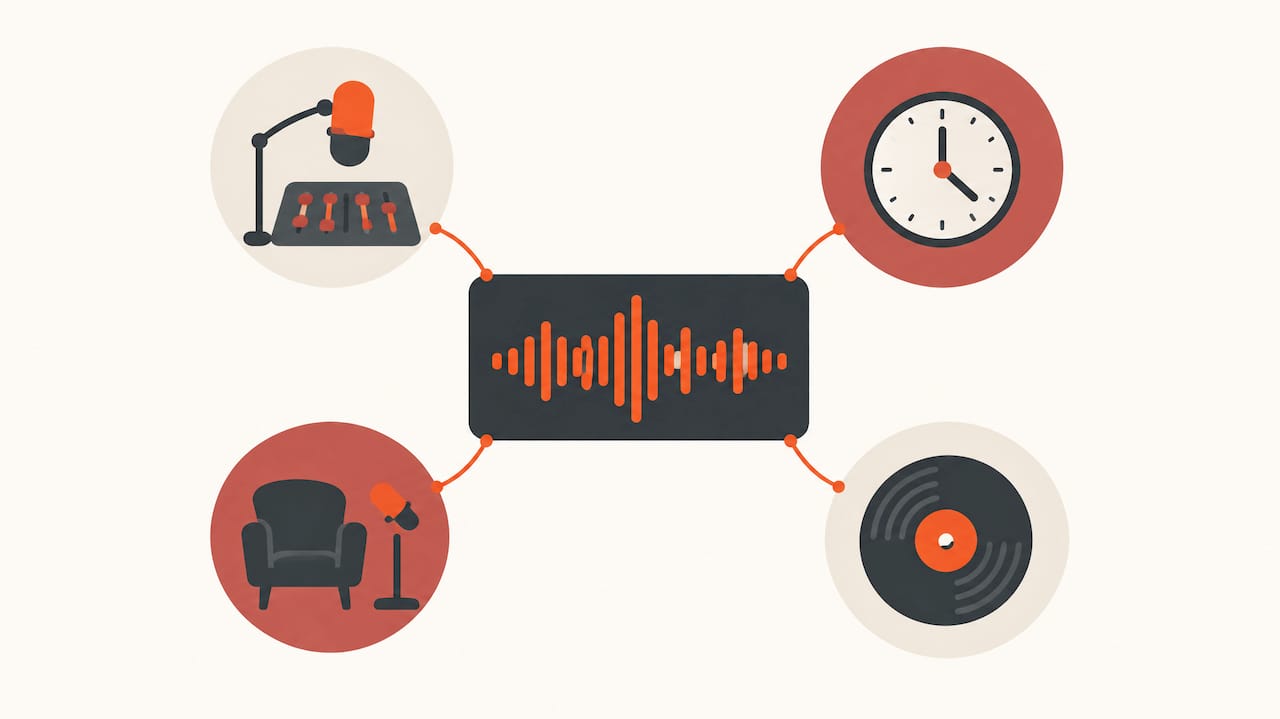
Within that timeline, you’re juggling four checklists at once:
- Production: radio edit, HQ master, clean file naming, ID3 tags, and your ISRC.
- Marketing: one-sheet, EPK, active streaming and download links, and any social proof worth flexing.
- Targeting: a list split into reachable stations, aspirational stations, and test shows.
- Execution: a personalized pitch, a follow-up schedule, and a simple way to track who said what.
Pro Tip: Build your tiered DJ list in a shared spreadsheet so your manager, your PR contact, and you are never pitching the same DJ twice.
What DJs and radio automation actually expect from your file
Here’s the part nobody tells you: a DJ can love your record and still never play it, because the file itself got rejected before a human ever heard it. Radio plugging guidance for 2025 is blunt about this: your radio edit should run around 3 to 3:30, your file needs to be high quality, and your metadata has to be clean from the jump.
That means:
- A radio edit between 3:00 and 3:30, with explicit content flagged honestly.
- Consistent file naming: Artist – Track Title – Version.
- Embedded ID3 tags and your ISRC baked into the file, not just mentioned in an email.
- A one-sheet or EPK with a one-line hook, a short bio, production credits, your release date, and working links.
- A quality pass checking bitrate and whether you’re sending WAV or MP3, since stations often want both available.
Messy metadata is a rejection risk, not just an inconvenience. Symphonic’s guidance on radio promotion notes that station automation systems parse filenames and ID3 tags directly, and a mismatch between the two can get your track ignored or misfiled before anyone ever presses play.
Where to actually send your song for airplay
Here’s the truth: chasing a flagship terrestrial station before you’ve built any track record is a waste of your energy. Viberate’s airplay research points out that independent artists gain the most traction on internet radio, college and campus stations, community stations, and specialist genre shows, the exact lanes where curators are actively hunting for new Hip-Hop and R&B voices instead of locking in on whoever already has a hit.
To build a target list that’s actually reachable:
- Start with artists who sound like you, then use artist-lookup tools to see which DJs and stations already play them.
- Check a station’s program page for show-specific submission instructions before you blast a general inbox.
- Look for a music director, program director, or specific DJ name instead of a generic “info@” address.
- Sort your list into three tiers: high-value targets, realistically reachable shows, and test submissions to gauge interest.
Our own guide to getting your music discovered on internet radio walks through this tiering process in more depth if you want a step-by-step version.
The pitch and follow-up that actually gets a reply
Keep your pitch to two or three sentences, max. Lead with your hook, tell the DJ why your sound fits their show specifically, and close with your streaming link plus the airtime window you’re hoping for.
- Sentence one: your hook, something that makes a DJ curious in five seconds.
- Sentence two: why this show, this specific one, makes sense for this song.
- Sentence three: your link and your ask, whether that’s a spin, an interview slot, or a specific airtime window.
Link your streaming track rather than attaching a file, and only send a downloadable WAV when a DJ actually requests one. Give your first follow-up seven to ten days to breathe, then send a second nudge two to three weeks out if you still haven’t heard anything. Keep both short and personal: reference their last show or a track they played recently so it reads like a real listener, not a mail merge.
Pro Tip: Mention one specific detail about the show you’re pitching, a segment, a guest, a vibe, because generic pitches are the fastest way into the delete folder.
The payola rules you cannot afford to skip
If you or your team pay for airtime, a mention, or any kind of sponsored placement, that arrangement has to be disclosed on-air. Section 317 of the Communications Act requires broadcasters to identify sponsored material and to collect disclosure information before any payment or promise of payment happens, and the FCC’s payola rules back that up with real teeth.
Failure to disclose paid airplay can result in significant fines and potential imprisonment per violation.
That penalty applies broadly, which is exactly why you want written documentation and a clear sponsorship announcement any time money is involved. Before you pay for a placement anywhere, confirm in writing that disclosure is part of the deal.
Turning spins into fans, press, and bookings
A spin that nobody tracks is a missed opportunity. Watch station playlists directly, use aggregator analytics where a station offers them, and keep a simple log of spin counts, time of day, and the geographic signal behind each play, since spin clusters by region can tell you exactly where to book your next show.
- Update your EPK with every station that spins you, it’s social proof that compounds fast.
- Pitch venues and promoters in the regions where your spins are clustering.
- Send a genuine thank-you to any DJ who gave you airtime, no exceptions.
- Offer that same DJ first access to your next single or a remix exclusive.
Pro Tip: A thank-you message costs you thirty seconds and often buys you a second spin down the line.
What we look for when you submit to Hot Mic Radio
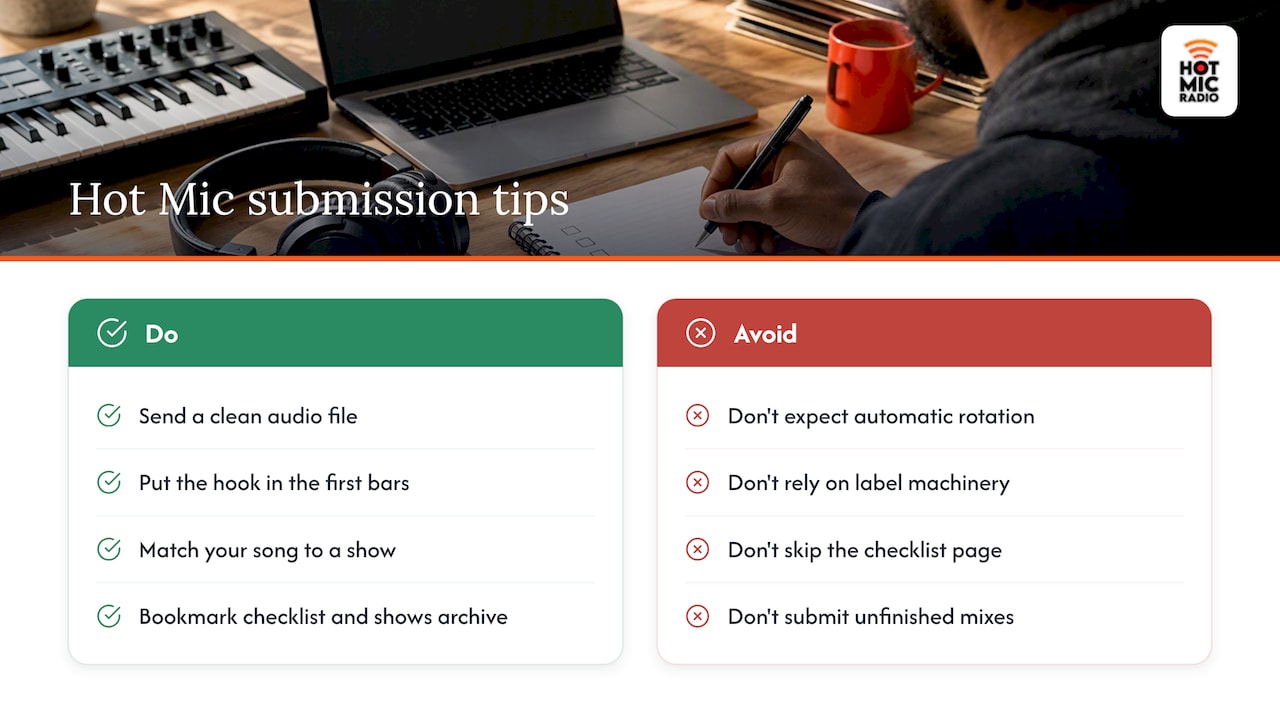
We built Hot Mic Radio around live DJ shows, regional scene spotlights, and a real lane for independent Hip-Hop and R&B artists who are grinding right now, not just the names who already have a machine behind them. When you submit, we’re listening for the same fundamentals this whole piece covers: a clean file, a hook that lands in the first few bars, and a sound that fits one of our shows.
After you submit, expect curation first. Not every track gets rotation, but every track gets heard by someone making real programming decisions. Our music submission checklist and our shows archive are the two pages to bookmark before you send anything our way.
— Hot Mic Radio Team
Want featured placement? Here’s how we can help
Organic pitching works, and you should absolutely do the legwork this guide just walked you through. But if you’ve got a release date coming up fast and a budget to back it, paid promotion through Hot Mic Radio gets your track in front of our audience without the weeks of cold outreach.
If you’re a brand or advertiser, our advertising page covers how to reach our Hip-Hop, R&B, and culture-focused audience directly.
- Choose organic pitching when you’ve got time and a growing DJ network but a tight budget.
- Choose a paid membership when your release date is close and you want guaranteed ears on the track.
- Either way, start with our submission checklist so your assets are ready the moment you commit.
Head to Hotmicradio to see what we can do together.
Where to go deeper on the legal and practical side
For the legal side, go straight to the source: the FCC’s payola and sponsorship rules and the sponsorship ID requirements for licensed broadcasters spell out exactly what disclosure looks like.
- Radio Promotion 2025 for a full breakdown of pre-release timing and asset prep.
- Viberate’s airplay guide for targeting independent-friendly stations.
- Symphonic’s radio promotion guide for metadata and file-naming standards.
- For low-budget DIY tactics, this promotion guide is a solid companion read.
Sources
- Payola and Sponsorship Identification | Federal Communications Commission
- Sponsorship ID and broadcasters | FCC enforcement area
- Radio Promotion 2025: How to Get Your Music on Air
- How to get played on the radio: unlock airplay success | Viberate
- Radio promotion for independent artists (Symphonic blog)
FAQ
How far ahead should I submit my song to DJs?
Start four to six weeks before your release date, which gives DJs time to review your track, add it into rotation planning, and fit it into an upcoming show, according to radio promotion guidance for 2025. Submitting the week of release is almost always too late for meaningful rotation.
Do I have to pay DJs to get radio airplay?
No, plenty of independent artists earn spins through a strong pitch and a well-targeted list of internet, college, and community stations, as Viberate’s research on airplay points out. Paid promotion, including Hot Mic Radio’s membership plans listed on our promote page, is an option for artists who want guaranteed placement faster, but it’s never required to get heard.
What happens if a DJ plays my song in exchange for payment and it’s not disclosed?
That’s payola, and it’s illegal under federal broadcasting rules. The FCC’s payola and sponsorship identification rules set penalties of up to $10,000 in fines and up to one year of imprisonment per violation, so any paid placement needs a clear sponsorship announcement on-air.
What file format should I send DJs?
Send a high-quality WAV or MP3 radio edit running about 3:00 to 3:30, with clean file naming and embedded ID3 tags including your ISRC. Metadata standards for independent artists show that mismatched filenames and tags are a common reason automation systems skip a track entirely.
How do I submit a song to Hot Mic Radio?
Start with our music submission checklist to prep your file and one-sheet, then follow the submission path listed there for our live DJ shows. If you’re looking for guaranteed featured placement instead of standard curation, our promote page lists Basic, VIP, and Group Membership options.

