

To request a local artist’s song, find a station that plays their kind of music, send a short, specific note to the right place (a request form, the show’s contact, or a submission page), and include the artist name, song title, city, and a link to hear it. If you’re the artist, send the track yourself through the station’s submission page. Either way, the clearer and more targeted you are, the better your odds.
We get this question a lot, and it makes us happy every time. Somebody in your city is out there grinding, and you want the world to hear them. Let’s get that record on the air.
TL;DR
- Match the station to the sound. A request lands better when the artist actually fits the station’s format and a specific show.
- Be specific. Artist, song title, city, a streaming link, and one line on why it belongs.
- Use the right door. Listener requests and artist submissions usually go to different places. Check the station’s website or app first.
- No promises anywhere. A request is not a guarantee. Follow up politely, then try another show or station.
- At Hot Mic Radio, artists never pay for airplay. Submit at hotmicradio.com/submit or in our iOS and Android apps.
Table of Contents
- Listener request vs. artist submission: know which one you’re doing
- Step 1: Find a station that fits the artist
- Step 2: Write the request (what to include)
- Step 3: Send it to the right place
- Step 4: Get the track ready (if you’re the artist)
- What if they don’t respond?
- Perspective: why local and independent sounds matter on our air
- Support the station with the Bars & Beats Club
- Make your request count
- FAQ
- Sources
Listener request vs. artist submission: know which one you’re doing
These two things get mixed up constantly, and mixing them up is the fastest way to get ignored.
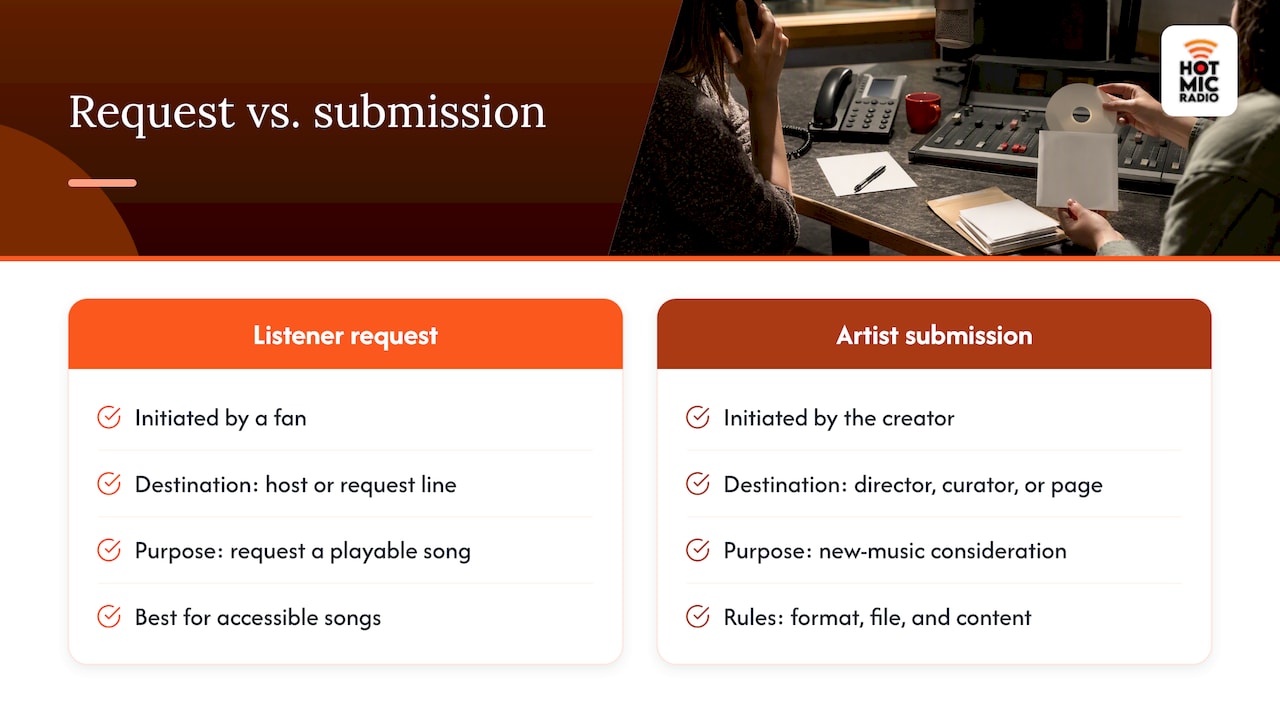
A listener request is a fan saying, “Please play this song.” It usually goes to a show host or a request line, and it works best for songs a station can already access.
An artist submission is a creator delivering new music for consideration. It goes to a music director, a show curator, or a submission page, and it usually has rules about format, file type, and content.
So what happens when you’re a fan who wants to push a local artist you love? You can do both jobs at once: send your request to the host, and tell the artist to submit directly. Stations tend to want music from the people who made it, with the right metadata and permissions. Some say so outright: one college station’s submission page asks for originals only, five minutes or less, submitted directly by the song’s creator is a common pattern, and that same page lists its own rules on clean lyrics and a consent form.
Step 1: Find a station that fits the artist
A great song sent to the wrong station is still a wrong-station song. Before you write anything, do ten minutes of homework.
- Name the lane. Is it hip-hop, R&B, neo-soul, Southern soul, gospel, dancehall, Afrobeats? Be honest and narrow.
- Listen for a week. Tune in at different hours. Do they play independent artists? Do they spotlight regional scenes?
- Find the show. Many stations program by daypart or by host. A late-night R&B slow-jam block and a drive-time hip-hop show are different animals.
- Check for a local angle. Stations that run regional spotlights or an independent showcase are built for exactly this kind of request.
If you want a deeper breakdown by genre, we’ve written them out: how to pitch music to hip-hop stations, R&B radio submissions, regional hip-hop submissions, and dancehall radio submissions.
Don’t forget traditional stations have a paper trail
If you’re targeting a terrestrial station, the FCC says each commercial and noncommercial station must keep a public inspection file on the FCC’s website. It’s a good place to confirm who a station is, what community it serves, and how to reach it. Online-only stations like ours work differently, so look for a submission page or in-app form instead.
Step 2: Write the request (what to include)
Keep it short. A host reading live or a coordinator sorting dozens of messages wants the facts in the first five seconds.
The request checklist
| Include | Why it matters | Example |
|---|---|---|
| Artist name (spelled right) | Avoids mix-ups with similar names | “Maya Rue” |
| Song title | The one thing they need to find | “Porch Light” |
| City or region | This is the “local” in local artist | “Baton Rouge, LA” |
| Genre or lane | Shows you know the format | “Southern soul / R&B” |
| A direct link | One click to hear it | Streaming or SoundCloud link |
| One line on the fit | Gives the host a reason | “Slow-burn record for your late-night block” |
| Your name and a way to reply | Hosts like to answer listeners | Name, email or handle |
A few details that save headaches:
- Use a clear subject line if you’re emailing, like “Request: [Song] by [Artist], [City].”
- One song per message. Three links look like a mass blast.
- Spell hard names out. If the artist’s name or the town has an unusual spelling, say how it’s pronounced so the host doesn’t stumble on air.
- Skip the essay. Two to four sentences is plenty.
A message that works
Hi [Host name], long-time listener here. I’d love to hear “Porch Light” by Maya Rue, a Southern soul and R&B singer out of Baton Rouge. It would fit right into your Friday night slow-down. Here’s the link: [link]. Thanks for supporting local music!
That’s it. Friendly, specific, easy to act on. Our full walkthrough for listeners is in how to make a radio song request that actually gets heard, and if the artist you’re after is from the classic era, see how to request old school songs on the radio.
Step 3: Send it to the right place
Where does the message go? Work down this list.
- The station’s website or app. Look for words like “request,” “submit,” “contact,” or “music submissions.” Most stations spell out the preferred method.
- The show’s own page or social account. Some hosts take requests directly on their feed.
- A music director or program contact. For artist submissions at a larger station, a named contact beats a generic inbox.
- The in-app request tools. If the station has an app, a request or dedication feature is often the quickest route.
At Hot Mic Radio, here’s the lay of the land:
- Artists: submit your music at hotmicradio.com/submit, or send it through the Hot Mic Radio app on iOS and Android.
- Listeners: the app’s landing page shows the schedule for the day, so you can see which show is on and aim your request at the right host. It also links straight to the iOS and Android apps.
- On the web: you can also listen at hotmicradio.app, a short link that’s easy to share with friends and family so they can download the app too.
Step 4: Get the track ready (if you’re the artist)
If you’re submitting rather than requesting, read the station’s rules before you hit send. Requirements differ, but these are the usual suspects:
- Originals. Many stations want songs you wrote or own the rights to.
- Length. Radio-friendly runtimes get more airplay. We break down the sweet spot in 3:00 to 3:30 radio edits programmers actually play.
- Clean or explicit. Some stations only air clean versions, and say so. The college station mentioned above requires clean lyrics and a signed consent form. Include a clean edit when you have one, and label every version clearly.
- File format and metadata. A properly named file with correct credits is easier to log and play. Lock yours down with 3 music metadata rules independent artists must set before release.
- A short bio and a reason. Who are you, where are you from, why this station?
On that last point, a pitch lands harder when it explains why the song fits the show. Practical advice on explaining that fit carries over from playlists to radio programs: lead with the sound, the audience, and the context, not just “please play my song.”
What if they don’t respond?
It happens, and it’s rarely personal. Stations get piles of messages, and some say upfront that they may not reply if a track isn’t selected. Here’s a sane way to handle silence:
- Check the rules again. Did you use the right form? Attach what they asked for?
- Wait a couple of weeks, then send one polite follow-up. Keep it to two lines and restate the song and link.
- Listen for it. Many stations never confirm; the song just shows up in rotation.
- Try a different show. A rejection from one host isn’t a verdict on the music.
- Build a relationship. Listen, comment, share the show. Hosts remember the names that show up with kindness.
- Widen the net. Online radio, community stations, college stations, and genre-specific shows all count.
And the honest truth: a request never guarantees airplay. A host may love it and still not have a slot. A music director may pass because of format. Keep making music, keep requesting, and keep your tone gracious.
Perspective: why local and independent sounds matter on our air
Here’s where we stand. Hot Mic Radio was built on Hip-Hop and R&B, but the culture is huge: Gospel, Southern Soul, Soul, Motown classics, Neo-Soul, Jazz, Lo-fi, Soca, Afrobeats, Dancehall. We run live DJ shows and curated programming, including regional Hip-Hop spotlights that give a voice to scenes in different corners of the world.
We believe the next big superstar is out there right now, and you should hear them here first. That’s why we’re a proud supporter of emerging and independent Hip-Hop and R&B artists, and why we make room for both mainstream and independent names.
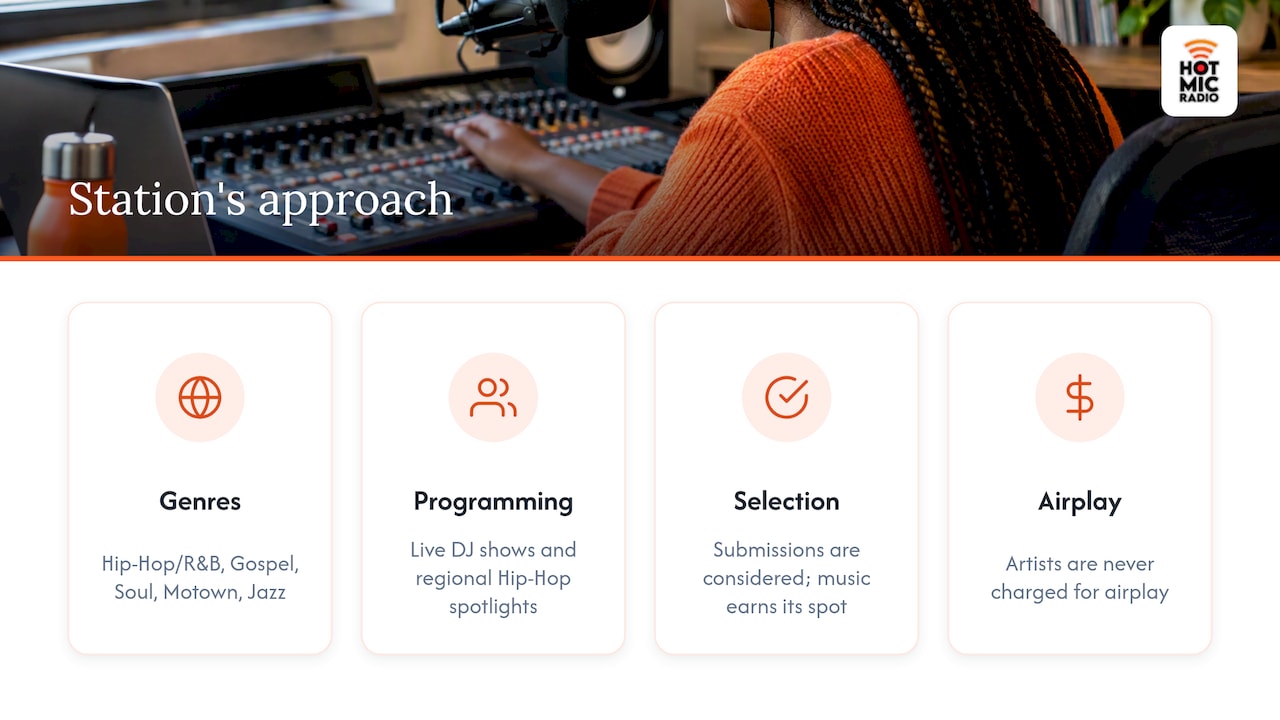
One rule we’ll never bend: we never charge artists to get their music played on our station. Submissions are how you get considered, and the music has to earn its spot like anything else. If you’re curious how we think about this world, dig into the independent music movement and how to release music on online radio.
So if you’ve got a local favorite, don’t be shy. Send the link, tell us the city, and tell us why it hits.
— Hot Mic Radio Team
Support the station with the Bars & Beats Club
Love what you hear and want to keep this thing growing? The Bars & Beats Club is how listeners support the station and receive perks based on tiers. You can join through the Hot Mic Radio app or at members.hotmicradio.com. It supports the station; it has nothing to do with getting music played, and artists never pay for airplay.
Here are the five tiers:
| Tier | Price | Highlights |
|---|---|---|
| The Headliner | $10/mo | Digital membership card, entry into giveaways (concert tickets and more), monthly email and text updates with behind-the-scenes programming insights, members-only live streams, members-only chat lounge |
| Platinum Status | $30/mo | Everything in The Headliner, plus a Hot Mic Radio branded bumper sticker or accessory and free general access to sponsored club events |
| Diamond Certified | $50/mo | Everything in Platinum Status, plus early access to select station events, concerts and club nights, a license plate frame, and a monthly members-only email with program previews, station news and exclusive DJ playlists |
| Allstar MC | $70/mo | Everything in Diamond Certified, plus a branded t-shirt, 20% off merchandise, 30% off VIP event and club access tickets, and on-air Allstar shoutouts |
| Hall of Fame | $100/mo | Everything in Allstar MC, plus a branded hoodie, a personalized on-air thank-you during special programming, 30% off merchandise, VIP event access with early seating and private meet-and-greets with artists or DJs, and Hot Mic Radio plays unedited music |
Brands that want to reach our audience can ask about advertising costs at hotmicradio.com/advertising. Artists who just want to be heard can head to our submission page. Free, always.
Make your request count
A little care goes a long way. Here’s a quick final pass before you send anything:
- Is the artist’s name spelled correctly?
- Did you include the song title, city, and a working link?
- Does the song match the station and show?
- Is it one song, in two to four friendly sentences?
- Did you send it where the station asked?
Want to hear how our hosts work the room? Check out how to tune into live DJ shows and meet the DJs behind the mic. And for the bigger picture on why this all matters, here’s why online radio matters for music fans.
FAQ
Can I request a local artist’s song on any radio station?
You can ask, but results depend on the station’s format and process. Some take listener requests through a form, app, or host; others only accept music from the artist. Check the station’s website or app for its preferred method, and pick a show that matches the artist’s genre.
Do I have to be the artist to submit a song to Hot Mic Radio?
Artists submit their own music at hotmicradio.com/submit or through the Hot Mic Radio app on iOS and Android. If you’re a fan, tell the artist about it and send a request to a host so they know there’s demand. Submissions are never charged for airplay.
Will my request guarantee the song gets played?
No. A request shows demand and gets the song in front of a host, but programming depends on format, schedule, and availability. A friendly follow-up and a well-matched pitch improve your chances, but nobody can promise a spin.
What should I put in a song request?
The artist name, song title, city, genre, a link to hear it, and one line on why it fits the show. Add your name and a way to reply. Keep it to a few sentences and one song per message.
Does it cost money to get my music played on Hot Mic Radio?
No. We never charge artists to get their music played on the station. The Bars & Beats Club is a way for listeners to support the station and receive perks based on tiers, and it’s separate from submissions.