
Baltimore club (B’more club) is a fast, sample-driven dance style born in early 1990s Baltimore, defined by an 8/4 beat structure and a tempo around 130 beats per minute. It runs on chopped breakbeats, repetitive vocal loops, and call-and-response energy built for the dance floor, not the headphones. Want to hear it right now? Pull up Apple Music’s “Best of Baltimore Club” playlist and expect something raw, rugged, and relentlessly danceable.
TL;DR:
- Baltimore club music is built around a distinctive 8/4 beat at roughly 130 BPM, using chopped breakbeats like “Sing Sing” and “Think (About It).”
- The genre relies on modular, loop-heavy structures designed for live DJ mixing and extended dance battles rather than traditional song forms.
- Pioneers such as Scottie B, Rod Lee, DJ Technics, DJ Class, Miss Tony, and Blaqstarr shaped the sound, which remains accessible through archives and curated playlists.
- Baltimore club spread regionally, influencing Jersey and Philadelphia clubs, which differ in tempo, samples, and overall energy, but share rhythmic DNA.
- The genre continues to thrive through DJ sets, local recognition, and platforms like Hot Mic Radio that foster community-driven sounds outside mainstream channels.
Table of Contents
- What Is Baltimore Club Music and Where Did It Come From?
- What Makes the Baltimore Sound So Distinct?
- Who Are the Essential Baltimore Club Artists and Tracks?
- Baltimore Club vs. Jersey Club vs. Philly Club: What’s Different?
- How Did Dancing and Local Venues Shape the Scene?
- Is Baltimore Club Music Still Alive Today?
- Why Regional Sounds Like Baltimore Club Deserve More Airtime
- Where to Hear Baltimore Club and Regional Sounds on Hot Mic Radio
- Sources
- FAQ
What Is Baltimore Club Music and Where Did It Come From?
Baltimore club evolved organically from local radio DJs, roller rinks, and rec centers where energetic and danceable tracks gained popularity through live audience response rather than studio or label planning, a scene where producers often look to buy beats online to craft their signature sound. That’s the whole story of this sound in one sentence, and it’s why the genre still feels more like a community ritual than a chart product.
The scene took shape in the early 1990s, when Baltimore DJs started fusing hip hop, house, and breakbeat into something faster and rougher than anything else on the radio dial. Local archival documentation credits a tight circle of pioneers with cracking the code and then spreading it citywide through mixtapes and radio slots.
- Scottie B helped establish the blueprint through his work with the Unruly Records crew, one of the genre’s foundational labels.
- Frank Ski used his radio platform to push club records to a mass audience, giving the sound its first real citywide reach.
- DJ Technics built a catalog that became a reference point for how a club record should be structured and mixed.
- DJ Class carried the sound into wider recognition with tracks built for both the club and the airwaves.
- Rod Lee produced some of the genre’s most sampled and reused breaks, shaping its rhythmic identity.
- Miss Tony brought a distinct vocal presence that made club records feel like a party host was in the room with you.
By the 2000s, the sound had visibility beyond Baltimore’s city limits, even as it stayed rooted in local radio and neighborhood parties. The archival push that followed in the 2010s and 2020s turned scattered mixtapes and radio rips into something researchers and fans could actually study.
What Makes the Baltimore Sound So Distinct?
Strip away everything else and Baltimore club comes down to one rhythmic engine: the 8/4 beat, running at roughly 130 beats per minute. That tempo sits in a sweet spot faster than most hip hop but not quite as frantic as hardcore breakbeat, which is exactly why it works for extended dance sessions without wearing dancers out in the first two minutes.
The genre’s signature comes from a small, reused pool of breakbeats. Two samples show up constantly: Gaz’s “Sing Sing” and Lyn Collins’ “Think (About It),” both chopped and looped into the rhythmic backbone of countless tracks. Layer in short vocal snippets, call-and-response hooks, and you’ve got the formula.
Here’s how a typical Baltimore club track gets built:
- Lock in the break. Producers start with a breakbeat sample, usually “Sing Sing” or “Think (About It),” chopped into a repeatable loop.
- Set the 8/4 pattern. The beat gets structured around eight counts instead of the standard four, giving the track its signature stomp.
- Drop in vocal hooks. Short, looped vocal phrases get layered over the beat, often shouted rather than sung.
- Keep it modular. Sections repeat with minimal variation so DJs can mix, extend, or cut tracks live without losing the crowd.
That modular approach isn’t an accident. Producers deliberately limited their sonic palette so records could be swapped in and out during a set without breaking the energy, which explains why so many Baltimore club tracks feel loop-heavy rather than verse-chorus structured.
Pro Tip: If you’re trying to spot Baltimore club in a mixed playlist, listen for the “Think” break specifically. That snare and horn stab combo has been sampled so often it’s practically the genre’s fingerprint.
Who Are the Essential Baltimore Club Artists and Tracks?
You can’t talk about this genre without naming the people who built it, and the good news is their catalogs are more accessible now than they’ve ever been.
Scottie B co-founded Unruly Records and helped define the label sound that other producers chased for years. Rod Lee earned a reputation for aggressive, break-heavy production that other DJs treated as a toolkit. DJ Technics built consistency into his catalog, making his records reliable go-tos for club sets across the city. DJ Class crossed over into broader recognition without losing the grit that made the sound work in the first place. Blaqstarr pushed the genre toward melodic experimentation, later collaborating with major-label artists while keeping club rhythm at the core. Miss Tony brought personality and vocal charisma that turned tracks into full-blown party experiences.
A starter playlist worth building:
- “Sample Freak” style cuts built on the “Think” break
- Rod Lee’s rawest club productions
- DJ Class’s crossover club records
- Blaqstarr’s melodic club experiments
- Scottie B’s Unruly-era output
- Miss Tony’s vocal-driven party tracks
For a curated shortcut, Apple Music’s “Best of Baltimore Club” playlist collects a lot of this in one place, which makes it one of the easiest entry points for a new listener trying to hear the samples in context rather than reading about them.
Baltimore Club vs. Jersey Club vs. Philly Club: What’s Different?
Baltimore club didn’t stay contained. It spread up the coast and mutated into regional cousins that share DNA but sound noticeably different once you know what to listen for.
- Jersey club runs faster, typically 132 to 140 BPM, and leans on the “bed squeak” sample along with heavily chopped vocal snippets, giving it a smoother, sexier production feel compared to Baltimore’s rawer edge.
- Philly club pushes tempo even higher and folds in sirens and hardstyle elements, creating a harder, more aggressive texture.
- Baltimore club stays rooted in its rugged, unpolished energy, with production that favors grit over gloss.
The cross-pollination runs both directions now. Jersey club has landed on mainstream pop and R&B records, while Philly producers borrow Baltimore’s break-sampling habits even as they speed everything up. Once you hear all three side by side, the family resemblance is obvious, but so is the attitude difference.
How Did Dancing and Local Venues Shape the Scene?
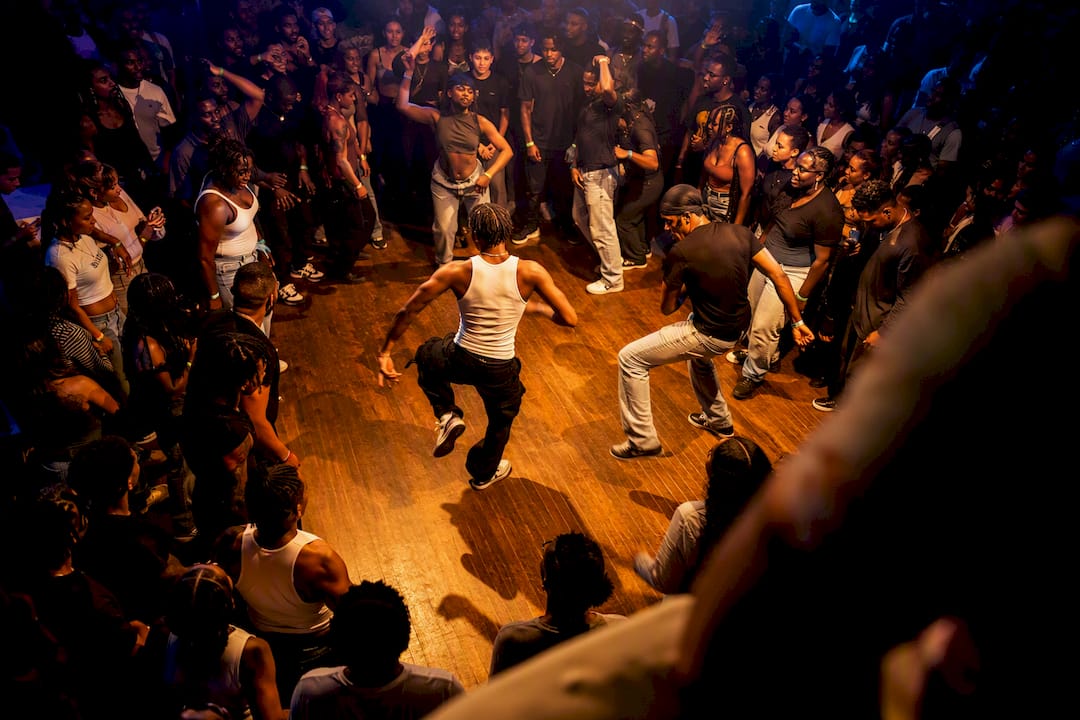
Baltimore club never existed as pure audio. It existed as something you danced to in a specific room, with specific people, and that shaped the music itself.
- Dance battles built around fast footwork gave DJs a reason to keep tracks loop-heavy and endless, since a shorter track meant a shorter battle.
- Roller rinks and rec centers doubled as informal venues where new records got tested on real crowds before they ever hit radio.
- Local radio broadcasts turned neighborhood favorites into citywide anthems within days, not months.
- Call-and-response vocal hooks existed specifically to keep a room chanting back, which is part of why the vocal snippets repeat so much.
The music adapted to the room. Longer, looped structures meant a DJ could stretch a set without losing momentum, and that practical need shaped the entire arrangement style of the genre.
Is Baltimore Club Music Still Alive Today?
Baltimore club is having a real preservation moment right now, and it’s not just nostalgia. A 2026 NPR feature captured artist perspectives from figures like Abdu Ali and DJ Ducky Dynamo, both of whom describe the genre as inseparable from the city’s physical spaces and youth culture rather than just a label on a playlist.
- The Baltimore Entertainment Archive has digitized historical material documenting the genre’s early DJs and structural traits.
- Recent local recognition and proclamations have formally acknowledged the sound’s cultural significance to the city.
- Reissues and streaming playlists now make canonical tracks easier to find than at any point in the genre’s history, which matters for a scene that spent decades circulating mostly on mixtapes and radio rips.
Why Regional Sounds Like Baltimore Club Deserve More Airtime
Genres like Baltimore club get treated as regional footnotes until a producer somewhere else scores a pop hit with the same techniques, and by then the origin story gets flattened into a footnote. That’s backwards. The scene’s raw, community-built sound deserves recognition on its own terms, not as a footnote to whatever mainstream artist borrowed its bounce.

Hot Mic Radio built its programming around the belief that regional scenes carry more musical information than chart rankings ever will. A city’s local hip hop scene tells you more about where a sound is actually headed than a Billboard position does, and Baltimore club is proof. The genre survived without major-label backing because a community of DJs and dancers kept it alive in rec centers and radio booths, which is exactly the kind of grassroots story that gets erased once a sound crosses into the mainstream.
What people underestimate about Baltimore club specifically is how deliberate its “simplicity” actually is. The loop-heavy, sample-repeating structure isn’t a limitation. It’s a functional choice built for DJs who need to mix live, for dancers who need extended battle time, and for a scene that valued the room over the recording. Treat that as a production philosophy, not a shortcut, and the whole genre makes a lot more sense.
— Hot Mic Radio Team
Where to Hear Baltimore Club and Regional Sounds on Hot Mic Radio
If Baltimore club has you craving more sounds built by communities instead of committees, Hot Mic Radio gives you a direct line to that same energy, minus the algorithm doing the picking. We built our programming around live DJ sets and regional spotlights precisely because the sound of a neighborhood scene rarely survives a corporate playlist untouched.
Head to our Hip Hop & R&B Archives for curated rotations that echo the same DIY, dance-floor-first energy Baltimore club was built on, or browse the full radio channels archive to find live DJ shows spinning regional sounds you won’t hear on mainstream radio. Tune in now and let the next set introduce you to a scene you haven’t discovered yet.
Sources
- Baltimore club — Wikipedia
- Baltimore Club Music – Baltimore Entertainment Archive
- From local radio to global influence, the rise of Baltimore club music — NPR
- You think you know but you have no idea: the difference between Baltimore, Philly, and Jersey club — VICE
FAQ
What is Baltimore club music also called?
It’s commonly called B’more club or just B’more, a nickname that sticks close to the city’s own accent and identity.
What makes Baltimore club different from other club music genres?
Baltimore club runs on an 8/4 beat and roughly 130 BPM tempo, built around chopped breakbeats like “Sing Sing” and “Think (About It),” which gives it a rawer, more repetitive feel than Jersey or Philly club.
What are some popular songs from Baltimore club music?
Tracks from Rod Lee, DJ Class, Scottie B, and Blaqstarr are considered genre staples, and Apple Music’s “Best of Baltimore Club” playlist collects many of the most representative cuts in one place.
Is Baltimore club still played in clubs today?
Yes. The sound continues through DJ sets, revival events, and archival programming, and stations like Hot Mic Radio feature regional and DJ-driven programming that keeps similar community-rooted sounds in rotation.
How do I start dancing to Baltimore club music?
Focus on fast footwork that matches the 8/4 beat rather than a standard four-count groove, and lean into the call-and-response vocal hooks, which were designed to cue crowd movement during live sets.