


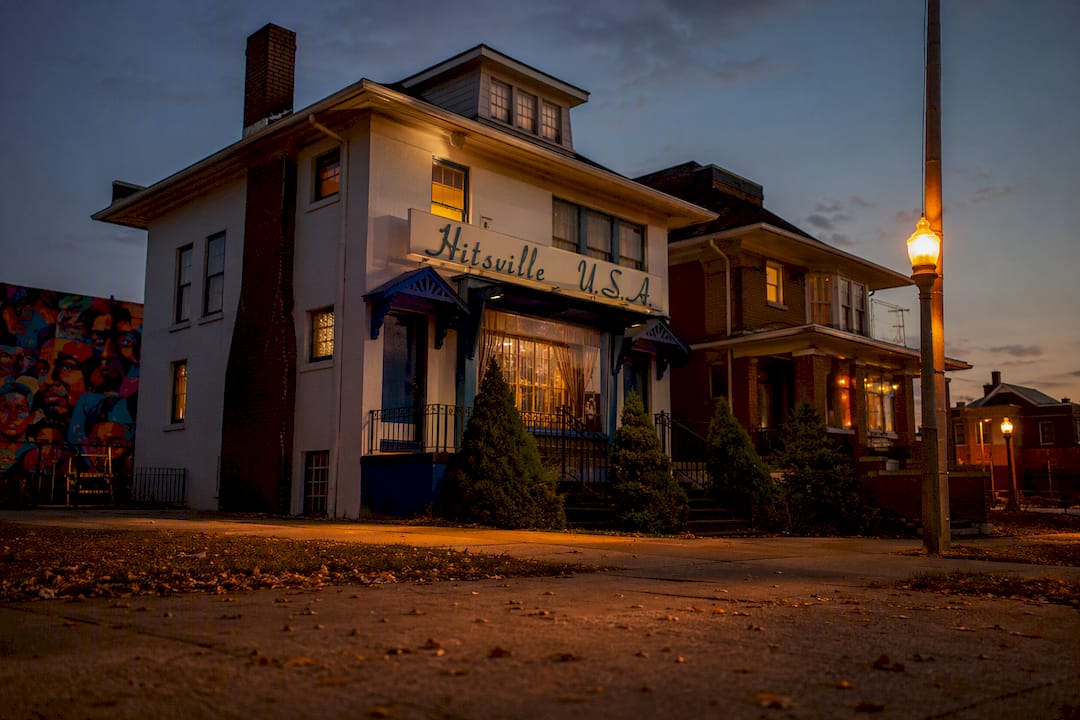
The Motown sound is a pop-inflected soul style built on a driving backbeat, melodic electric basslines, and gospel-derived call-and-response vocals, produced with such consistency that it turned a Detroit label into the most successful Black-owned business in American entertainment history. We’re talking tambourines slapping the backbeat, bass lines that hum like a second lead vocal, and horn charts polished enough for pop radio but rooted deep in the church. This wasn’t luck. It was a repeatable system, engineered inside a converted photo studio called Hitsville U.S.A.
Here’s the short version of what made it work:
- The rhythm section: tambourine riding the backbeat, layered drums, and basslines built to be hummed, not just felt.
- The vocal arranging: gospel call-and-response filtered through pop polish, so church fire came out sounding radio-ready.
- The people: Berry Gordy running quality control, The Funk Brothers laying the groove, and Holland-Dozier-Holland and Smokey Robinson writing the hooks that carried it all to the top of the charts.
Key Takeaways
The Motown sound succeeded because Berry Gordy paired a repeatable studio system with a house band and songwriting teams disciplined enough to produce hits on an industrial scale.
| Point | Details |
|---|---|
| Founding facts anchor the story | Berry Gordy launched Tamla/Motown in 1959 with an $800 loan, based at Hitsville U.S.A. |
| Sound built from specific traits | Tambourine backbeats, melodic bass, and gospel call-and-response define the recognizable style. |
| The Funk Brothers were the engine | This house band played on most of Motown’s catalog, giving it consistent instrumental identity. |
| The 1970s brought real change | The 1972 move to Los Angeles and artists demanding creative control reshaped the label’s formula. |
| Influence extends far beyond soul | Northern soul, neo-soul, and modern pop songwriting all carry traceable Motown DNA. |
Table of Contents
- The Origin Story Behind Motown Sound History
- What Musical Traits Define the Motown Sound?
- How Did Hitsville’s Studio Practices Shape the Sound?
- Who Were the Architects Behind the Motown Sound?
- Why Did Motown Matter Beyond the Charts?
- What Caused Motown’s Sound to Change in the 1970s?
- Where Do You Hear Motown’s Influence Today?
- Where Can You Hear the Motown Sound Today?
- Ready to Hear It for Yourself?
- A Historian’s Take on What Actually Made This Sound Work
- Sources
The Origin Story Behind Motown Sound History
Every account of motown sound history starts in the same place: a Detroit assembly line worker named Berry Gordy who believed songwriting royalties would beat a factory paycheck. In January 1959, Gordy borrowed $800 from his family and launched Tamla Records, soon expanding into the Motown name. That loan is one of the best-documented origin stories in American music, and the Detroit Historical Society still treats it as foundational Detroit history, not just music trivia.
Gordy’s next move mattered just as much as the loan. He purchased a modest house at 2648 West Grand Boulevard and converted it into a working studio and label headquarters. He nicknamed it Hitsville U.S.A., and the name stuck because it was accurate. Within a couple of years, that house was cranking out national hits from a converted garage studio, with a photography space upstairs doubling as an echo chamber.
Early success came fast. Barrett Strong’s “Money (That’s What I Want)” and The Miracles’ “Shop Around” put the label on the map before the 1960s had really gotten started, proving that Gordy’s formula could compete with established labels on their own turf. From there, the growth curve got steep. Between 1961 and 1971, Motown notched 110 top ten hits, a run few labels in any genre have matched before or since.
What set Gordy apart wasn’t just talent scouting. He built an actual production system, and he borrowed the blueprint from the industry he knew best:
- Standardize the process. Gordy modeled Motown’s operation on Detroit’s auto assembly lines, treating each song like a product moving through stages rather than a one-off creative accident.
- Install quality control. Weekly meetings put nearly finished songs in front of Gordy and other staff, who voted and critiqued the way an assembly line inspector might flag a defective part.
- Send it back if it’s not ready. Songs that didn’t pass got reworked, no matter how established the writer or producer behind them was.
- Repeat weekly. The consistency of the meetings, not just individual talent, is what kept quality steady across dozens of artists and hundreds of releases.
Music historians point to this assembly-line hitmaking model as the real engine behind the label’s early dominance. It wasn’t one genius songwriter or one breakout star. It was a factory floor for hits, with Gordy as foreman.
What Musical Traits Define the Motown Sound?
If you want to know what is Motown sound at the note level, start with the bottom of the mix. The bass isn’t just holding down the root note. It’s melodic, often walking through countermelodies that could stand on their own as a hook. That approach traces largely to bassist James Jamerson, whose playing turned the low end into a lead instrument hiding in plain sight.
Layer the tambourine on top of that, hitting the backbeat alongside the drum kit, and you get the propulsive, slightly percussive shuffle that makes so many Motown classics songs instantly danceable. Many tracks pushed the rhythmic density even further. Sessions sometimes stacked two drummers playing in unison or overdubbed, plus three or four separate guitar parts layered to build a thicker, more textured groove than a standard four-piece band could produce alone.
The vocal side pulls straight from the church. Call-and-response phrasing, a lead singer trading lines with a group answering back, came directly out of gospel tradition, then got dressed up with pop-friendly harmonies and clean enunciation aimed at mainstream radio. That combination, gospel fire plus pop polish, is arguably the single clearest way to answer the “motown sound explained” question in one sentence.
Arrangement choices did the rest of the work. Horn sections punctuated hooks without overwhelming the vocal. String sections, borrowed from orchestral pop, helped Motown records cross over onto stations that otherwise ignored R&B. And the songwriting itself favored melodies simple enough to sing in the car but constructed with enough harmonic movement to reward closer listening.
Between 1961 and 1971, Motown landed 110 songs in the Billboard top ten, a run built almost entirely on this repeatable combination of rhythm, melody, and vocal arranging rather than any single breakout artist.
A few other traits round out the anatomy of the sound:
- Trebly, radio-ready mixing that favored car speakers and transistor radios over audiophile depth, since that’s where most listeners actually heard the records.
- Echo chamber processing, achieved by piping audio through a repurposed upstairs room at Hitsville, which gave vocals and drums a distinctive room tone.
- Duplicated instrumentation, including layered guitars and doubled drum parts, that thickened the arrangement without cluttering the mix.
- Found-sound studio tricks, like stomping on wooden planks or working in a toy piano for texture that a standard drum kit couldn’t provide.
None of this happened by accident. It’s the product of a specific studio culture that treated experimentation as part of the job description, not a departure from it.
How Did Hitsville’s Studio Practices Shape the Sound?
Hitsville U.S.A. ran less like a polished recording facility and more like a workshop that never really closed. The Motown Museum still preserves Studio A, nicknamed “the snake pit,” where The Funk Brothers recorded around the clock, often cutting multiple sessions for different artists in a single day.
The Funk Brothers deserve more credit than casual fans usually give them. This house band, which included Jamerson on bass, Benny Benjamin on drums, and a rotating cast of guitarists and keyboardists, played on the overwhelming majority of Motown’s output through the 1960s. That kind of consistency, the same players locking in behind different singers week after week, is exactly why the label’s catalog sounds so unified despite dozens of different vocalists passing through.
Quality control didn’t stop with Gordy’s weekly meetings. According to accounts from UCLA’s School of Music, those sessions functioned almost like a courtroom. Producers and writers had to defend their songs in front of colleagues, and tracks got sent back for rework even when a respected name was attached. Nobody was exempt from the standard.
The studio itself encouraged inventive shortcuts:
- The echo chamber, built from an unused upstairs room, gave recordings a signature ambience without expensive outboard gear.
- Overdubbing let engineers stack extra guitar or drum parts onto existing takes, thickening the groove after the fact.
- Nonstandard percussion, from wooden planks to tambourines to improvised objects, added texture that a stock drum kit couldn’t replicate.
- Producer-songwriter teams, especially Holland-Dozier-Holland, worked almost like an internal pipeline, cranking out hit after hit for The Supremes and Four Tops using a repeatable formula of hook-first writing.
Pro Tip: Put on a pair of headphones next time you spin a classic Motown track and listen specifically for the bass. If it feels like it’s carrying its own melody instead of just anchoring the rhythm, you’re hearing James Jamerson’s fingerprint on nearly every hit from that era.
Who Were the Architects Behind the Motown Sound?
Ask anyone who’s studied motown artists list history closely, and the same names keep surfacing, not because they were famous first, but because they built the machine that made everyone else famous. Berry Gordy set the vision and enforced the standards, but he wasn’t a hands-off executive. He sat in on sessions, weighed in on arrangements, and had final say on what left the building.
Holland-Dozier-Holland, the trio of Brian Holland, Lamont Dozier, and Eddie Holland, functioned almost like an in-house hit-writing engine. Their formula favored strong opening hooks, driving rhythm tracks, and lyrics simple enough to sing along with on first listen. They wrote for The Supremes, The Four Tops, and Martha and the Vandellas, often turning out multiple charting singles in a single year.
Smokey Robinson occupied a rarer role. He performed as the frontman of The Miracles while also writing and producing for other Motown acts, including early hits for The Temptations. That dual identity, artist and architect, made him one of the label’s most valuable assets precisely because he understood both sides of the equation.
The Funk Brothers gave all of that songwriting its physical shape. Jamerson’s bass lines, Benjamin’s drumming, and guitarist contributions from players like the label’s rotating studio cast turned sheet music into something you could dance to. A handful of representative recordings show how these elements combined:
- “My Girl” by The Temptations, where the bassline and horn hook do as much storytelling as the lyrics.
- “Stop! In the Name of Love” by The Supremes, a Holland-Dozier-Holland showcase built on a stop-time hook.
- “You’ve Really Got a Hold on Me” by The Miracles, Smokey Robinson’s writing and vocal delivery in one package.
- “Ain’t Too Proud to Beg” by The Temptations, driven by Funk Brothers rhythm work at its tightest.
Each of these classic Motown artists contributed a distinct piece, but the sound only comes together because Gordy insisted those pieces fit a consistent standard.
Why Did Motown Matter Beyond the Charts?
Motown’s cultural weight goes well past chart positions, though the chart positions were impressive enough on their own. The label achieved something unusual for its era: consistent crossover airplay on stations that had historically kept Black artists off pop playlists. That crossover wasn’t incidental. Gordy pursued it deliberately, polishing arrangements specifically to win over listeners who might never have tuned into R&B radio otherwise.

Touring in the segregated South put that crossover success to a real-world test. Motown acts routinely played to integrated crowds at a time when that was still legally or socially contested in parts of the country, and those shows became small, repeated proof that the music itself was dissolving lines audiences had been told were fixed.
The business side carried its own significance. Motown wasn’t just a record label employing Black artists. It was a Black-owned company with Black executives, engineers, and staff running the operation from the top down, a structure that was almost unheard of in the mainstream entertainment industry at the time.
Motown’s role in American popular music wasn’t limited to hit records. It demonstrated that a Black-owned enterprise could achieve mainstream crossover success while keeping creative and business control in Black hands, reshaping what the music industry assumed was possible.
That legacy shows up in concrete institutional form today. The Motown Museum still operates out of the original Hitsville building in Detroit, preserving instruments, session logs, and studio spaces exactly as they were used. Documentaries, university curricula, and music history programs continue treating the label’s rise as a case study in both artistic achievement and business innovation, which says something about how far the story reaches beyond nostalgia. If you’re curious how gospel’s fingerprints shaped that vocal DNA, gospel’s influence on R&B traces that lineage in more detail.
What Caused Motown’s Sound to Change in the 1970s?
The classic Motown formula didn’t just fade. It got dismantled by a specific set of decisions and departures.
- Motown relocated to Los Angeles in 1972, chasing film and television opportunities, a move that pulled the label away from Detroit’s studio ecosystem and the Funk Brothers who had defined its sound for over a decade.
- Star artists demanded creative control, and Motown, needing to keep its biggest names, gave in. Marvin Gaye’s What’s Going On and Stevie Wonder’s Innervisions replaced tight three-minute singles with album-length, socially conscious statements.
- Holland-Dozier-Holland left the label in a contract dispute, removing the hit-writing pipeline that had powered so much of the 1960s output.
- The singles-factory model gave way to an album-oriented approach, which produced artistically ambitious work but broke the assembly-line consistency that had made the earlier sound so recognizable.
The shift wasn’t a decline in quality. It was a fundamentally different business, chasing different goals.
Where Do You Hear Motown’s Influence Today?
Motown’s fingerprints show up far outside its own catalog. The northern soul scene in England built an entire subculture around obsessively collecting Motown and Motown-adjacent singles, keeping the sound alive on dance floors decades after Hitsville’s original run. Neo-soul artists borrowed the label’s melodic bass approach and gospel-rooted vocal phrasing, filtering it through modern production. Even contemporary pop songwriting still leans on the hook-first, verse-chorus efficiency that Holland-Dozier-Holland helped standardize.
Producers working today continue recycling specific Motown techniques, whether they know the lineage or not:
- Layered, melodic basslines that function as a hook rather than pure rhythm support, a direct descendant of Jamerson’s approach.
- Gospel-inflected call-and-response, still a staple in contemporary R&B and soul-adjacent pop.
- Tight, efficient song structures built around an immediate hook, echoing the label’s assembly-line writing discipline.
- String and horn arrangements used sparingly to elevate a pop mix without burying the vocal, a technique Motown helped mainstream.
The institutional legacy keeps this history accessible rather than academic. The Motown Museum, documentaries, and university music programs treat Hitsville’s practices as a genuine case study in production and business strategy, not just a nostalgia act. For listeners tracing how these rhythmic ideas later merged with global sounds, Afrobeats’ influence on modern R&B picks up a related thread decades later.
If you’re chasing that regional identity angle, it’s worth noting how “Detroit sound” still gets invoked as a stylistic shorthand well outside soul music, including in modern hip-hop production circles built around Detroit-styled beats.
Where Can You Hear the Motown Sound Today?
Understanding the Motown sound in theory only gets you halfway. The rest comes from actually listening for these traits in context, ideally on headphones where the layered guitars and bass hooks aren’t getting lost.
- “My Girl” by The Temptations for the interplay between horn hook and bassline.
- “Ain’t No Mountain High Enough” by Marvin Gaye and Tammi Terrell for call-and-response vocal trading.
- “Reach Out I’ll Be There” by The Four Tops for Holland-Dozier-Holland’s dramatic arrangement instincts.
- “I Heard It Through the Grapevine” by Marvin Gaye for tambourine-driven backbeat and tension-building production.
- “Dancing in the Street” by Martha and the Vandellas for the Funk Brothers at full rhythmic force.
Hot Mic Radio’s Classic R&B Archives curate this era alongside the soul and gospel traditions that fed into it, giving you a listening path rather than just a playlist.
| Point | Details |
|---|---|
| Listen for the bass first | Jamerson’s melodic basslines carry hooks that often rival the lead vocal for attention. |
| Headphones reveal layering | Overdubbed drums and multiple guitar tracks are easiest to isolate with headphones, not speakers. |
| Tambourine marks the backbeat | The percussive backbeat accent is one of the fastest ways to identify a Motown-era production. |
The Motown sound survives because its core mechanics, melodic bass, gospel call-and-response, and tight pop arranging, still work exactly the way they did in 1962.
Ready to Hear It for Yourself?
Reading about the tambourine on the backbeat is one thing. Actually hearing it lock in with a walking bassline is a completely different experience, and that’s where Hot Mic Radio comes in. We built our programming around honoring exactly this kind of musical lineage, from Motown classics to the gospel, soul, and hip-hop sounds that grew out of it. Our Radio Channels let you tune into curated blocks that trace this history in real time, no crate-digging required. Lock in with us and let the Funk Brothers’ groove do the rest of the talking.
A Historian’s Take on What Actually Made This Sound Work
Most explanations of the Motown sound fixate on individual genius, a great singer here, a clever hook there, and miss the actual mechanism. The real story is organizational. Gordy’s weekly review meetings, where established writers got sent back to rework songs, mattered more than any single talent on the roster. That’s an uncomfortable truth for anyone who wants to reduce this history to inspiration rather than infrastructure.
The conventional narrative also underrates the Funk Brothers relative to the featured singers. Session musicians rarely get billing, but the rhythmic consistency across dozens of different vocalists only makes sense once you understand the same handful of players were behind nearly every one of them.
If you take one thing from this history, prioritize listening over reading. Put on “My Girl” and follow the bassline instead of the vocal for thirty seconds. The theory clicks faster than any explanation can manage.
— Hot Mic Radio Team
Sources
- Motown — Wikipedia
- Birthplace of the Motown Sound — Motown Museum
- Motown Records — Detroit Historical Society
- The Sound that Changed America: The History of Motown — Houston Symphony

