


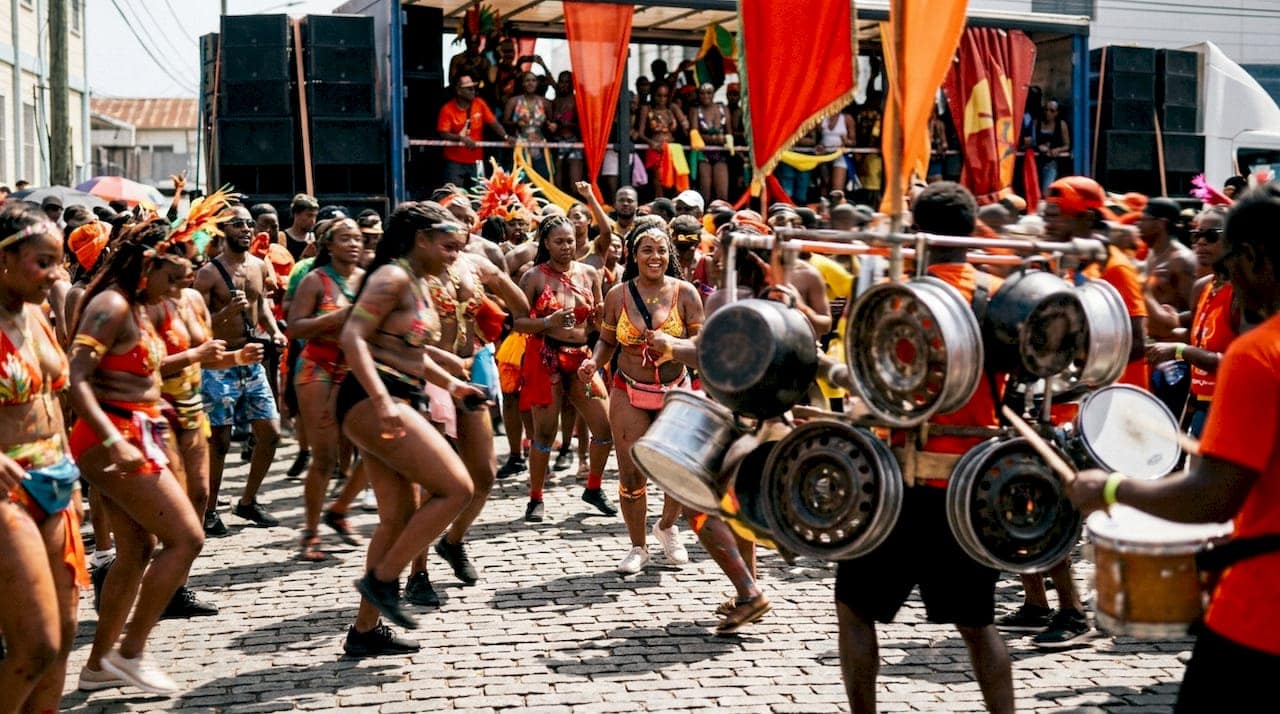
Soca, short for “soul of calypso,” is a high-energy Caribbean dance genre born in Trinidad and Tobago in the early 1970s. Cambridge Dictionary confirms the etymology: a contraction of “soul” and “calypso,” coined by the genre’s founding figure, Lord Shorty (Garfield Blackman). This guide covers everything you need to go from zero to playlist-ready: the origin story, every major substyle, the artists you have to know, and a curated starter sequence you can queue up tonight.
Before we get into it, lock in these three anchors:
- Lord Shorty (Garfield Blackman): the Trinidadian musician who invented soca by fusing Afro-Caribbean calypso with East Indian rhythms during the 1970s.
- Machel Montano: the contemporary king of the genre, a multiple Road March winner and the artist most responsible for soca’s global reach.
- Road March: the formal prize awarded at Trinidad Carnival to the song played most at judging points along the parade route, essentially soca’s Super Bowl trophy.
Key Takeaways
Soca is the “soul of calypso,” a Trinidad and Tobago invention that prioritizes rhythmic energy and collective dance over lyrical storytelling, with eight distinct substyles ranging from 90 BPM groovy soca to 150 BPM power soca road march anthems.
| Point | Details |
|---|---|
| Etymology and origin | “Soca” means “soul of calypso”; Lord Shorty invented it in Trinidad and Tobago in the early 1970s. |
| Three ear-ID cues | Listen for: relentless syncopated percussion, call-and-response vocals, and a BPM above 90. |
| Subgenre range | Eight major substyles exist, from groovy soca (90 BPM) to power soca (130 to 150 BPM) to Afrosoca. |
| Two artists to name | Machel Montano (contemporary power soca) and Kes the Band (groovy soca) are the best entry points for new listeners. |
| Hot Mic Radio soca programming | The Hot Mic Radio soca archive curates classic and contemporary sets organized by substyle and era. |
Table of Contents
- What is the soca music guide’s starting point? The origin story
- What does soca actually sound like?
- What are the main types of soca music?
- How is soca different from calypso, reggae, and dancehall?
- Key soca artists and the tracks every beginner needs to hear
- How soca is arranged and produced
- Soca’s role in Carnival and community life
- A starter playlist to learn soca by ear
- How soca has evolved since the 1990s
- Why Hot Mic Radio curates soca the way we do
- What we think about soca that most guides get wrong
- Tune into soca on Hot Mic Radio
- Sources
What is the soca music guide’s starting point? The origin story
According to Britannica, soca is a popular dance music from Trinidad and Tobago that emphasizes rhythmic energy and studio production. That description is accurate, but it undersells the cultural collision that created it.
The timeline that built a genre
The late 1960s in Trinidad were a pressure cooker. Calypso, the island’s dominant popular music, was rooted in lyrical wit, social commentary, and storytelling. It was music you listened to. What the Carnival crowd increasingly wanted was music that moved them, literally, down the road.
Lord Shorty, born Garfield Blackman, heard that gap and filled it. Drawing on the rhythmic patterns of East Indian folk music, specifically the chutney and tassa drumming traditions brought to Trinidad by indentured laborers, he layered those rhythms over calypso’s harmonic structure. The result was something faster, more percussive, and built for bodies in motion.
His 1974 recording “Indrani” is widely cited as the first soca track, a song that named an Indo-Trinidadian woman and sonically honored the culture she came from. “Endless Vibrations” followed and pushed the template further. Wikipedia’s entry on soca music credits Lord Shorty as the genre’s originator, a point echoed by every serious music reference.
One detail most guides skip: Lord Shorty originally spelled the word “sokah” to make the Indo-Caribbean influence explicit. The Jamaica Information Service documents that the modern “soca” spelling became standard after a 1976 newspaper transcription dropped the “h.” The spelling changed; the intent did not.
Where Mighty Sparrow and Arrow fit in
Mighty Sparrow, the “Calypso King of the World,” did not invent soca, but his stature legitimized it. His willingness to incorporate the new rhythmic approach into his recordings gave the genre credibility with audiences who might have dismissed it as a novelty. Arrow, the Montserratian artist best known for “Hot Hot Hot” (1982), showed that the soca template could travel beyond Trinidad and become a pan-Caribbean and international hit. Both figures represent the genre’s first wave of cross-island adoption.
What does soca actually sound like?
The fastest way to identify soca by ear is percussion. Everything else, the synths, the vocals, the brass, sits on top of a drum pattern that is relentless and forward-driving.
Here are the core sonic markers:
- Tempo: Groovy soca typically runs in a moderate to mid-tempo range. Power soca is faster, suitable for road march anthems.
- Rhythmic emphasis: A syncopated kick-and-snare pattern with heavy use of the “and” beats, creating a rolling, almost unstoppable forward momentum.
- Call-and-response vocals: The lead singer throws out a phrase; the crowd (or a backing vocal line) answers. This structure is built for outdoor Carnival settings where thousands of people need to participate without knowing the full lyrics.
- Percussion layers: Congas, timbales, and shakers sit under or alongside drum machine patterns in studio recordings.
- Synths and steelpan: As documented by DLG, smaller-budget recordings replace horn sections with synthesizers, while larger live productions bring in steelpan and brass.
- Lyrical focus: Party, vibes, togetherness, and Carnival celebration dominate. Red Bull Music Academy notes that soca deliberately shifted away from calypso’s lyrical supremacy toward studio-engineered rhythmic impact designed for dancing crowds.
That last point is the key contrast with calypso. Soca is not trying to tell you a story. It is trying to make you move.
What are the main types of soca music?
MasterClass’s soca guide identifies at least nine distinct substyles. Here are the ones you will actually encounter, organized so you can tell them apart at a glance.

A few things worth noting about these fusions: Chutney soca is not a recent crossover experiment. It reflects Trinidad’s actual demographic reality, where Indo-Caribbean communities have shaped the island’s culture for over 150 years. Ragga soca, meanwhile, shows how porous the border between soca and dancehall has always been, a point worth keeping in mind when you read about dancehall’s influence on pop music.
For club sets: Power soca and ragga soca hit hardest. For slow dancing or a chill fete vibe: Groovy soca is your lane. For Carnival road march: Power soca and Dennery segment are built for exactly that.
How is soca different from calypso, reggae, and dancehall?
These genres share geography and some DNA, but they are doing very different things.
Soca vs. calypso
Calypso is a lyricist’s art form. The best calypsonians, Mighty Sparrow included, built careers on wordplay, political satire, and social commentary. The melody and rhythm existed to carry the words. Soca inverted that hierarchy. The rhythm is the point; the lyrics serve the groove. You will hear soca choruses that are essentially one repeated phrase, because repetition is a feature, not a limitation. It gets a crowd chanting in unison.
Instrumentally, calypso leans on acoustic guitar, brass, and a more relaxed rhythmic feel. Soca’s drum machine and synth-forward production gives it a density and volume that calypso never aimed for.
Soca vs. reggae and dancehall
Reggae’s signature is the “skank,” a guitar or keyboard chop on the offbeat that creates a laid-back, almost hypnotic pulse. Soca has no equivalent. Where reggae pulls you into a groove and holds you there, soca pushes you forward. Reggae BPMs typically sit in the 60–90 range; power soca can run nearly twice that.
Dancehall is closer to soca in tempo and energy, and the two genres have cross-pollinated heavily, hence ragga soca. But dancehall’s vocal delivery, the DJ “toasting” over a riddim, is distinct from soca’s melodic lead vocal approach. Dancehall also carries a harder lyrical edge, more confrontational and explicit, while soca skews toward celebration and communal joy.
Quick first-listen test: If the song makes you want to wave your hands and chant along, it is probably soca. If it makes you sway and nod, reggae. If it makes you want to dance aggressively in a small space, dancehall.
Key soca artists and the tracks every beginner needs to hear
Here is your essential roster, from the genre’s founder to the artists running the game right now.
- Lord Shorty (Garfield Blackman): The inventor. Start with “Indrani” (1974) and “Endless Vibrations” to hear soca at its birth, raw, joyful, and rhythmically unlike anything calypso had done before.
- Mighty Sparrow: The calypso giant who helped legitimize soca’s early years. His track “Drunk and Disorderly” shows how he absorbed the new rhythmic energy without abandoning his lyrical sharpness.
- Arrow: The Montserratian artist who took soca international. “Hot Hot Hot” (1982) remains one of the most recognized Caribbean songs globally and is a perfect entry point for anyone skeptical that soca can cross cultural lines.
- Machel Montano: The undisputed contemporary standard-bearer. Wikipedia notes his status as a multiple Road March winner and one of the most influential artists in the genre’s modern era. Start with “Advantage” for power soca and “Like Ah Boss” for his showmanship at full volume.
- Bunji Garlin: The king of ragga soca. “Differentology” (2013) is the track that introduced many American listeners to the genre, partly because it was remixed with Fuse ODG and got significant international play. Raw energy, toasting vocals, and a riddim that does not quit.
- Destra Garcia: One of the most powerful female voices in soca history. “Bonnie and Clyde” and “I Dare You” showcase her ability to command a Carnival crowd with pure vocal force. She is power soca with personality.
- Alison Hinds: The “Queen of Soca” from Barbados. “Roll It Gal” is her signature, a groovy soca anthem that became a Crop Over festival staple and introduced Bajan soca to a wider audience.
- Rupee: The Barbadian artist who brought soca closest to mainstream American pop. “Tempted to Touch” got radio play in the US in the mid-2000s and remains a gateway track for listeners coming from an R&B background.
- Kes (Kes the Band): Trinidad’s premier groovy soca outfit. “Hello” is the track to start with: melodic, warm, and built for a fete rather than a road march. Their production sits closer to contemporary pop than most soca acts, which makes them an easy entry point.
How soca is arranged and produced
Studio soca and live soca are genuinely different listening experiences, and understanding why helps you appreciate both.
In the studio, the foundation is almost always a programmed drum pattern. Producers sequence the kick, snare, and hi-hat with precision, then layer congas and shakers on top to add the organic feel that pure drum machine lacks. Synth bass replaces the acoustic bass guitar on most contemporary recordings. Horns, when they appear, are often synthesized on smaller-budget productions, though bigger acts bring in live brass for recordings and always for major live shows.
Live setups for Carnival truck sets are a different world. A full percussion section, steelpan players, and a brass line can sit alongside the DJ triggering backing tracks. The result is louder, more chaotic, and more communal than any studio version. The crowd noise becomes part of the mix.

Vocal mixing in soca prioritizes intelligibility of the hook over everything else. The chorus needs to cut through outdoor noise, which means heavy compression on the lead vocal and a mix that pushes the vocal forward rather than burying it in the instrumental.
Pro Tip: When EQing soca tracks for a DJ set or streaming playlist, boost the 80–120 Hz range slightly to reinforce the kick drum’s punch, and add a gentle presence boost around 3–5 kHz to keep the lead vocal cutting through. Avoid over-compressing the master bus or you will flatten the rhythmic dynamics that make soca feel alive.
Soca’s role in Carnival and community life
Soca does not just soundtrack Carnival. It structures it. Understanding that relationship is the difference between hearing soca as party music and understanding it as a civic ritual.
Road March is the formal competition at the heart of Trinidad Carnival. TriniTravels documents that the prize goes to the song played most at official judging points along the parade route, which means artists and their teams actively campaign to get their track on every truck. Winning Road March is a career-defining achievement, and the competition shapes which songs get produced each year.
Jump up is the act of moving through the streets with a mas band during Carnival, and the music playing from the trucks determines the energy of that movement. A great road march track has to sustain energy for hours, which is why power soca’s repetitive, chant-driven structure is not a creative limitation but a functional requirement.
Fetes are the pre-Carnival parties, ticketed events that run from December through Carnival season (February or March in Trinidad). Fete culture has its own sonic preferences: groovy soca and slower-tempo tracks get more play at fetes than on the road, because the crowd is dancing in place rather than marching.
The call-and-response structure of soca lyrics is not accidental. When 50,000 people are moving through Port of Spain and a truck plays a song, the only way to participate is if the song teaches you the response in real time. That is why soca hooks are short, repetitive, and phonetically simple. The music is designed for collective participation at scale.
A starter playlist to learn soca by ear
Queue these up in order and you will cover the genre’s major eras and substyles in a single sitting.
- “Indrani” — Lord Shorty (1974): the origin point, calypso DNA with new rhythmic energy
- “Hot Hot Hot” — Arrow (1982): soca’s first international crossover
- “Drunk and Disorderly” — Mighty Sparrow: calypso-soca bridge, lyrical wit meets new groove
- “Roll It Gal” — Alison Hinds: Bajan groovy soca, essential for understanding regional variation
- “Tempted to Touch” — Rupee: the track that brought soca closest to American R&B radio
- “Hello” — Kes the Band: contemporary groovy soca at its most melodic
- “Differentology” — Bunji Garlin: ragga soca, high energy, toasting vocals
- “Advantage” — Machel Montano: power soca road march template
- “Bonnie and Clyde” — Destra Garcia: power soca with commanding female vocal
- “Like Ah Boss” — Machel Montano: showmanship and production at the genre’s current peak
Three-step listening method:
- Identify the percussion pattern first. Before you hear the melody or lyrics, focus on the kick drum and the layers above it. Is it relentless and fast (power soca) or rolling and melodic (groovy soca)?
- Spot the vocal style. Is the singer melodically leading, or toasting/chanting over the track? Toasting points toward ragga soca. A melodic lead with a simple, repeated hook is classic power or groovy.
- Map to subgenre by feel. Does it make you want to march, sway, or chant? Road march energy equals power soca. Sway and melody equals groovy. Chant and aggression equals ragga.
Find the full soca rotation, including new tracks and classic sets, at the Hot Mic Radio soca archive.
How soca has evolved since the 1990s
The 1990s were a turning point. Digital production tools became affordable, and Trinidadian producers started building tracks that were faster, louder, and more sonically dense than anything the analog era had produced. Power soca as a distinct category crystallized in this period, with BPMs climbing and the emphasis on road march utility intensifying.
Machel Montano was central to this shift. His willingness to incorporate EDM production techniques, festival-ready drops, and international collaborations pulled soca into conversations it had never been part of before. By the 2010s, you could hear soca-influenced production in mainstream pop tracks without the artists or labels ever naming the source.
Afrosoca is the genre’s most significant recent development. The fusion of soca’s rhythmic framework with afrobeats’ percussion vocabulary and melodic sensibility reflects a genuine cultural exchange between the Caribbean diaspora and West African music scenes. Hot Mic Radio’s coverage of afrobeats’ influence on contemporary sound traces how that exchange works in practice. For a deeper look at the artists driving afrobeats forward, the Naija Tips Land afrobeats artist guide is worth bookmarking alongside this one.
Diaspora scenes in New York, London, and Toronto have been equally important. West Indian communities in these cities created a demand for soca outside of Carnival season, which pushed artists to produce music that worked in club environments year-round rather than just for the six-week Carnival window. The Brooklyn Labor Day Carnival (J’Ouvert and the West Indian American Day Parade) and Notting Hill Carnival in London are now major soca stages in their own right, drawing audiences who may never visit Trinidad but know every Road March winner.
Why Hot Mic Radio curates soca the way we do
At Hot Mic Radio, soca sits in what we call “The Global Beat,” alongside Afrobeats and Dancehall. That placement is intentional. These genres share a common thread: they are built for community, for movement, and for the kind of collective joy that does not translate well to passive listening.
Our curation criteria for soca programming come down to four things: historical significance (does this track represent a moment in the genre’s evolution?), dance utility (does it work in a fete, a club, or a road march context?), regional representation (are we covering Trinidad, Barbados, St. Lucia, Dominica, and the diaspora scenes?), and production quality (does it hold up on speakers that are actually trying to reproduce the percussion punch?).
We rotate both classic tracks and contemporary releases, which means you might hear Lord Shorty’s “Indrani” followed by a new Kes the Band single. That is not an accident. Understanding where soca came from makes the current stuff hit differently.
The Hot Mic Radio soca archive is where we keep the full rotation organized by show and era. If you want to go deeper on how global music influences shape what you hear, we have that conversation happening across the platform too.
What we think about soca that most guides get wrong
Soca gets flattened into “Caribbean party music” by writers who have never stood on a Carnival road. That framing is not wrong, exactly, but it misses the weight of what the music actually does.
The call-and-response structure, the repetitive hooks, the sheer volume of a truck set: none of that is accidental or unsophisticated. It is a technology for creating collective experience at scale. When 80,000 people are chanting the same four words behind a truck in Port of Spain, that is not mindless repetition. It is a form of civic communion that most Western music never attempts.
The other thing guides underestimate is the genre’s internal diversity. Treating soca as one sound is like treating hip-hop as one sound. The distance between a Dennery segment track from St. Lucia and a groovy soca ballad from Kes the Band is as wide as the distance between trap and conscious rap. The subgenres are not marketing categories. They reflect genuinely different cultural contexts, tempos, and functions.
Start with the playlist. Then go to a fete or a Carnival, even a diaspora one in New York or Toronto. The music makes a different kind of sense when your body is in the room.
Tune into soca on Hot Mic Radio
Hot Mic Radio’s soca programming is live, curated, and built for listeners who want more than an algorithm-generated playlist. Our DJs know the genre from the road up, and the soca archive gives you organized access to sets that cover every substyle covered in this guide.
If you are coming from an R&B or hip-hop background and soca is new territory, the archive is the right starting point. You will find groovy soca sets for late-night listening and power soca mixes for when you need the energy to match the moment. Our live DJ shows bring that same curation energy in real time. Check the R&B and Hip-Hop archives while you are there — the culture connects more than you might expect. Head to the Hot Mic Radio soca archive and hit play.
Sources
These are the references that informed this guide, each worth bookmarking for a different reason.
- Soca music
- Soca | Caribbean, Calypso & Reggae Fusion | Britannica
- A guide to soca music. Red Bull Music Academy Daily (expert perspective)
- SOCA | definition in the Cambridge English Dictionary
- Soca — Jamaica Information Service


Post comments (0)