


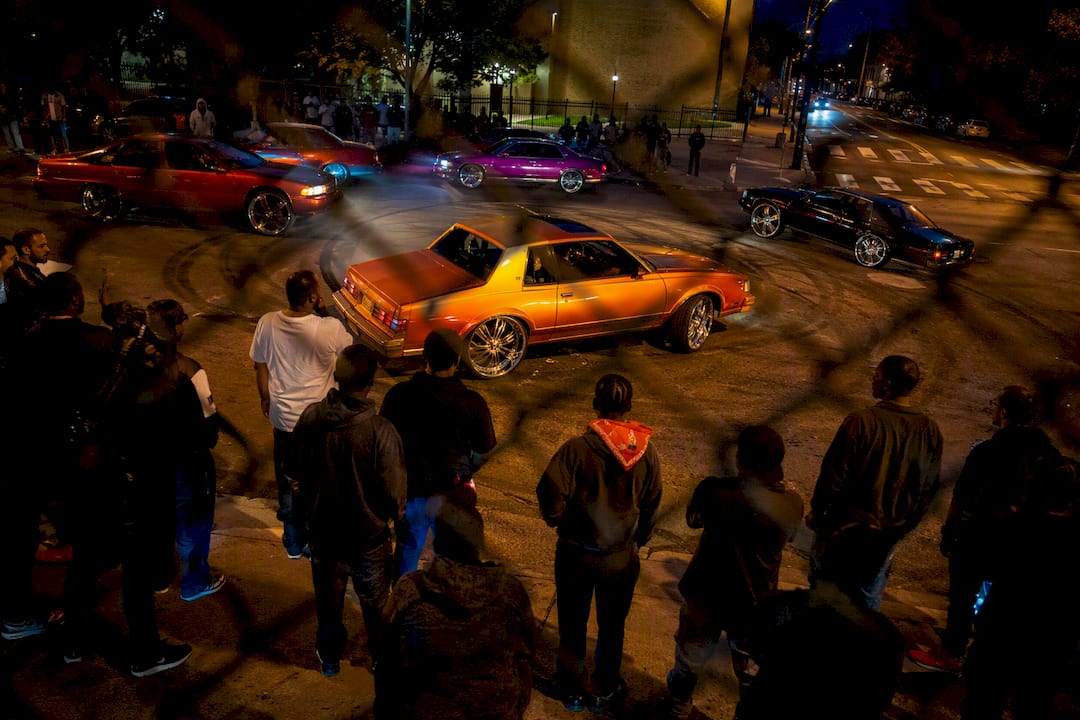
Hyphy is the Bay Area’s own strain of hip hop, an Oakland slang term for “hyperactive” that turned into a full sound and lifestyle. It came together in the late 1990s and broke wide in the early 2000s, built on the shoulders of Keak da Sneak, who coined the word on record, and Mac Dre, the movement’s spiritual leader and label founder.
TL;DR:
- Hyphy evolved from Bay Area mobb music by speeding up tempos, increasing bass, and adding chaotic synth sounds to create an energetic, unhinged style.
- Key figures like Mac Dre and Keak da Sneak shaped the movement’s identity, with independent labels and local distribution fueling its growth before mainstream exposure.
- The style is characterized by fast beats, heavy bass, exaggerated synth stabs, and vocal effects tailored for street performances and car culture events.
- Sideshows, ghost riding, scraper cars, and street dancing formed the visual and physical culture that complemented hyphy’s music and slang.
- Although it fragmented commercially, hyphy’s influence persists in modern West Coast trap, social media, and community culture that celebrates its DIY roots.
Table of Contents
- The Bay Area Hyphy History Behind the Sound
- What Makes the Hyphy Sound Different
- The Artists and Labels Who Built the Movement
- Sideshows, Ghost Riding, and the Look of Hyphy Culture
- Growing Pains: Policing, Commercialization, and Community Backlash
- Where Hyphy’s Influence Lives Today
- Why Hot Mic Radio Keeps Hyphy in Rotation
- Hear the Hyphy Legacy on Hot Mic Radio
- Sources
The Bay Area Hyphy History Behind the Sound
Before there was hyphy, there was mobb music, the slower, bass-heavy Bay Area style that ruled the 1990s underground. Hyphy grew directly out of that sound, but sped it up, brightened it, and gave it a reason to move. Producers took the mobb template and pushed the tempo, cranked the low end, and layered in synths that sounded like they were built for chaos on purpose.
The word itself traces back to Oakland, and KQED’s reporting on the movement credits Keak da Sneak with putting “hyphy” on wax as early as the late 1990s, describing the culture as “pure energy” that went far beyond the music itself. That phrase stuck because it was accurate. Hyphy wasn’t a subgenre you just listened to. It was something you did, whether that meant losing your mind at a sideshow or going dumb in the middle of the street.
Mac Dre gave the movement its backbone. His label, Thizz Entertainment, became the model for how Bay Area artists got music into the world without waiting on a major label to say yes. Sick Wid It Records, run by E-40, did similar work on the other side of the bridge. Between the two camps, a whole regional economy of trunk sales, mixtapes, and hand-to-hand hustling kept the scene alive years before anyone outside California knew the word “hyphy” existed.
That DIY infrastructure wasn’t incidental. According to Wikipedia’s history of Bay Area hip hop, the region had been running its own independent distribution model for decades, and hyphy simply plugged into machinery that was already built and already working.
Pro Tip: If you want to hear the transition from mobb to hyphy in real time, run Mac Dre’s earlier catalog against his Thizz-era work back to back. The tempo shift alone tells the whole story.
Here’s a rough timeline of how it all unfolded:
- Late 1990s: Keak da Sneak coins “hyphy” on record; Mac Dre builds Thizz Entertainment as an independent label.
- Early 2000s: The sound spreads through mixtapes and trunk sales across Oakland, Vallejo, and the East Bay.
- 2005 to 2007: Hyphy achieved commercial attention, with mainstream radio and MTV exposure increasing sharply.
What Makes the Hyphy Sound Different
Hyphy tracks move faster than the mobb music that preceded them, and they hit harder in the low end. Wikipedia’s entry on the genre describes the style as 808 heavy, with eccentric synth riffs and vocal samples chopped into something almost cartoonish. That’s not an insult. The exaggeration was the point. Hyphy production wanted to sound unhinged because the culture around it was too.
Three producers did more than anyone to define that palette. Traxamillion, often called the king of the “hyphy beat,” built tracks engineered for maximum sideshow energy. Rick Rock brought a heavier, more menacing low end that connected hyphy back to its mobb roots. Droop-E, son of E-40, added a sharper, more modern edge as the sound matured, while Sean T contributed some of the rawest, most stripped down beats in the catalog.
A few production choices show up again and again once you start listening for them:
- Snare and hi-hat patterns built for street dancing, not headphones
- Synth stabs pitched high enough to feel jittery on purpose
- Vocal chops and ad-libs dropped in like sound effects rather than lyrics
- Bass tuned to rattle car trunks, since so much of hyphy was made to be heard from a moving vehicle
If you want a quick education in the sound, start with E-40’s “Tell Me When To Go,” produced by Lil Jon but pure hyphy in spirit, then move to Mac Dre’s “Thizzelle Dance” and Keak da Sneak’s “Super Hyphy.” Traxamillion’s instrumental work, especially his contributions to “The Slap” compilation series, shows the production style at its purest, stripped of vocals entirely.
The Artists and Labels Who Built the Movement
Mac Dre sits at the center of hyphy’s history, and not just because of the label he ran. His music, his slang, and his sheer presence gave the movement its personality before “hyphy” was even a household word outside Northern California. His death in the early 2000s turned him into something closer to a folk hero, and Thizz Entertainment kept releasing his music for years afterward.
Keak da Sneak did the linguistic heavy lifting. Beyond coining the term itself, his gravel-toned delivery and street reporting style became a blueprint for how hyphy rappers were supposed to sound: aggressive, funny, and completely unbothered by polish.
E-40 was already a Bay Area legend before hyphy existed, but he became the movement’s biggest crossover success. “Tell Me When To Go” put hyphy slang on national radio and MTV in 2006, giving the culture a mainstream entry point it had never had before.
Mistah F.A.B. played a different role. According to KQED’s oral history of the scene, he worked as a connector across Oakland’s neighborhoods, using collaboration tracks to ease turf tensions and present hyphy as one unified regional sound rather than a patchwork of rival blocks.
A few more names and labels rounded out the scene:
- The Federation, whose “Hyphy” track functioned almost as an anthem and title track for the whole movement
- The Pack, a younger Berkeley group whose 2006 single “Vans” showed hyphy could evolve past sideshow anthems into something with crossover pop appeal
- Sick Wid It Records, E-40’s label, which operated alongside Thizz as one of the two major independent engines of the scene
Sideshows, Ghost Riding, and the Look of Hyphy Culture
Hyphy was never just a sound. It was a full visual and physical culture, and most of that culture grew out of something that predates the music entirely: Bay Area car culture. Scraper cars, older sedans stripped down and customized with candy paint and oversized rims, had been an East Bay institution for years before hyphy gave them a soundtrack. Academic work on the movement notes that the scraper car scene actually preceded the music, which means hyphy songs were scoring a culture that already existed rather than inventing one from scratch.
Sideshows were the public stage for all of it. These were impromptu gatherings, sometimes drawing hundreds of cars and spectators, where drivers would perform stunts in the street: doughnuts, drifting, and the signature move known as ghost riding, where the driver climbs out and dances alongside a car that’s still rolling. Scraper bikes, elaborately customized bicycles built by teens too young to drive, mirrored the same aesthetic on a smaller scale and gave younger kids a way into the culture.
The dancing had its own vocabulary. “Going dumb” meant losing yourself completely to the music, arms and head snapping in exaggerated, almost violent motion. “Thizzing” referenced ecstasy use, tied to Mac Dre’s slang and later folded into dance moves and even a hand sign. Fashion followed suit: mouth grills, oversized sunglasses called “stunna shades,” and bright colors that matched the energy of the music.

Slang was arguably hyphy’s most durable export. Terms like “hyphy,” “hella,” “yadadamean,” and “getting stupid” traveled far beyond the Bay Area, showing up in national rap vocabulary long after the sideshow scene itself had cooled down.
Growing Pains: Policing, Commercialization, and Community Backlash
Hyphy gave Bay Area youth something the region hadn’t had in a while: a culture that was entirely their own, built without waiting for approval from New York or Los Angeles. Scholarly analysis frames the whole movement as an act of regional defiance, a response to years of the national music industry treating the Bay Area as an afterthought.
That defiance came with real costs. Sideshows drew large crowds fast, and the same stunts that made them thrilling, doughnuts, ghost riding, drifting in tight city blocks, also made them dangerous. Contemporary reporting from the Los Angeles Times documented injuries and property damage tied to sideshow events, which pushed Oakland and neighboring cities toward aggressive policing responses, including car impounds and dedicated task forces aimed at breaking up the gatherings.
Commercialization created its own tension. Once labels and MTV started paying attention around 2005, artists faced pressure to sand down the rougher edges of the sound for radio. Some embraced the crossover moment; others felt it diluted what made hyphy distinct in the first place. That friction shows up clearly in the movement’s own oral history:
- Grassroots mixtape networks and regional promoters, not major labels, drove most of the initial 2005 to 2007 push
- The lack of a centralized industry investment, as Complex’s oral history documents, limited a sustained national tour or lasting major-label breakthrough
- Several artists struggled to translate local sideshow anthems into songs that worked outside a Bay Area context
- Media coverage often focused more on the danger of sideshows than the music, which colored public perception of the whole culture
The result was a movement that peaked hard and fast, then fragmented once the spotlight moved elsewhere.
Where Hyphy’s Influence Lives Today
Hyphy never fully disappeared. It scattered into other sounds and other cities, and pieces of it are still audible if you know what to listen for. The tempo shifts and chaotic energy that defined hyphy production share clear DNA with the ratchet sound that came out of the Bay Area and Los Angeles in the early 2010s, and echoes of that 808-driven bounce turn up in later electronic and trap-adjacent subgenres that borrowed the same appetite for exaggerated low end.
Retrospective coverage from The Oaklandside marking hyphy’s twentieth anniversary points to a culture that never really left. Scraper bike teams still organize community rides in Oakland. Old hyphy tracks resurface regularly on social media, introducing the sound to listeners who were toddlers during its commercial peak. Younger Bay Area producers still reach for the same synth textures and chopped vocal tricks, even when the songs they’re building land in a completely different genre.
A few threads keep the legacy active:
- Scraper bike culture persists as an organized, intergenerational community activity in Oakland
- Hyphy slang remains embedded in national rap vocabulary well beyond its regional origin
- Modern West Coast producers regularly sample or reference the Traxamillion and Rick Rock sound palette
- Archival and retrospective journalism keeps introducing new listeners to the movement’s foundational tracks
Hyphy still functions as a touchstone for Bay Area identity precisely because it was never engineered for the mainstream. It was built by the region, for the region, and that origin story is part of why it still resonates decades later. For anyone tracing the roots of West Coast hip hop’s louder, weirder, more physical side, hyphy is where that thread starts.
Why Hot Mic Radio Keeps Hyphy in Rotation
We treat regional hip hop history as something worth protecting, not just referencing. Hyphy is one of the clearest examples of a scene that built its own infrastructure, its own slang, and its own sound with zero permission from the industry gatekeepers, and that’s exactly the kind of story Hot Mic Radio exists to keep alive.
Our regional spotlight programming exists because scenes like this one deserve more than a Wikipedia footnote. Hyphy proves that a culture can peak commercially, fragment under industry pressure, and still leave permanent fingerprints on how a whole coast makes music. That’s the pattern we watch for in every independent artist we feature today, whether they’re working out of Oakland, Atlanta, or a bedroom studio nobody’s heard of yet.
We’d argue the biggest misread of hyphy is treating it as a fad that “died” once the mainstream moved on. It didn’t die. It decentralized, the same way it started.
— Hot Mic Radio Team
Hear the Hyphy Legacy on Hot Mic Radio
Hot Mic Radio gives you a way to hear this history instead of just reading about it, and that’s the real advantage over digging through scattered YouTube uploads and half-dead blog archives on your own. Our Hip Hop Archives run curated sets that trace Bay Area sound from mobb music through hyphy and into what came after, so you get context along with the tracks.
Live DJ shows bring that same regional spotlight energy to your speakers in real time, and our Hip Hop & R&B Show, The Beat Drop, regularly digs into producer-driven eras like this one. If you’re a producer working in that same 808-heavy tradition, resources like this guide to selling beats online can help you turn that sound into something sustainable, the same way Thizz Entertainment and Sick Wid It once did it independently.
Tune into the Hip Hop Archives now and hear where hyphy fits inside the bigger story of Bay Area hip hop.
Sources
For readers who want primary material beyond this overview, a few sources stand out. KQED’s reporting offers first-person cultural framing straight from participants. Complex’s oral history captures the movement’s peak and fragmentation in the artists’ own words. Academic grounding comes from VCU’s Scholars Compass analysis, while NPR’s 2006 coverage documents the sound as it broke nationally.
- ‘It’s Pure Energy’: How Hyphy Came to Define Bay Area Hip-Hop | KQED
- Scholarly analysis of hyphy culture (VCU Scholars Compass)

