


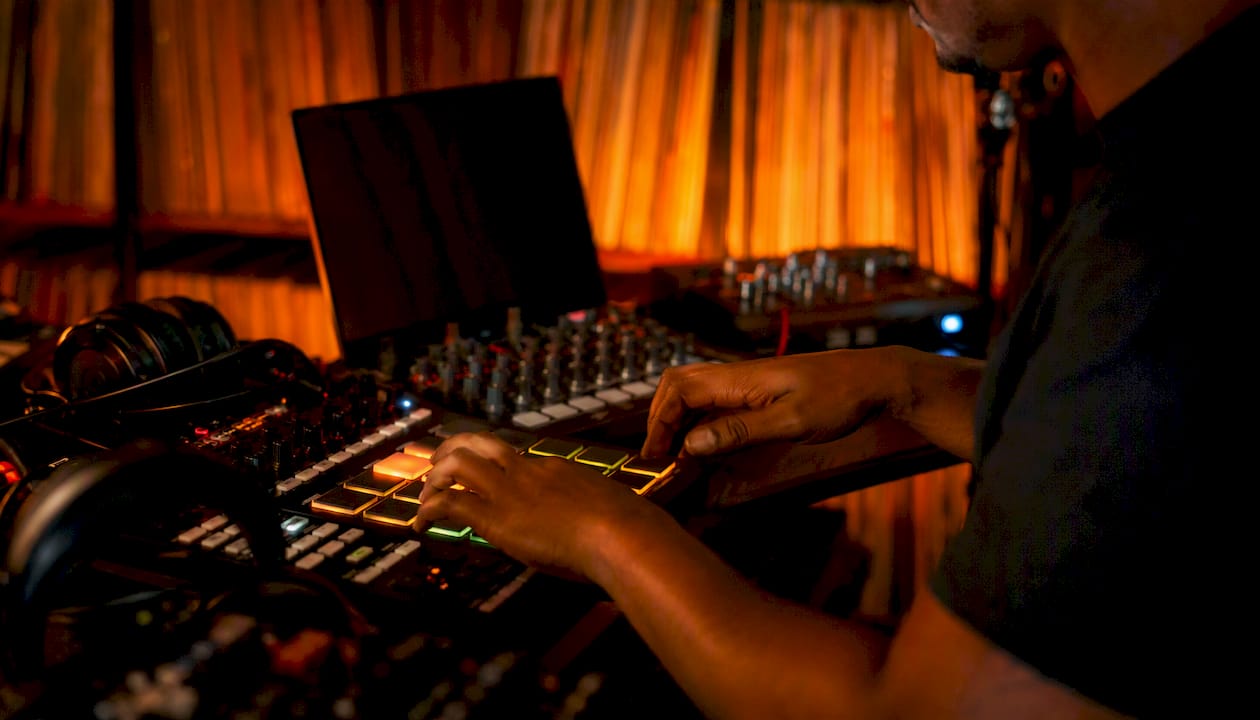
A dancehall riddim is the reusable instrumental track, drum pattern plus bassline, that a producer builds once and multiple artists then voice over with different lyrics and melodies. That’s the whole concept in one breath. The clearest example is Sleng Teng, the 1985 digital riddim built by King Jammy off a preset from a Casio keyboard, which flipped Jamaican music on its head and got rewired hundreds of times over. We’re breaking down how riddims work, where they came from, and which ones you need to know, and we’ll point you toward where to actually hear them, including right here on Hot Mic Radio.
Key Takeaways
A dancehall riddim is a reusable drum-and-bass instrumental that multiple artists voice independently, and its evolution from analog studio work to Sleng Teng’s 1985 digital breakthrough defines dancehall’s entire modern sound.
| Point | Details |
|---|---|
| Riddim defined | It’s the instrumental backbone (drum pattern plus bassline) that gets reused across many separate vocal tracks. |
| 1985 turning point | Sleng Teng, built by King Jammy on a Casio preset, launched dancehall’s digital era and spawned hundreds of versions. |
| Six essential riddims | Sleng Teng, Stalag, Real Rock, Bam Bam, Punanny, and Joyride each shaped a distinct era of the genre. |
| Producers shape the sound | King Tubby, King Jammy, Steely & Clevie, and Studio One each left a distinct technical fingerprint on riddim culture. |
| Hear it live | Hot Mic Radio’s Global Beat programming plays dancehall, Afrobeats, and Soca in curated live DJ sets. |
Table of Contents
- What Is a Dancehall Riddim, Really?
- How Are Riddims Made, Released, and Reused?
- When Did Dancehall Riddims Evolve Into What We Know Today?
- Which Riddims Should You Actually Know?
- Who Are the Producers Behind Dancehall’s Biggest Riddims?
- Why Do Riddims Matter Beyond the Studio?
- How Do You Spot and Find Riddims Yourself?
- Why This Matters to How Hot Mic Radio Programs Global Sounds
- Ready to Hear These Riddims in Action?
- Sources
What Is a Dancehall Riddim, Really?
The word itself gives away the origin. “Riddim” is the Jamaican Patois pronunciation of “rhythm,” and Jamaican musicians have used it for decades to describe a specific thing: an instrumental track built to stand on its own, get released, and get reused by a whole roster of vocalists over time, as Wikipedia’s breakdown of riddim lays out clearly. It’s not a beat in the American hip-hop sense, purchased once and locked to one song. A riddim has a life of its own.
Musically, a riddim usually stacks a few core ingredients:
- A tight, repeating drum pattern that anchors the groove, often programmed rather than played live
- A prominent, melodic bassline that frequently carries more of the song’s identity than the drums do
- Short ostinato hooks (a synth stab, a horn line, a vocal chop) that repeat and become instantly recognizable
- Tempos that typically sit in the 95 to 120 BPM range, per Wikipedia’s dancehall entry
- Sparse, punchy arrangements that leave room for a vocalist to sit right on top of the mix
You’ll also run into a handful of terms that get thrown around constantly in dancehall culture, and knowing them makes everything click faster:
- Riddim: the instrumental itself, built to be voiced by multiple artists
- Voicing: the act of an artist recording vocals over an existing riddim
- Version: one specific vocal take on a riddim (there can be dozens per riddim)
- Dub: an instrumental or stripped-down mix, often with heavy reverb and echo, born out of 1960s and 1970s studio experimentation
- Selector: the DJ at a sound system event who picks and mixes the records
- Relick (or rewick): when a producer revives an old riddim with updated production
Once you’ve got that vocabulary down, the rest of dancehall history opens right up.
How Are Riddims Made, Released, and Reused?
Building a riddim starts in the studio with the drum pattern, usually programmed first on a drum machine or digital workstation, then layered with a bassline designed to be the song’s real hook. Producers lean on synth presets, whether that’s a Roland drum machine in the analog era or software plugins today, to shape a signature sound that’s instantly identifiable. The arrangement stays intentionally minimal. Every open space in the mix is real estate for a future vocalist.

Release formats have shifted dramatically over the decades. In the 1970s and 1980s, a riddim might drop on a 7-inch single, with the vocal cut on the A-side and the instrumental (the “version”) on the B-side for sound systems to play and rework live. Today, a single riddim often gets packaged as its own digital compilation, a “riddim album” stacking ten or more different artists’ versions of the same instrumental, ready to stream as one project, a format Electronic Beats’ genre guide traces through dancehall’s modern catalog culture.
This is the heart of what’s called the riddim-plus-voicing practice: one producer builds the track, and a rotating cast of artists records over it independently, sometimes without ever meeting each other. Sleng Teng alone has reportedly been voiced hundreds of times since 1985, a sprawling family tree of songs sharing one digital skeleton, according to entries in Wiktionary’s riddim reference.
Pro Tip: Always check the producer or label credit before you assume you know a riddim’s full story. Two songs can sound completely different vocally while sharing the exact same instrumental underneath, and the credit line is usually your fastest way to confirm it.
When Did Dancehall Riddims Evolve Into What We Know Today?
Riddim culture didn’t start with dancehall. It grew out of roots reggae and dub experimentation through the 1950s to 1970s, when studios like Studio One, run by Clement “Coxsone” Dodd, and dub pioneer King Tubby were already treating instrumental tracks as reusable foundations rather than one-off backing music.
The real pivot came in the late 1970s and early 1980s, when dancehall split off from roots reggae with a harder, faster, more DJ-centered sound, a shift Wikipedia’s dancehall history attributes to changing sound system culture and a new generation of vocalists. Then came 1985, and everything changed again.
| Era | Years | What Happened |
|---|---|---|
| Roots and dub | 1950s to 1970s | Studio One and King Tubby establish riddims as reusable instrumental tracks |
| Early dancehall shift | Late 1970s to early 1980s | Faster, DJ-centered sound splits from roots reggae |
| Digital revolution | 1985 | Sleng Teng, built by King Jammy on a Casio preset, launches the fully digital riddim era |
| Producer and relick era | 1990s | Steely & Clevie and others dominate; classic riddims get revived with modern production |
The Sleng Teng moment deserves its own line item. King Jammy took a preset rhythm meant for a cheap home keyboard and turned it into the backbone of a genre, spawning hundreds of versions and proving a riddim could be built entirely inside a machine, no live band required.

Which Riddims Should You Actually Know?
If you want to understand dancehall, these six riddims are non-negotiable listening. Each one shaped how the genre sounds, and most are still getting versioned today.
- Sleng Teng (King Jammy, 1985): the digital riddim that started it all, built from a Casio MT40 preset. Wayne Smith’s “Under Mi Sleng Teng” (1985) is the original vocal, and the riddim has since been voiced hundreds of times across reggae and dancehall.
- Stalag (Ansel Collins, originally 1973): one of the most sampled and versioned riddims in Jamaican history, later famously reworked by artists across decades; its skeletal drum pattern has powered dancehall and even hip-hop tracks.
- Real Rock (Studio One, Sound Dimension, 1967): a Coxsone Dodd production so foundational it’s considered one of reggae’s most reused bass-and-drum templates, still turning up in new versions today.
- Bam Bam (Sly & Robbie / Channel One, late 1970s): originally cut by the Maytones, later exploded into dancehall consciousness through Sister Nancy’s iconic vocal cut and continues getting sampled globally.
- Punanny (Steely & Clevie, early 1990s): a defining early-90s riddim tied to Shabba Ranks, showcasing the producer duo’s signature digital drum programming.
- Joyride (Dave Kelly, 1990s): a riddim closely tied to the golden run of Jamaican dancehall producers, giving several artists a platform during a hugely competitive era for riddim releases.
What ties all six together is longevity. A riddim built in 1967 or 1973 can still show up freshly voiced decades later, because the instrumental itself never expires, only the vocal on top changes. That’s part of why Electronic Beats’ genre guide to essential riddims treats producer catalogs almost like living archives rather than closed chapters.
The cross-over case worth knowing: Sleng Teng’s DNA didn’t stay in Jamaica. Its digital, drum-machine-driven approach influenced UK bass music, and elements of that stripped-down, bass-forward production logic echo through genres far outside reggae and dancehall, feeding directly into how dancehall has shaped mainstream pop production decades later.
Who Are the Producers Behind Dancehall’s Biggest Riddims?
Riddims don’t build themselves. Behind every canonical track sits a producer or label with a signature approach, and knowing their names tells you almost everything about a riddim’s sound before you even hit play.
- King Tubby: the dub originator whose remixing and mixing-board techniques (heavy echo, stripped instrumentals, dramatic drop-outs) laid the groundwork for treating a track’s instrumental as its own art form.
- King Jammy: Tubby’s former engineer, who went digital in 1985 with Sleng Teng and became the architect of the computer-driven dancehall sound.
- Steely & Clevie: the production duo (Wycliffe “Steely” Johnson and Cleveland “Clevie” Browne) responsible for some of the most influential digital riddims of the late 1980s and 1990s, including Punanny.
- Studio One (Coxsone Dodd): reggae’s original hit factory, where Real Rock and countless other foundational riddims were cut, often called the Motown of Jamaica.
- Dave Kelly and Penthouse Records: key players in the 1990s producer era, pushing riddims like Joyride into heavy rotation.
- Ward 21: a more recent production crew keeping relick culture alive by updating older riddims for new generations of dancehall artists.
Producer credit isn’t just trivia. Because a single riddim can carry a dozen or more separately owned vocal versions, tracking who built the instrumental matters enormously for royalties and ownership, a complexity the academic analysis of riddim ownership practices digs into directly.
Why Do Riddims Matter Beyond the Studio?
Riddims are a community event before they’re ever a recording. Sound systems and selectors have historically been the delivery mechanism, playing dubplates and fresh versions live at dances long before a track ever hit a shop shelf, testing what worked in real time in front of a crowd.
That reuse cycle didn’t just recycle old tracks. It pushed vocalists to compete for space on the same instrumental, forcing constant lyrical and melodic innovation, which is part of what keeps the genre feeling alive rather than repetitive.
Riddim culture channels collective evolution: producers craft durable foundations and vocalists are pushed to innovate, which keeps the genre both stable and continually creative, as Electronic Beats’ genre analysis points out.
The global reach is real too, but it comes with a caution. Dancehall’s digital, riddim-driven approach has rippled into hip-hop, UK grime, and pop production. At the same time, cultural writers pushing back on 2026’s Carnival coverage note that soca and dancehall get flattened into one generic “island vibe” online, when they’re actually distinct traditions with different roots, tempos, and performance contexts, a point Latination’s 2026 feature makes directly. Dancehall grew out of Jamaican sound system dances; soca grew out of Trinidad Carnival’s parade energy. Similar family, different house.
How Do You Spot and Find Riddims Yourself?
Once you know what to listen for, riddims start jumping out at you everywhere. Here’s the quick method:
- Listen for the bassline first. In most riddims, it carries more melodic weight than the vocal itself.
- Watch for the drop, the moment the drums cut and the bassline stands alone before crashing back in.
- Clock the tempo. Dancehall riddims generally sit at 95 to 120 BPM, noticeably slower than soca’s faster Carnival pace.
- Notice repeated synth stabs or drum-machine textures; that’s usually the producer’s fingerprint.
- Search streaming platforms by riddim name or producer credit, not just artist name, to pull up multiple versions at once.
Label compilations and dedicated riddim playlists are your best entry point, alongside sound-system mix archives that preserve how these tracks actually played live. For a more technical look at how rhythm programming works underneath dance music broadly, SoundBridge’s breakdown of drum arrangement is worth a read even outside dancehall specifically.
Why This Matters to How Hot Mic Radio Programs Global Sounds
We built our Global Beat lineup because riddim culture is exactly the kind of storytelling we love: one foundation, endless voices. When our DJs spin dancehall alongside Afrobeats and Soca, we’re not just playing songs, we’re tracing a whole lineage. That’s the experience we want you tuned into.
Ready to Hear These Riddims in Action?
Reading about Sleng Teng and Stalag is one thing. Hearing a selector actually mix between three different versions of the same riddim back to back is a completely different rush, and that’s exactly what our live DJ shows deliver. Hot Mic Radio’s Global Beat programming puts dancehall, Afrobeats, and Soca right next to each other in the rotation, so you get the full Caribbean picture instead of a flattened, algorithm-fed version of it.

Our curated shows connect the dots between the classic riddims we just walked through and where dancehall’s influence shows up today, including in the hip-hop programming that borrowed heavily from that same digital, bass-first playbook. Want the play-by-play on how to actually catch these sets live? Check out how to tune into our live DJ shows and start listening today.
Sources
- Riddim — Wikipedia
- Genre Guide: Dancehall’s Most Essential Riddims — Electronic Beats
- The riddim method: aesthetics, practice, and ownership in Jamaican dancehall — Manuel Marshall (PDF)
- Why Soca and Dancehall are everywhere in 2026 and where the sounds come from — Latination


Post comments (0)