



Radio airplay pays songwriters and publishers through performing rights organizations, while sound recording royalties only kick in under specific digital and satellite licenses, collected by SoundExchange. If you write songs, perform on records, or own a label, you need to register with the right outfit now, because unregistered work simply doesn’t get paid. ASCAP, BMI, SESAC, GMR, and SoundExchange are the five names you need to know.
TL;DR:
- AM/FM stations pay composition royalties through one PRO, while performers and labels receive no terrestrial recording royalties; SoundExchange covers eligible digital and satellite plays.
- Songwriters should register every composition with exactly one PRO; featured performers need SoundExchange accounts, and labels should register master recordings there.
- PRO payouts depend on station fees, audience reach, airtime, and station type; smaller stations may be sampled, so inaccurate metadata can hide plays.
- Distributions usually arrive quarterly, often one or two quarters after airplay; unmatched digital royalties can remain in segregated accounts for up to three years.
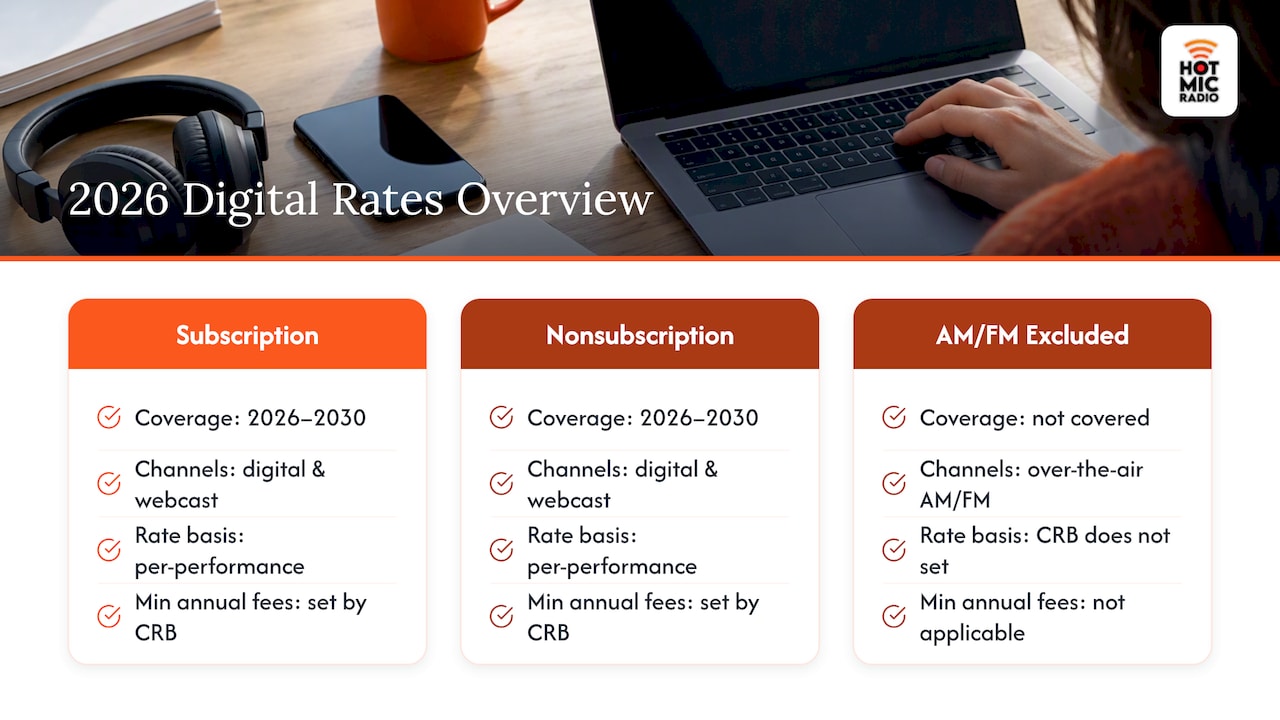
- The 2026 statutory rates cover eligible commercial digital transmissions through 2030, with separate subscription and nonsubscription structures, but exclude over the air AM/FM broadcasts.
Table of Contents
- Types of Radio Royalties: Composition vs. Sound Recording
- Who Collects and Pays Out: PROs vs. SoundExchange
- How PROs Turn Radio Plays Into Actual Dollars
- Registration, Metadata, and When the Checks Actually Arrive
- 2026 Digital Royalty Rates: What the CRB Just Set
- Your Royalty Checklist: Don’t Leave Money on the Table
- Why Radio Exposure Still Moves the Needle
- Getting Your Music Heard: Submissions and Promotion With Hot Mic Radio
- FAQ
- Sources
Types of Radio Royalties: Composition vs. Sound Recording
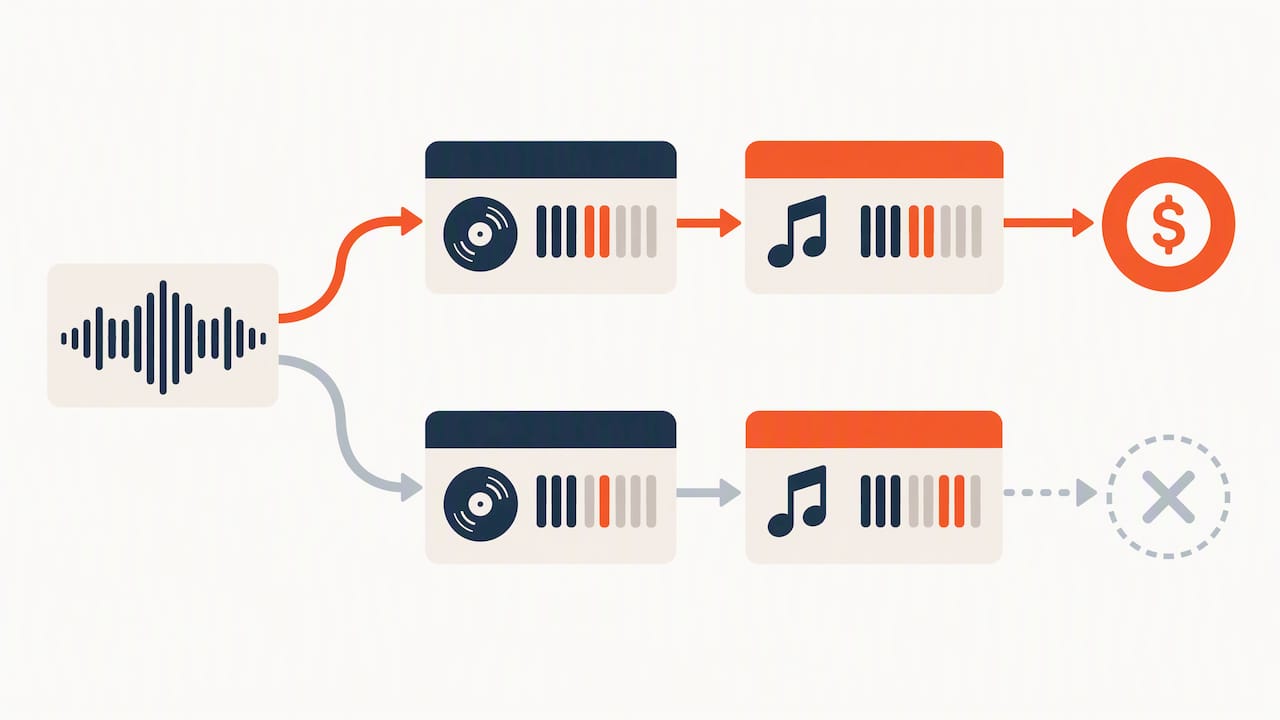
Here’s the split that trips up almost every new artist we talk to: there are two separate copyrights hiding inside every song that hits the airwaves, and they get paid completely differently.
The musical composition is the song itself, the melody and lyrics, owned by the songwriter and publisher. The sound recording is the actual recorded performance, owned by the artist, producer, or label. AM/FM radio in the U.S. only pays the composition side. According to Vanderbilt’s analysis of radio performance rights, terrestrial stations don’t owe performers or labels a dime for spinning a sound recording over the air. That exemption is strictly for over-the-air broadcast.
- Composition royalties flow from AM/FM and digital radio alike, straight to songwriters and publishers through a PRO.
- Sound recording royalties only apply to certain digital and noninteractive transmissions, like webcasting and satellite radio, not traditional terrestrial play.
- The same song can generate one royalty stream on FM and two streams online, which is exactly why registration on both sides matters.
Who Collects and Pays Out: PROs vs. SoundExchange
Five organizations run this entire system, and knowing which one matches your role saves you months of chasing money that’s already sitting in an account somewhere.
ASCAP, BMI, SESAC, and GMR are the performing rights organizations, and every songwriter and publisher needs to be affiliated with exactly one. Join as a writer, list your catalog, and the PRO tracks performances and pays you a share of the license fees it collects from stations, venues, and streaming services. SoundExchange handles something different entirely: it administers the statutory license for digital performance of sound recordings, per the U.S. Copyright Office’s musicians’ income guide, and splits that money between the label and the featured performer.
- If you write songs, you need a PRO, period, whether or not you ever step in front of a mic.
- If you performed on the recording, you need a SoundExchange account to collect your share of digital spins.
- Labels and copyright owners register masters with SoundExchange; the Copyright Office notes that missing registrations are one of the biggest reasons performers go unpaid.
How PROs Turn Radio Plays Into Actual Dollars
This is the part that feels like a mystery until you see the formula, so let’s break it down the way ASCAP and BMI actually run it.
- Each station pays a blanket license fee based on its revenue, market size, and format.
- The PRO converts tracked performances into credits, weighted by audience reach, time of day, and station type.
- Your royalty equals your credits multiplied by the current dollar value per credit, which shifts quarter to quarter depending on how much money is in the pool.
Big stations get full census tracking, meaning every spin counts, which often depends on reliable studio equipment and broadcast hardware as explained in our guide to the best computers for radio broadcast and internetradio. Smaller or regional stations often get sampled instead of fully monitored, according to Trolley’s breakdown of royalty calculation, which means plays can slip through the cracks if your metadata isn’t properly registered with the monitoring services tracking that station.
Statistic Callout: BMI’s royalty policy describes bonus tiers built on performance volume, including a hit song bonus triggered above 95,000 performances in a single quarter. That’s the kind of number that separates a radio hit from a modest catalog cut.
Registration, Metadata, and When the Checks Actually Arrive
Getting paid isn’t automatic. You have to build the paper trail before the plays happen, because royalties can’t find a home they don’t know exists.
- Join a PRO (ASCAP, BMI, SESAC, or GMR) and register every composition you write, solo or co-written.
- Create a SoundExchange account and register your masters if you performed on them, even as a featured guest.
- Lock in your ISRCs and songwriter splits at release time, not six months later when you’re trying to fix a mismatch.
Expect a lag. Trolley’s reporting notes that distributions are typically quarterly, and the performances you’re paid for often happened a quarter or two earlier. Money tied to performances nobody can match sits in reserve, what the industry calls black box royalties, and it stays unclaimed until someone proves ownership.
Pro Tip: Update your metadata with your distributor and PRO the day a track drops, not after it starts getting spins. Mismatched ISRCs are the number one reason plays go unpaid.
2026 Digital Royalty Rates: What the CRB Just Set
The Copyright Royalty Judges don’t touch your FM royalties, but they set the per-play economics for everything streamed or webcast, and 2026 brought a fresh determination.
According to the Federal Register’s 2026 determination, the Copyright Royalty Judges published interim per-performance rates and minimum annual fees covering commercial digital transmissions for 2026 through 2030, with separate structures for subscription and nonsubscription services. These statutory rates apply only to eligible noninteractive digital and webcast channels, never to over-the-air AM/FM.
Statistic Callout: The same Federal Register determination notes that unmatched digital performance funds can sit in segregated accounts for up to three years before reallocation, which means proof of ownership filed late can still recover real money.
Your Royalty Checklist: Don’t Leave Money on the Table
Here’s the move list, straight up, no fluff.
- Register every composition with your PRO the moment it’s finished, not when it starts charting.
- Open a SoundExchange account if you performed on the record, whether you’re the headliner or a feature.
- Double check ISRCs, songwriter splits, and publisher info before release, then confirm again after.
- Track your release and distribution records, and file a claim the moment you spot an unmatched or missing royalty.
Hot Mic Radio’s submission and promotion pathways give independent artists a real shot at measurable spins, which only pays off when your paperwork is already locked in.
Pro Tip: Run your catalog through a metadata audit every time you drop new music. Small gaps compound into real missed money over a year of airplay.
Why Radio Exposure Still Moves the Needle
We’ve watched plenty of independent artists treat airplay like a side quest, but it’s often the funnel that leads to streaming spikes, booked shows, and sync licensing calls nobody saw coming. A single spin on the right regional show can push a new listener straight into your catalog, and that’s revenue a royalty check never captures on its own.
— Hot Mic Radio Team
Getting Your Music Heard: Submissions and Promotion With Hot Mic Radio
We built our submission and promotion pathways specifically for independent Hip-Hop and R&B artists who are grinding right now and need real ears on the music, not just a royalty statement someday. Our Basic, Group, and VIP Membership tiers ($6,699, $14,999, and $12,999 one-off, respectively) connect you to curated rotation and live DJ shows, and our advertising services help labels and managers put campaigns in front of a culture-focused audience.
None of this replaces registering with your PRO or SoundExchange, that’s still on you. What we offer is the exposure infrastructure that turns a spin into a fan base. Check out how to get radio airplay through our pathways and get your submission moving today.
FAQ
Do artists get paid for radio airplay?
Songwriters and publishers get paid for radio airplay through PROs like ASCAP, BMI, SESAC, or GMR, since AM/FM stations owe composition royalties. Performers and labels generally don’t get paid for traditional terrestrial spins, per Vanderbilt’s analysis, though digital and satellite plays are a different story through SoundExchange.
How are radio royalties calculated?
PROs convert tracked performances into credits weighted by station reach, time of day, and license fees collected from that station, then pay out per credit value. Trolley explains that larger stations get full census tracking while smaller ones may be sampled, so accurate registration matters for catching every play.
How much does radio airplay cost artists?
There’s no fixed fee to simply get played, since radio decides what fits its format, but artists often invest in promotion, publicity, or submission services to get noticed. Membership and promotional packages vary by provider and scope, so costs depend on what kind of exposure campaign you’re running.
How much money is 1,000,000 streams worth?
Streaming payouts depend on the platform’s per-stream rate, your distribution deal, and whether the stream is interactive or noninteractive, and no single source in this guide publishes a universal per-stream dollar figure for that scenario. Radio airplay royalties, by contrast, run through a separate PRO and SoundExchange system with its own distinct rate structure, not a flat per-stream rate.
Sources
- Vanderbilt Journal of Entertainment & Technology Law — analysis of radio public performance rights
- Trolley — Understanding payouts: how performance royalties are calculated and reported
- U.S. Copyright Office — Musicians’ income (educational materials)
- Federal Register — Determination of rates and terms for digital performance of sound recordings (2026)

