


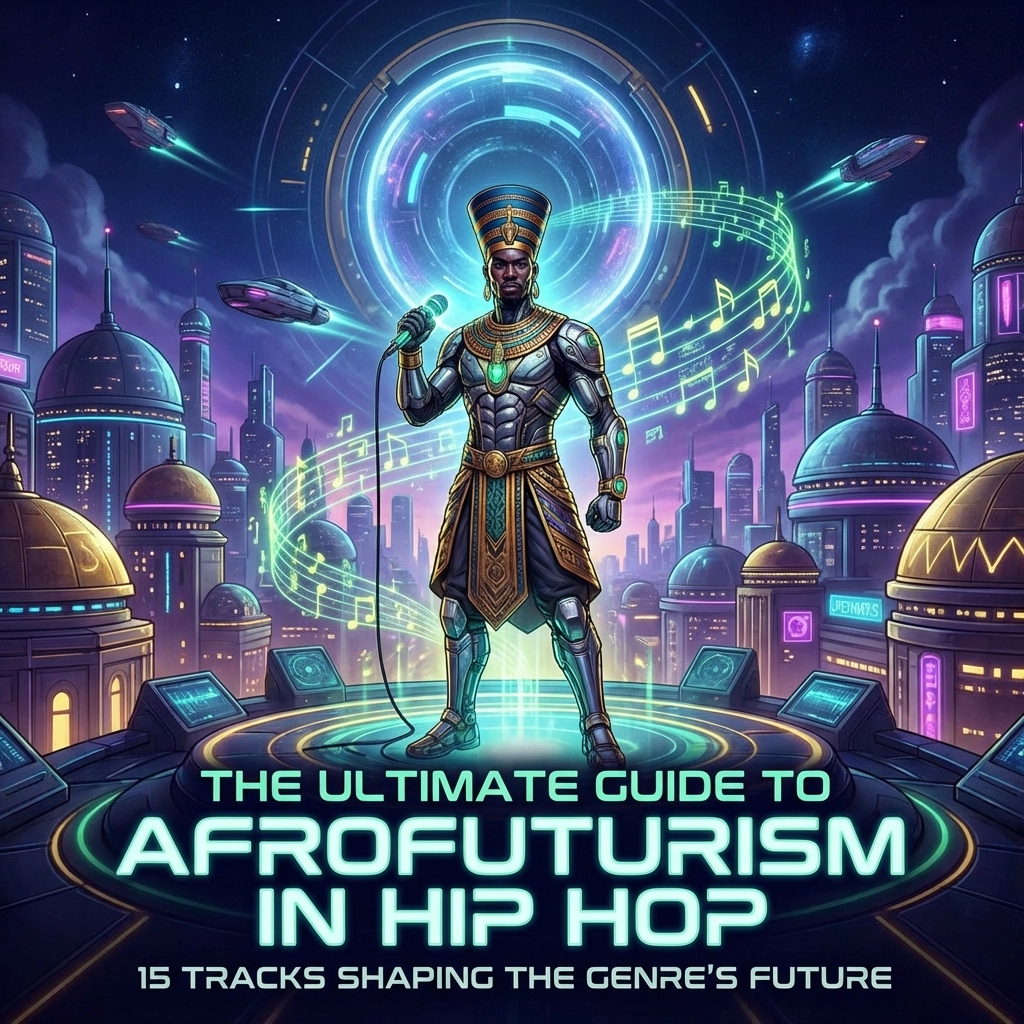
Picture this: spaceship funk meets conscious rap, where Black liberation meets intergalactic beats, and where the future isn’t just imagined: it’s soundtracked. That’s Afrofuturism in hip hop, and it’s been quietly revolutionizing the game for decades.
From Parliament-Funkadelic laying the groundwork to artists like Janelle Monáe and Flying Lotus pushing boundaries today, Afrofuturist hip hop isn’t just music: it’s a movement. It’s about reclaiming narratives, reimagining Black identity in space and time, and using technology as a tool for liberation rather than oppression.
The Pioneers: Building the Foundation
1. OutKast – “Elevators (Me & You)” (1996)
André 3000 and Big Boi didn’t just put the South on the map: they put it in orbit. This track’s futuristic production and otherworldly flow patterns established OutKast as the godfathers of Southern Afrofuturism. The elevator metaphor isn’t just about getting high; it’s about ascending to new dimensions of Black consciousness.
2. Digital Underground – “The Humpty Dance” (1990)
Before Tupac was changing the world, he was learning from Digital Underground’s playbook of eccentric, tech-savvy funk. DU’s cartoon-like personas and digital-age wordplay paved the way for hip hop’s more experimental side.
3. Kool Keith – “Earth People” (1996)
As Dr. Octagonecologyst, Kool Keith created one of hip hop’s wildest space odysseys. This track is pure alien funk: bizarre, brilliant, and completely unhinged in the best way possible.
4. Freestyle Fellowship – “Innercity Griots” (1993)
The Fellowship’s rapid-fire, stream-of-consciousness style felt like downloading information directly from the future. Their approach to rhythm and language as technology was decades ahead of its time.
The Modern Era: Expanding the Universe
5. Janelle Monáe – “Many Moons” (2008)
Monáe’s android persona and her exploration of freedom through sci-fi metaphors made this track essential Afrofuturist listening. The music video’s stark, metallic visuals redefined what Black futurism could look like in the digital age.
6. Flying Lotus feat. Kendrick Lamar – “Never Catch Me” (2014)
FlyLo’s cosmic production paired with Kendrick’s introspective bars created something transcendent. The track explores death, rebirth, and transformation through a distinctly Black spiritual lens wrapped in space-age sonics.
7. Death Grips – “Guillotine” (2011)
Aggressive, industrial, and completely uncompromising, Death Grips brought punk energy to Afrofuturist themes of resistance and rebellion against systems of control.
8. Shabazz Palaces – “An echo from the hosts that profess infinitum” (2011)
Palaceer Lazaro’s cryptic, cosmic poetry over otherworldly beats created a new template for experimental hip hop. This track feels like intercepting transmissions from a parallel universe.
9. clipping. – “Body & Blood” (2014)
Daveed Diggs and his producers created horror-core Afrofuturism, using noise, glitch, and power electronics to explore Black trauma and resilience through a sci-fi lens.
The Next Generation: Pushing Boundaries
10. Danny Brown – “Grown Up” (2013)
Brown’s helium-high delivery and apocalyptic production created a unique strain of post-internet Afrofuturism. His music feels like the soundtrack to a digital breakdown and rebirth.
11. Mykki Blanco – “High School Never Ends” (2012)
Blanco’s genre-fluid approach and exploration of identity through digital personas expanded Afrofuturism’s scope beyond traditional gender and sexual boundaries.
12. Open Mike Eagle – “Dark Comedy Morning Show” (2014)
Eagle’s art-rap approach and surreal humor created a more accessible entry point into experimental hip hop, proving Afrofuturism doesn’t always have to be serious to be profound.
13. JPEGMAFIA – “Baby I’m Bleeding” (2018)
Peggy’s sample-heavy, glitch-filled production style feels like the internet itself having an existential crisis. His music captures the chaos and possibility of living in the digital age.
14. Saba feat. Smino – “LIFE” (2018)
This collaboration brought Afrofuturist themes to a more mainstream audience, blending cosmic production with deeply personal storytelling about Black life and survival.
15. Little Simz – “Selfish” (2021)
Simz’s cinematic approach and her exploration of self-discovery through cosmic metaphors represent the global expansion of Afrofuturist hip hop beyond American borders.
What Makes Afrofuturism in Hip Hop Unique
Sound: Technology as Liberation
Afrofuturist hip hop doesn’t just use technology: it reimagines what technology can do for Black communities. Synthesizers, drum machines, and digital effects aren’t just tools; they’re instruments of transformation. Artists use these sounds to create sonic worlds where Black people aren’t just surviving: they’re thriving, evolving, and exploring new possibilities.
The production often features:
- Layers of synthesizers creating ethereal, spacey atmospheres
- Chopped-up samples that deconstruct and reconstruct reality
- Drum patterns that feel both futuristic and rooted in Black musical tradition
- Vocal effects that suggest transformation or otherworldliness
Visuals: Reclaiming the Future
From OutKast’s silver space suits to Janelle Monáe’s android aesthetic, Afrofuturist hip hop has always been deeply visual. These artists use fashion, music videos, and album art to create alternative realities where Black identity isn’t limited by current social constraints.
The imagery often includes:
- Metallic and space-age clothing
- Cosmic and otherworldly settings
- Technology that serves rather than oppresses
- Black bodies reimagined in powerful, futuristic contexts
Message: Liberation Through Imagination
At its core, Afrofuturist hip hop is about freedom: freedom from current limitations, freedom to imagine better futures, and freedom to exist outside the narrow boxes society creates. These artists use science fiction, fantasy, and cosmic themes to explore very real issues of racism, identity, and resistance.
Why This Matters for Hip Hop’s Future
Afrofuturism in hip hop isn’t just a cool aesthetic choice: it’s a necessary evolution. As our world becomes increasingly digital and globalized, these artists are showing us how to maintain our humanity while embracing technological change. They’re proving that the future doesn’t have to look like the dystopias we’re often sold in mainstream media.
For fans listening on Hot Mic Radio, this represents the cutting edge of where hip hop culture is heading. These artists aren’t just making music; they’re creating blueprints for how Black art and identity can evolve in the digital age.
The beauty of Afrofuturist hip hop is that it refuses to accept limitations. It says: why can’t Black people be astronauts, androids, time travelers, and cosmic beings? Why can’t our music sound like the future instead of being stuck in the past? Why can’t we use technology to enhance our humanity instead of replacing it?
These 15 tracks represent just the beginning of a movement that’s reshaping not just hip hop, but how we think about Black identity, technology, and the future itself. From the pioneering work of OutKast to the boundary-pushing experiments of today’s artists, Afrofuturism continues to expand the possibilities of what hip hop can be.
As we move deeper into the digital age, expect these themes and sounds to become even more relevant. The future of hip hop isn’t just Black; it’s cosmic, transformative, and unlimited in its possibilities.


Post comments (0)