



Chopped and screwed is a remix technique built on two moves: slowing a song’s tempo way down (“screwing”) and manually repeating or cutting phrases for emphasis (“chopping”). DJ Screw, born Robert Earl Davis Jr., pioneered the style in early 1990s Houston, turning it into a mixtape economy that reshaped Southern rap for good. We’re breaking down exactly how that happened.
TL;DR:
- A real screw mix slows tracks to roughly 60–70 beats per minute and adds live repeats with a crossfader; digital versions usually omit them.
- The 1998 storefront gave the Screwed Up Click a base; individually dubbed gray tapes paired local freestyles with instrumentals and often introduced new crew material.
- Biographers and Houston archives describe Screw’s style as deliberate turntable innovation, not a byproduct of lean culture, despite the circles’ overlap.
- Changing a commercial song’s tempo or pitch does not transfer ownership; Screw tapes often used uncleared instrumentals, so altered versions still raise copyright concerns.
Table of Contents
- How DJ Screw and the Screwed Up Click built a Houston institution
- The tools and tempo behind screwing and chopping
- Meet the people who built the Screwed Up Click
- How chopped and screwed spread past Houston and split into new forms
- Why the lean association misses the real story
- The throughline from Houston mixtapes to modern production
- What the University of Houston archives reveal
- Where mixtapes and copyright law actually stood
- Why we keep this history in rotation
- FAQ
- Sources
How DJ Screw and the Screwed Up Click built a Houston institution
Robert Earl Davis Jr. started DJing as a teenager, but the sound that would carry his name didn’t show up overnight. According to University of Houston’s archival exhibit, Screw spent the early 1990s experimenting with turntable techniques in his bedroom, slowing records down and chopping phrases until he landed on something nobody else in Houston was doing. He started handing out tapes to friends. Word spread fast.
By the mid-90s, demand outpaced what one guy with a four-track and a dual cassette deck could handle. People were driving across town just to get the latest tape. So in 1998, Screw opened Screwed Up Records and Tapes, a storefront that turned his bedroom hustle into a real operation. That move mattered. It gave the Screwed Up Click, the loose crew of rappers and friends who recorded freestyles over his mixes, a home base and a release valve for new material almost every week.
The grey tapes (named for their blank, handwritten labels) became the currency of Houston street rap:
- Screw dubbed each tape individually, which meant no two copies sounded exactly alike.
- Local rappers freestyled over existing instrumentals, turning the tapes into audition reels for the whole S.U.C. roster.
- Fans lined up outside the store on release days, sometimes before sunrise.
- The tapes functioned as both mixtapes and compilation albums, years before that model went national.
During his lifetime, Screw released four studio albums: All Screwed Up, 3 ‘N The Mornin’ (Part One), 3 ‘N The Mornin’ (Part Two), and I Wanna Get High with Da Blanksta, according to University of Houston’s collection notes. The 3 ‘N The Mornin’ series in particular pushed the sound past Houston’s city limits and gave outsiders their first real taste of what screw tapes actually sounded like.
The tools and tempo behind screwing and chopping
Screwing and chopping are two separate techniques that Screw fused into one signature style, and understanding the mechanics explains why nothing else sounds quite like it. Here’s the breakdown:
- Screwing slows a track’s tempo, generally down to roughly 60 to 70 beats per minute according to Wikipedia’s technical overview, which also drops the pitch and gives vocals that underwater, molasses quality.
- Chopping layers in manual repeats, stutters, and stop-time breaks, created by cutting back and forth between two copies of the same record on the crossfader.
- Pitch manipulation happened on vinyl first, using a turntable’s pitch control to nudge one copy of a record ahead of or behind the other, then dubbing the blend to cassette.
- Four-track processing let Screw slow the cassette dub even further after the initial mix, stacking tempo drops in layers rather than one single pass.
This is a fundamentally different process from the modern “slowed and reverb” trend, which usually applies a digital pitch-and-tempo plugin to an entire track in one pass with no live chopping, no crossfader work, and no hands-on repetition. The original method was physical labor: two turntables, a mixer, a steady hand, and hours of trial and error, as Screw’s archival finding aid documents in detail.
Pro Tip: If you want to hear the difference instantly, compare any modern slowed-and-reverb remix to an original grey tape. The reverb version smooths everything into one wash; a real screw tape still has texture, stutters, and live edits you can actually point to.
Meet the people who built the Screwed Up Click
DJ Screw didn’t build this sound alone, and the S.U.C. roster is where the Houston scene found its voice. Each member brought something different to the tapes, and together they turned freestyle sessions into a regional sound with staying power.
- Fat Pat became one of the most recognizable voices on the tapes before his death in 1998, with a flow that fit perfectly over Screw’s slowed productions.
- Lil’ Keke helped define the laid-back, conversational delivery that became a signature of the Houston style and carried it into his own solo career.
- Big Pokey brought a deeper, grittier tone to the crew and stayed active in Houston rap well beyond the S.U.C.’s early years.
- Big Moe blended singing and rapping on the tapes, a move that widened the sound’s appeal and influenced how melody got used in Southern rap.
- HAWK (Big Hawk) was both a performer and one of the people who helped keep the S.U.C.’s legacy intact after Screw’s death.
- Lil’ Flip came up through the same orbit and went on to have one of the biggest mainstream crossover careers of anyone connected to the original scene.
Beyond the S.U.C. itself, DJs like Michael “5000” Watts and OG Ron C picked up the technique and carried it forward, releasing their own chopped and screwed series and keeping the style alive for a new generation of listeners who never got to hear an original grey tape in person.
How chopped and screwed spread past Houston and split into new forms
Before streaming existed, this sound traveled the hard way: on cassette, then on burned CDs, then through early peer-to-peer file sharing once the internet caught up. College radio shows and touring DJs carried the aesthetic to other Southern cities, and by the 2000s it had become a reference point far beyond Texas.
- Regional DJs in other Southern markets adapted the technique for their own local mixtapes and freestyle scenes.
- File-sharing networks in the early 2000s put digitized screw tapes in front of listeners who’d never set foot in Houston.
- The “slowed and reverb” trend that exploded on streaming platforms borrows the tempo drop without the hands-on chopping, a simplified descendant rather than a direct continuation.
- Phonk producers folded screwed vocal samples into a harder, more aggressive production style popular in online hip-hop subcultures.
- Mainstream artists outside Houston have referenced the slowed aesthetic in guest verses and production choices, often stripping away the original mixtape context in the process.
That last point matters. Once the technique left Houston, it stopped being tied to a specific community, a specific store, and a specific crew of rappers, and started functioning more like a generic effect.
Why the lean association misses the real story
Chopped and screwed got tied to codeine-based “lean” culture early on, partly because some of the same Houston circles overlapped with both. But biographers and archivists push back hard on treating that association as the origin story. Lance Scott Walker’s biography of DJ Screw frames the technique as deliberate technical innovation built from turntable skill, not a byproduct of drug use, and draws on firsthand interviews with people who watched Screw work.
Archival sources at the University of Houston make a similar point: the mixtape economy and the specific hardware Screw used explain the sound far better than any drug narrative does. When the aesthetic spread nationally and globally, something else happened too: scholars describe a kind of identity laundering, where mainstream use of the slowed sound strips away its specific Houston, Black, working-class roots and turns it into a mood or an effect with no attached history.
The throughline from Houston mixtapes to modern production
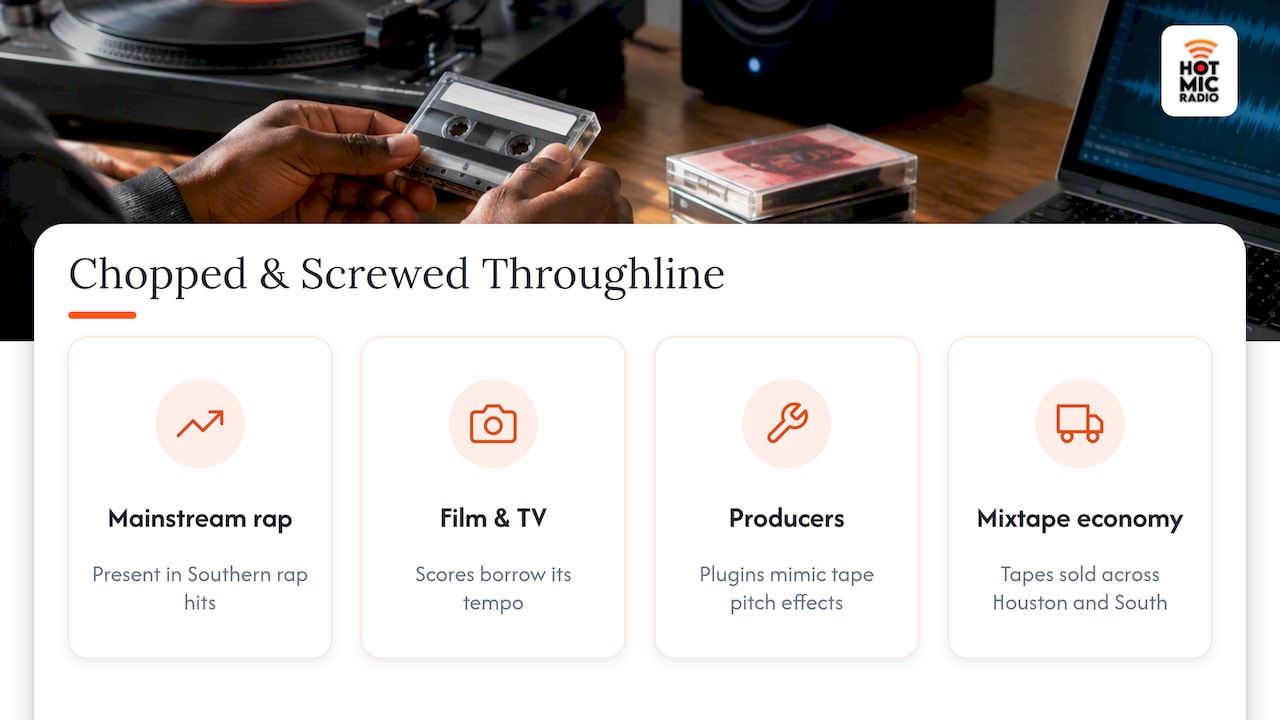
The chopped and screwed influence shows up everywhere from Southern rap’s biggest mainstream moments to film and television scoring choices that borrow its tempo and texture. Artists across genres have used slowed interludes or screwed hooks as a direct nod to the Houston tradition, and producers working digitally now chase that same molasses feel with plugins built to mimic tape pitch effects. Tools like those covered in guides on bending pitch with delay to mimic tape machines exist precisely because producers still want that analog warble without owning two turntables and a crossfader.
The screw tape catalog remains one of the most cited examples of a regional mixtape economy that reshaped a national genre, according to University of Houston’s archival finding aid, which notes that Screw’s tapes sold widely across Houston and the broader South and that 3 ‘N The Mornin’ became commercially significant well beyond the local scene.
The legacy isn’t just sonic. It’s structural: the idea that a DJ could build an entire local industry around homemade tapes, sold out of a single storefront, is a blueprint that independent artists still study today.
What the University of Houston archives reveal
The University of Houston’s digital collections hold photographs, handwritten lyric sheets, master screw tapes, flyers, and obituary materials tied to DJ Screw and the Screwed Up Click. Family donations helped build out the collection, and the materials have supported public exhibits as well as academic research into the scene’s history.
These primary sources do more than confirm dates. Handwritten set lists and flyers show how often Screw and the S.U.C. were recording and performing, correcting the popular assumption that the whole operation ran casually. The paper trail points to something closer to a disciplined, fast-moving local business, built years before anyone called mixtapes a format worth studying.
DJ Screw was found dead on November 16, 2000, with autopsy findings citing a combination of codeine promethazine and other substances, according to University of Houston’s archival records. That documented fact sits alongside, not in place of, the technical record the archives preserve.
Where mixtapes and copyright law actually stood
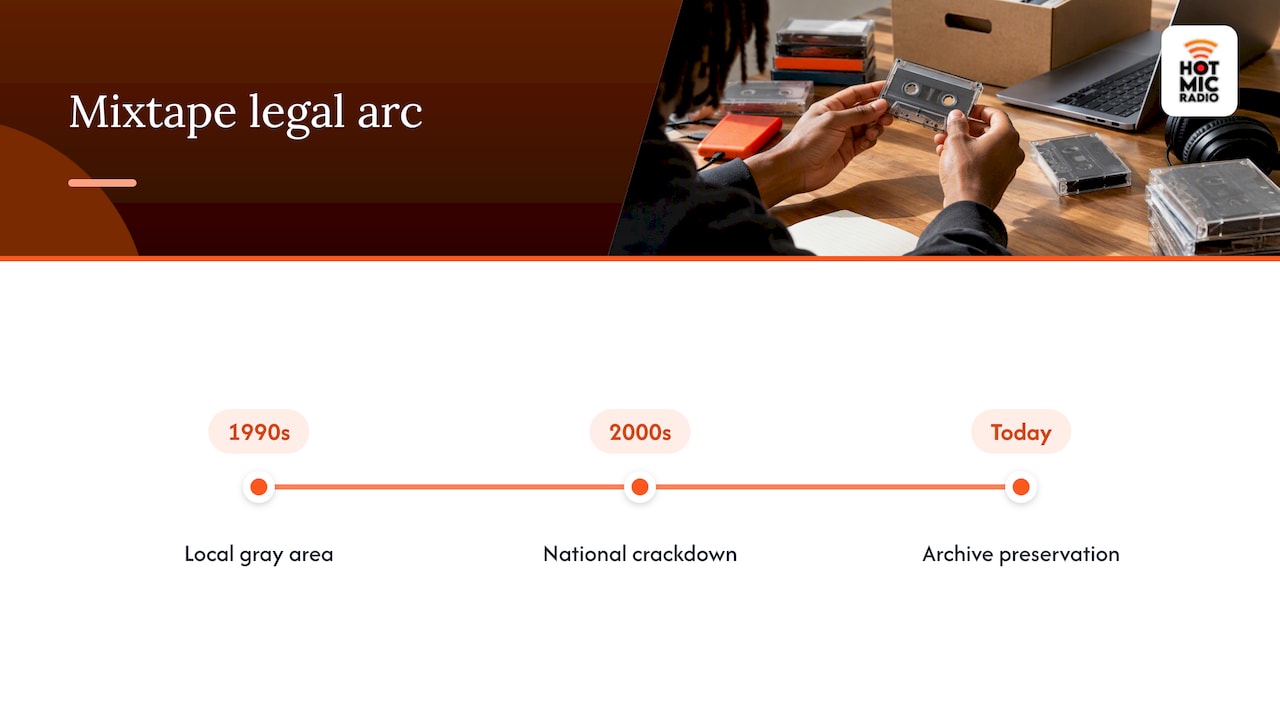
Screw tapes operated in a legal gray area that most of the mixtape era shared: the instrumentals rappers freestyled over were rarely cleared, and the tapes themselves were sold directly out of the store without major-label involvement. That business model worked because enforcement was inconsistent and because the tapes functioned more like local word-of-mouth marketing than mass-market product.
That gray area didn’t last forever. As mixtape culture scaled up nationally in the 2000s, labels and rights holders got more aggressive about enforcement, and plenty of mixtape DJs elsewhere in the country faced legal pressure or shutdowns for uncleared samples. Chopped and screwed versions of commercial songs raise the same basic copyright questions as any unauthorized remix: altering tempo and pitch doesn’t change who owns the underlying composition or recording. The legal exposure around mixtape culture is a big part of why so much of this history survives only through archives and firsthand accounts rather than commercial reissues, since many original tapes were never formally cleared for wide redistribution.
Why we keep this history in rotation
We built Hot Mic Radio around the idea that regional scenes deserve real curation, not just a footnote in a bigger playlist. That’s why our programming makes room for the kind of regional hip-hop storytelling that explains where a sound came from, not just what it sounds like now, the same approach we bring to deep dives like our Bay Area hyphy history coverage.
Live DJs matter here because a human behind the mix catches the context an algorithm skips. If you want to hear that philosophy in action, our classic hip-hop archives and broader Hip-Hop and R&B programming are built to connect those dots for you.
— Hot Mic Radio Team
FAQ
Where did the term “chopped and screwed” come from?
The term combines the two techniques involved: “screwed” refers to slowing a track’s tempo and pitch, while “chopped” refers to manually repeating or cutting phrases. The name traces directly back to DJ Screw, whose nickname and technique gave the style its label in early 1990s Houston.
Who originated chopped and screwed?
DJ Screw, born Robert Earl Davis Jr., originated the technique in Houston in the early 1990s, according to University of Houston’s archival exhibit. He later opened Screwed Up Records and Tapes in 1998 to meet demand for his mixtapes and built a crew, the Screwed Up Click, around the sound.
How was DJ Screw found dead?
DJ Screw was found dead on November 16, 2000, with an autopsy citing a combination of codeine promethazine and other substances, according to University of Houston’s archival records. Biographers and archivists stress that his technical innovation, not drug culture, should anchor his legacy.
What rapper doesn’t cuss?
This question isn’t addressed by the sources behind this history of chopped and screwed music, and attaching a specific name here would go beyond what we can verify. If you’re curious about clean-lyric artists in Hip-Hop broadly, that’s a separate topic from the Houston screw scene covered in this piece.
Sources
- DJ Screw · Brothers in Rhyme: Fat Pat, Big Hawk, and the Screwed Up Click · University of Houston
- DJ Screw Photographs and Memorabilia // Digital Collections
- DJ Screw (book) — UT Press
- DJ Screw Collection | University of Houston Libraries (finding aid)

