



Cultural music exchange is the collaborative creation and sharing of music across cultural boundaries, blending distinct traditions into new hybrid sounds that strengthen global understanding. Organizations like the British Council and the Beijing Enlai Foundation actively fund and organize these exchanges, proving that music diplomacy is a serious, structured field. The best examples of cultural music exchange show how artists from opposite ends of the world can sit in the same room, listen hard, and create something neither could have made alone. At Hot Mic Radio, we live this truth every day. Hip-Hop and R&B are themselves products of cross-cultural musical influences, built from African rhythms, blues, jazz, and gospel colliding on American soil.
1. What are the most impactful examples of cultural music exchange?
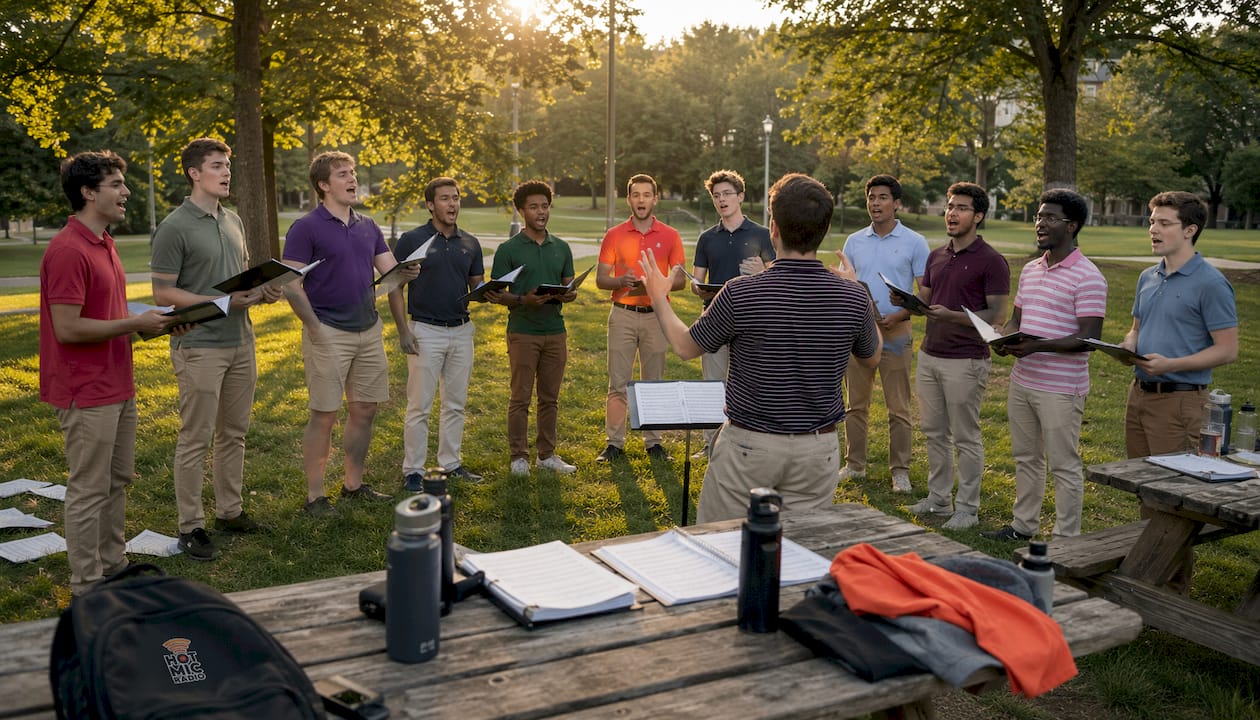
The Yale Whiffenpoofs choir tour of China stands as one of the most vivid recent examples of cross-cultural musical collaboration. Organized by the Beijing Enlai Foundation, the tour ran from march 19 to april 3, 2026, covering six cities over 16 days. The choir performed alongside local Dong ensembles in Guizhou, blending Western choral harmonies with the Dong people’s polyphonic singing tradition. That kind of side-by-side performance is where real exchange happens, not in a lecture hall.
The British Council funded a three-year project that brought Irish and Iraqi musicians together to blend traditional Irish melodies with Middle Eastern performance styles. The project culminated at Celtic Connections festival in the UK, one of the world’s premier folk and roots gatherings. Three years of development produced something neither community could have rushed. The patience of that process is the point.
During the China-Brazil Year of Culture in april 2026, the Copacabana Fort Orchestra performed in Nanning, China. The orchestra blended Brazilian classics with traditional Chinese songs, including a stage collaboration with local children at the regional Sanyuesan festival. That image of Brazilian musicians playing alongside Chinese kids at a local festival tells you everything about what music exchange can do at its best.
- Yale Whiffenpoofs and Dong choir: Western choral meets Chinese polyphony across six cities
- Irish-Iraqi collaboration: Three years of work blending Celtic melody with Middle Eastern modes
- Copacabana Fort Orchestra in Nanning: Brazilian and Chinese repertoires shared on the same stage
- Celtic Connections festival: A recurring platform where global traditions meet live audiences
Pro Tip: When researching music exchange programs, look for projects with multi-year timelines. Single-concert collaborations rarely produce the depth of fusion that sustained partnerships achieve.
2. How does creative negotiation shape new musical forms?
Creative negotiation is the process by which musicians from different traditions make careful, deliberate decisions about which elements to share, adapt, or protect. It is not a simple mashup. It requires artists to weigh rhythm, instrumentation, lyrical content, and sociocultural meaning before combining them. Missteps happen when traditions get treated as aesthetic commodities rather than living expressions of identity.
Jordi Savall’s “Mare Nostrum” project is the clearest working model of this process in the classical world. The project fuses Western early music with Eastern Arab maqam modes, using multilingual texts and dialogic musical juxtaposition. Savall’s approach centers on universal affects like the lament to create shared emotional ground before any technical blending begins. That sequencing matters. You build the emotional bridge first, then the musical one.
“Music acts as a cultural bridge not by erasing differences but by conscientiously translating and negotiating distinct identities into collaborative expressions. The lament, the cry, the longing — these are human before they are cultural.”
Insight drawn from research on intercultural competence in cross-cultural music projects
The Irish-Iraqi collaboration demonstrates this negotiation in practice. Irish uilleann pipes and Iraqi maqam scales do not naturally share a key or a scale system. The musicians spent years learning each other’s tuning systems, performance gestures, and emotional vocabularies before writing a single collaborative piece. That is creative negotiation at its most serious.
3. What role do music exchange programs and festivals play?
Structured music exchange programs do something that casual listening cannot. They place artists inside each other’s cultural environments, forcing embodied practice rather than surface observation. Embodied practice means learning a tradition through physical gesture, language, social context, and daily life, not just sheet music. That depth produces authentic fusion rather than imitation.
Live festivals function as the public face of this work. Celtic Connections, the Sanyuesan festival, and similar events create shared spaces where audiences participate in cultural exchange alongside the artists. The audience’s presence matters. A crowd that includes both Irish folk fans and Iraqi diaspora listeners changes what the music means in real time.
| Exchange format | Primary benefit | Example |
|---|---|---|
| Immersive residency | Deep cultural learning through daily practice | Yale Whiffenpoofs in Guizhou |
| Festival performance | Broad audience reach and shared experience | Celtic Connections, Sanyuesan |
| Multi-year partnership | Sustained creative development | Irish-Iraqi British Council project |
| Digital collaboration | Speed and global scale | Online hybrid genre production |
Digital platforms have accelerated the pace of cultural music exchange dramatically. Streaming services and social media now enable instant international collaborations that produce hybrid genres and reach global audiences without a single flight booked. That speed is a gift and a risk. Fast exchange can skip the embodied practice that makes deep fusion possible.
- Residency programs give artists time to absorb a tradition before performing it
- Festival stages create collective participation that deepens cultural understanding
- Digital tools expand access but require intentional depth to avoid surface-level exchange
- Cultural year programs like the China-Brazil initiative use state support to fund large-scale live events
Pro Tip: If you want to experience music exchange firsthand, look for music festivals that program multi-day artist residencies alongside public performances. The residency component is where the real work gets done.
4. Can cultural music exchange preserve identity while driving innovation?
Music exchange preserves cultural identity best when artists treat their own tradition as non-negotiable before entering collaboration. The Dong choir in Guizhou did not abandon their polyphonic style to accommodate the Yale Whiffenpoofs. They performed it alongside Western choral harmony, letting both traditions stand. That parallel structure is a model worth studying.
The tension between preservation and innovation is real, but it is productive. Immigrant communities demonstrate this balance every day. A Nigerian musician living in London carries Afrobeats rhythms into UK grime sessions, producing something new without erasing either source. Music connects communities precisely because it can hold multiple identities at once without forcing a choice.
Situational context shapes how exchange lands. The same collaboration performed in Lagos, London, and Lagos again will produce three different audience experiences. Place, tradition, and audience expectation all filter the meaning of the music. Authentic exchange accounts for that variation rather than flattening it into a single global product.
Pro Tip: When evaluating a cultural music collaboration, ask whether both traditions are audibly present in the final product. If one tradition disappears, that is assimilation, not exchange.
Key takeaways
Authentic cultural music exchange requires embodied practice, creative negotiation, and sustained time. Surface-level collaboration produces imitation; deep partnership produces genuinely new musical forms that honor both source traditions.
| Point | Details |
|---|---|
| Embodied practice is non-negotiable | Musicians must immerse in each other’s cultural environments, not just study recordings. |
| Creative negotiation takes time | Multi-year projects like the Irish-Iraqi collaboration produce deeper fusion than single events. |
| Festivals amplify exchange | Live events create shared audience experiences that extend the impact beyond the artists. |
| Identity and innovation coexist | The strongest exchanges keep both traditions audibly present rather than blending them into one. |
| Digital tools expand reach | Streaming and social media accelerate exchange but cannot replace in-person cultural immersion. |
What we’ve learned from years inside the music
Here at Hot Mic Radio, we have a specific take on cultural music exchange that most think pieces miss. People talk about it like it is a diplomatic exercise, something that happens in concert halls with government funding and press releases. But the most powerful exchanges we have witnessed happen in the informal spaces. A producer from Atlanta sampling a Fela Kuti record at 2 AM. A Houston rapper building a hook over an Afrobeats drum pattern because it felt right. That is exchange too, and it is happening constantly.
The uncomfortable truth is that Hip-Hop has always been a vehicle for cultural identity and exchange, often without anyone calling it that. West African percussion, Caribbean sound system culture, Puerto Rican DJ techniques, and Southern blues all fed into the same New York block party. No British Council grant required. The exchange was driven by proximity, necessity, and the shared desire to make something that hit.
What formal programs get right is documentation and intentionality. The Yale-Dong collaboration was recorded, studied, and shared. That matters for preservation. But the energy, the reason people keep doing this across every culture and every era, comes from something simpler. Music feels good when it connects. That is the whole story.
— Hot Mic Radio Team
Hot Mic Radio: where cultural fusion lives in every track
At Hot Mic Radio, we have been curating the sounds of cultural music blending since day one. Hip-Hop and R&B are the most documented examples of cross-cultural musical fusion in American history, built from dozens of global traditions colliding and creating something entirely new.
Our Hip Hop archives and R&B collections are living proof of what happens when cultures share their sound. Every track in our rotation carries the fingerprints of multiple traditions. Tune in and hear the exchange in real time. This is not a history lesson. This is the culture, live and uncut, every single day.
FAQ
What is cultural exchange in music?
Cultural exchange in music is the collaborative process where musicians from different traditions share, blend, and adapt each other’s sounds, instruments, and performance styles. The goal is mutual learning and creative innovation, not replacement of one tradition by another.
What makes a music exchange program successful?
Successful music exchange programs combine sustained time, embodied cultural immersion, and creative negotiation. Projects like the three-year British Council-funded Irish-Iraqi collaboration show that depth requires years of development, not a single performance.
How do music festivals support cultural exchange?
Live music festivals create shared spaces where artists and audiences from different backgrounds participate in cultural dialogue together. Events like Celtic Connections and the Sanyuesan festival in China serve as essential platforms for this kind of public exchange.
How does digital technology affect cultural music exchange?
Digital platforms accelerate the speed and scale of exchange by enabling instant international collaborations and global audience reach. The risk is that fast digital exchange can skip the embodied practice that produces genuine cultural fusion rather than surface-level borrowing.
Is Hip-Hop an example of cultural music exchange?
Hip-Hop is one of the clearest examples of cultural music exchange in modern history. It draws from West African percussion, Caribbean sound system culture, Puerto Rican DJ techniques, and American blues, fusing them into a genre that continues to absorb and reflect global music traditions worldwide.


Post comments (0)