
Streaming radio is a continuous, curator-led live audio broadcast delivered over the internet instead of AM or FM frequencies — and if you’re a Hip-Hop or R&B head, it’s the wave you need to be riding right now. Unlike on-demand apps that hand the aux cord to an algorithm, streaming radio puts a real human DJ in the driver’s seat. Stations like Hot Mic Radio program the vibe, set the energy, and keep the culture moving. Licensing bodies like SoundExchange handle royalty collection on the digital side, while aggregators like TuneIn let you pull up any station from your phone or smart speaker. Whether you’re here to listen, submit your music, or place an ad in front of a locked-in audience, this guide breaks it all down.
Core elements at a glance:
- Hot Mic Radio — curated Hip-Hop, R&B, Afrobeats, and more, with live DJ sets
- SoundExchange — collects and distributes digital performance royalties for U.S. streaming stations
- TuneIn — one of the most widely used aggregators for finding and streaming internet radio stations
Table of Contents
- How does streaming radio actually work?
- How is streaming radio different from on-demand and podcasts?
- Why Hip-Hop and R&B listeners are coming back to curated radio
- Why advertisers value streaming radio — and how ad formats work
- How artists can get featured on a streaming radio station
- U.S. licensing and royalties: what stations owe and what artists earn
- How to tune in across every device you own
- What metrics tell you if a streaming station is performing
- Key Takeaways
- Why curation beats the algorithm every time
- Hotmicradio: listen, advertise, and submit your music
- Useful sources and next steps
How does streaming radio actually work?
The technical chain is simpler than it sounds. A DJ or host records or broadcasts live audio, which gets encoded into a compressed digital format and pushed to a streaming server. That server sends the audio out over the internet, and your app or browser buffers a small chunk before playback begins. The result: music in your ears within seconds, from anywhere on the planet.
The most common audio codecs used are MP3, AAC, and Ogg/Opus, delivered over standard HTTP or HTTPS. Each codec compresses audio differently, and stations typically offer multiple bitrate tiers to accommodate different data needs and listening preferences. Choosing a lower bitrate on mobile saves data without killing the vibe too much.
One thing to know: there’s always a 1–5 second delay between the studio and your speakers. That’s just the encoding and buffering process doing its job. It’s not a glitch — it’s architecture.
Pro Tip: If you’re on a shaky mobile connection, drop to a lower bitrate stream first — understanding seamless flow with smooth music transitions can make all the difference. Most stations offer a 64kbps or 128kbps option that buffers far less than a high-quality stream on spotty 4G.

How is streaming radio different from on-demand and podcasts?
Short answer: control, curation, and community. Streaming radio is linear and shared — everyone tuned in hears the same song, the same DJ drop, the same moment. On-demand platforms let you pick every track. Podcasts are pre-recorded episodes you download or stream on your own schedule. Three totally different listening experiences, three different ad strategies.

| Feature | Streaming Radio | On-Demand Streaming | Podcasts |
|---|---|---|---|
| Content flow | Continuous, scheduled, live | User-controlled, any time | Episodic, downloadable |
| Curation | Human DJ or programmer | Algorithm or personal playlist | Host-produced episodes |
| Shared moments | Yes — simultaneous listening | No | No |
| Ad placement | Pre-roll, mid-roll, host-read | Inserted or skipped | Host-read, dynamically inserted |
| Discovery | DJ-driven, surprise-based | Recommendation engine | Topic-driven search |
For a deeper look at how these formats stack up for Hip-Hop fans specifically, check out radio vs. streaming on the Hot Mic Radio blog. The short version: if you want to discover something new without doing the work, curated radio wins every time.
Why Hip-Hop and R&B listeners are coming back to curated radio
Algorithm fatigue is real. A 2025 industry overview confirmed a resurgence of interest among Millennials and Gen Z who are actively seeking human-led, discovery-based programming over algorithmic recommendations. When every playlist starts sounding the same, people go looking for a DJ who actually has taste.
Stat to know: Younger listeners are returning to curated streaming radio, driven by the desire for human programming and genuine music discovery — not just “more of what you already like.”
There are a few reasons this hits different for Hip-Hop and R&B fans specifically. The culture is too layered for an algorithm to get right. Regional scenes, underground artists, diaspora sounds — a machine doesn’t know what to do with that. A curated station does. Streaming radio also serves as active background for work or study, cutting decision fatigue because you never have to choose the next song. And for listeners in the diaspora, a station like Hot Mic Radio that programs Afrobeats, Dancehall, and Southern Soul alongside classic Hip-Hop is a genuine cultural connection that no algorithm replicates.
Why advertisers value streaming radio — and how ad formats work
Streaming radio delivers something rare: an audience that’s locked in and not scrolling. When a listener tunes into a live DJ set, they’re present. That attention is what advertisers are actually buying.
Key metrics you’ll hear in any streaming radio ad conversation:
- Average Concurrent Listeners (ACL) — how many people are tuned in at any given moment
- Listener Hours — total time the audience spends with the stream; the best proxy for brand exposure
- Impressions — how many times an ad is served
- eCPM — effective cost per thousand impressions; the standard pricing benchmark
- Completion Rate — the percentage of listeners who hear an ad through to the end
Common ad formats on curated stations include pre-roll spots (before the stream starts), mid-roll breaks (between songs or sets), and host-read sponsorships where the DJ delivers your message live. That last format is gold on a station with a loyal audience — the DJ’s credibility transfers directly to your brand.
Pro Tip: Keep audio spots to 30 seconds or under and align them with live show moments rather than generic rotation. A mid-roll during a live DJ set on Hot Mic Radio hits differently than a generic insertion between tracks — the audience is already hyped.
How artists can get featured on a streaming radio station
Radio still moves the needle for discovery. Live DJ curation creates moments that algorithms can’t manufacture — thousands of listeners hearing your track for the first time, together. Here’s how to put yourself in position:
- Prep your materials. Have a high-quality MP3 or WAV file, your ISRC code, a short artist bio (under 150 words), and links to your social profiles and streaming pages ready before you reach out.
- Write a tight submission message. One paragraph max: who you are, what the track sounds like, and why it fits the station’s programming. No essays.
- Target the right shows. On Hot Mic Radio, match your sound to the programming — Hip-Hop, Indie R&B, Neo-Soul, Afrobeats. Sending a Gospel track to a Hip-Hop show is a miss.
- Use the official submission portal. Hot Mic Radio has a DJ submission page built for exactly this. Use it. Cold DMs get lost.
- Follow up once, professionally. Give it two weeks, then send one polite follow-up. After that, let the music do the talking.
For a broader look at how online radio fits into an independent artist’s strategy, the online radio guide for artists on Hot Mic Radio is worth your time.
U.S. licensing and royalties: what stations owe and what artists earn
Every U.S. streaming radio station has legal obligations before it plays a single track. There are two separate rights to clear: performance rights (for the sound recording) and publishing rights (for the underlying composition). Different organizations handle each.
- SoundExchange — collects and distributes digital performance royalties for sound recordings. Stations pay SoundExchange; artists and labels get paid through it. If you’re an artist and you’re not registered, you’re leaving money on the table.
- ASCAP — a performing rights organization (PRO) that licenses the composition side for its member songwriters and publishers.
- BMI — another major PRO, covering a massive catalog of compositions across Hip-Hop, R&B, and beyond.
- SESAC — a smaller, selective PRO that also handles composition licensing for certain songwriters and publishers.
Stations typically hold blanket licenses from each PRO and report their playlists regularly for royalty calculation. Artists should register with SoundExchange and their chosen PRO to make sure payments route correctly.
Metadata is money. Accurate artist name, track title, and ISRC code at the point of submission are what connect a spin to a royalty payment. Missing or wrong metadata means delayed or lost payouts — for everyone in the chain.
This article is general information, not legal advice. Confirm current licensing requirements with SoundExchange, your PRO, or a qualified music attorney for your specific situation.
How to tune in across every device you own
Getting on Hot Mic Radio or any curated streaming station takes about thirty seconds. Here’s how:
- Station website — the simplest option. Hit play on the web player directly from your browser, no app needed.
- Mobile apps — look for the station’s dedicated app or use an aggregator. TuneIn carries thousands of internet radio stations and works on both iOS and Android.
- Smart speakers — ask Alexa or Google Assistant to play the station by name. Most major streaming stations have a skill or integration.
- In-car streaming — connect via Bluetooth, Apple CarPlay, or Android Auto and run the station’s app or TuneIn through your dashboard.
- Desktop browsers — Chrome, Safari, and Firefox all handle HTTP audio streams natively. No plugin required.
If you’re hitting buffering issues, drop to a lower bitrate stream first. If that doesn’t fix it, check your Wi-Fi signal or switch from cellular to Wi-Fi. The 1–5 second latency is normal and not the same as buffering — if the stream keeps stopping, it’s a connection issue, not the station.
What metrics tell you if a streaming station is performing
For stations and advertisers alike, raw listener counts are just the starting point. The numbers that actually matter:
- Average Concurrent Listeners (ACL) — the real-time audience size; what advertisers use to price inventory
- Unique Listeners — total individual tuners over a period; measures reach
- Listener Hours — cumulative time in-stream; the strongest indicator of audience engagement
- Impressions — ad serves; used for campaign delivery reporting
- Completion Rate — percentage of ads heard in full; listener hours and completion rate correlate most closely with brand recall on linear streams
- eCPM — the standard pricing metric for comparing ad inventory value across stations
Stations pull these from server logs and analytics dashboards, typically reported weekly or monthly. For advertisers running awareness campaigns, listener hours and completion rate are the metrics to watch. For direct-response buys, layer in any trackable action (promo code redemptions, URL visits) alongside those baseline numbers.
Key Takeaways
Streaming radio is a continuous, curator-led internet broadcast that delivers shared listening moments, human-programmed discovery, and measurable ad inventory — making it the most culturally connected format for Hip-Hop and R&B audiences.
| Point | Details |
|---|---|
| Streaming radio is curator-led | A human DJ programs the flow — no algorithm decides what plays next. |
| Licensing requires two rights | U.S. stations must clear performance rights (SoundExchange) and publishing rights (ASCAP, BMI, or SESAC). |
| Listener hours beat raw uniques | For ad campaign valuation, time-in-stream and completion rate are the strongest performance signals. |
| Artists need clean metadata | Accurate ISRC and track info at submission is what routes royalty payments correctly and fast. |
| Hot Mic Radio is the destination | For curated Hip-Hop, R&B, Afrobeats, and live DJ sets, Hot Mic Radio is where the culture lives online. |
Why curation beats the algorithm every time
Here’s our honest take: the conversation around streaming radio is almost always framed as “old format vs. new tech,” and that framing misses the point entirely. The real question isn’t whether internet radio can compete with on-demand platforms on convenience — it can’t, and it doesn’t need to. The question is what on-demand platforms fundamentally cannot do.
They cannot manufacture a shared moment. When thousands of listeners hear the same DJ drop the same record at the same time, that’s community. That’s culture moving in real time. An algorithm serving you a personalized playlist is, by design, a solo experience. There’s nothing wrong with that — but it’s a different thing. For Hip-Hop and R&B, genres built on collective experience, call-and-response, and regional identity, the curator-led format isn’t nostalgia. It’s the format that actually fits the music.
Advertisers who understand this stop buying streaming radio like it’s a cheaper version of a Spotify ad and start treating it like what it is: a direct line into a community that’s already paying attention.
Hot Mic Radio: listen, advertise, and submit your music
Hot Mic Radio is the curated alternative to algorithmic radio for Hip-Hop, R&B, and Black culture — live DJ sets, regional scene spotlights, and a full spectrum of sound from Afrobeats to Southern Soul, all in one place. No shuffle button, no “because you listened to” suggestions. Just real programming from people who live the culture.
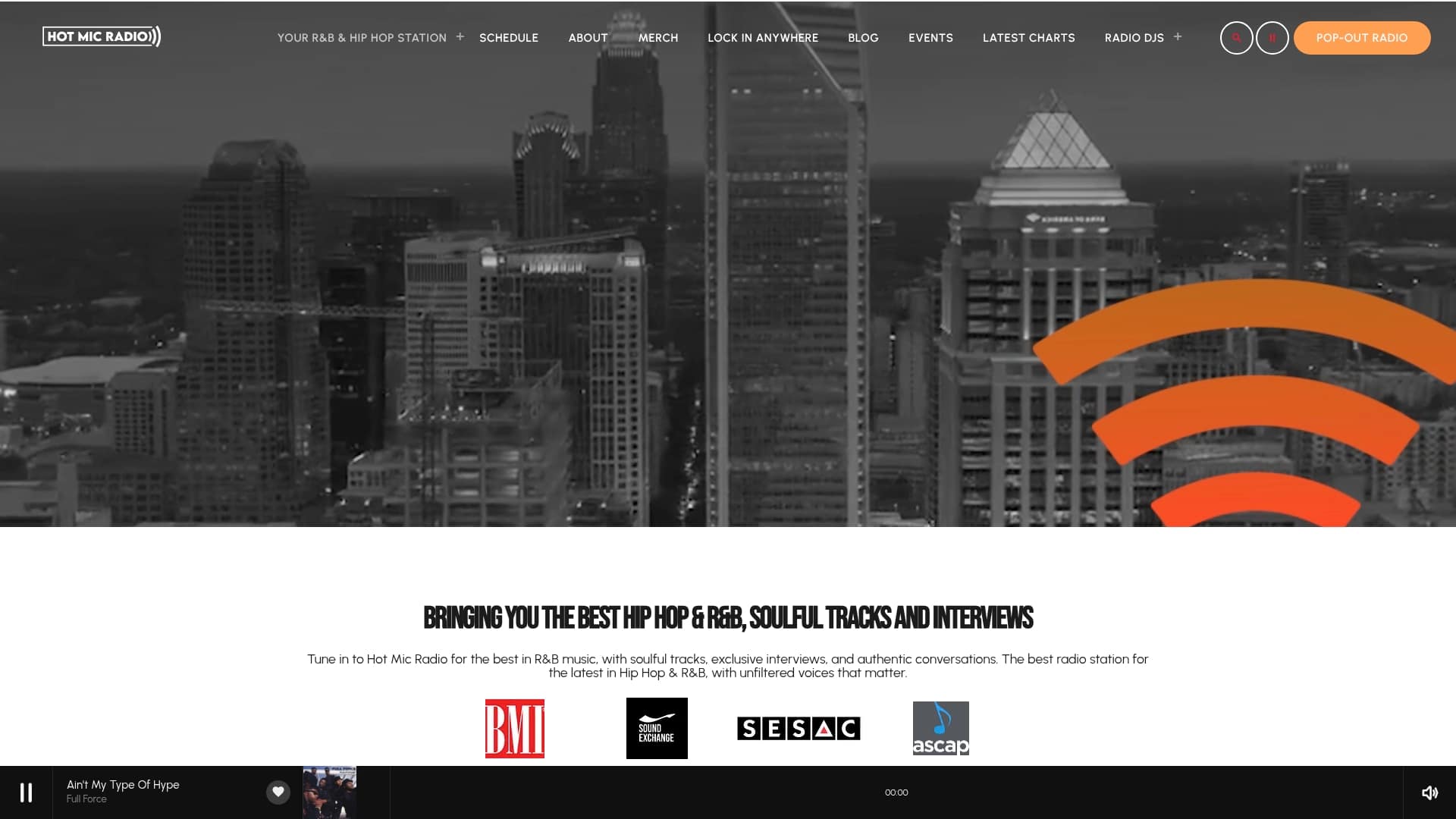
Listeners can pull up the Hip-Hop archives or the R&B show catalog right now and start vibing. Advertisers looking to reach a locked-in, culturally engaged audience can reach out through the site for sponsorship and ad placement details. Artists ready to get their music heard by a real DJ and a real audience can submit directly through the DJ submission portal. The culture is live — come be part of it.
Useful sources and next steps
Ready to go deeper? These are the authoritative resources worth bookmarking:
- SoundExchange — register as an artist or label to collect digital performance royalties; essential for any artist getting spins on U.S. streaming stations
- ASCAP — join as a songwriter or publisher to license your compositions and collect performance royalties
- BMI — the other major PRO; register your catalog and track royalty payments from streaming stations
- SESAC — selective PRO membership; worth researching if ASCAP or BMI isn’t the right fit for your catalog
- TuneIn — the go-to aggregator for finding and streaming internet radio stations across devices
- radio.co — Radio Streaming Breakdown — solid technical and business primer on how streaming radio works end-to-end
- Hotmicradio — online radio for music fans — publisher perspective on why internet radio still matters in 2026


Post comments (0)