


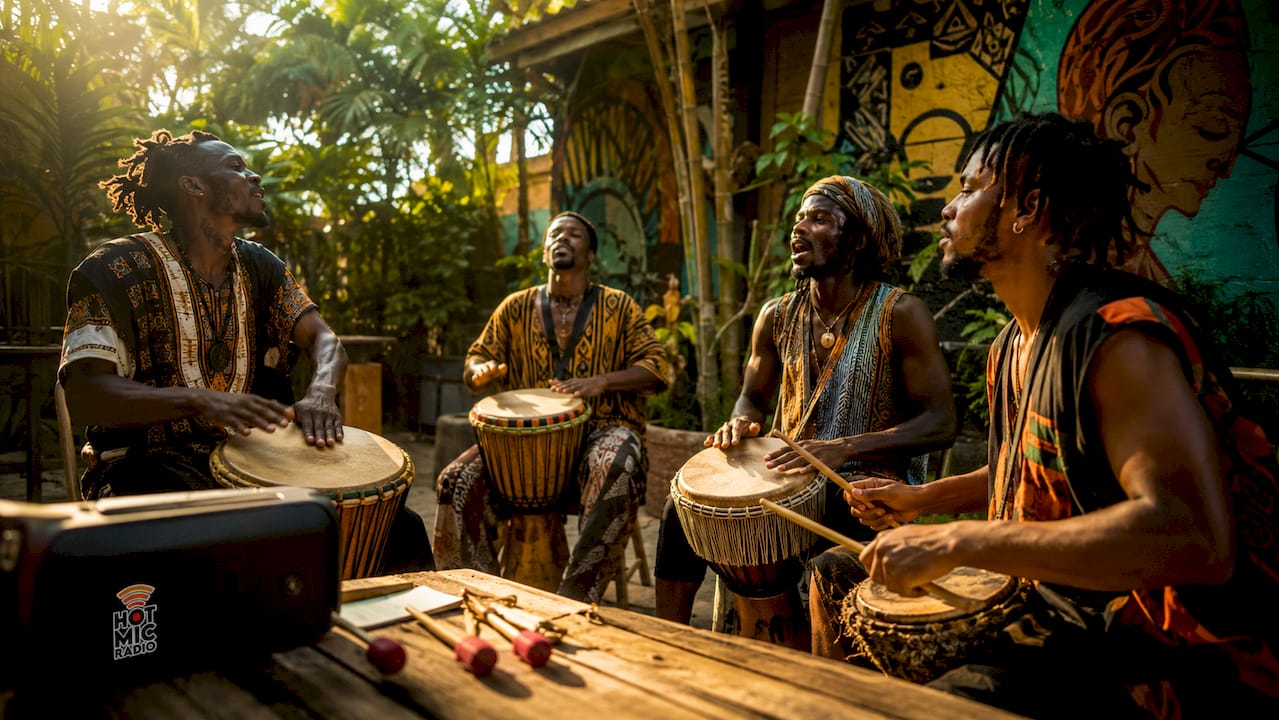
African music is the foundational DNA of rhythm and blues (R&B), contributing the polyrhythmic structures, call-and-response vocals, and improvisational spirit that define the genre’s soul. This is not a metaphor. The African rhythms that shaped modern music trace directly from West and Central African traditions through the diaspora into jazz, gospel, blues, and ultimately R&B. Understanding why African music influences R&B means tracing a living cultural thread, not a historical footnote. At Hotmicradio, we hear that thread every single day in the music we play and love.
Why African music influences R&B at its core
R&B’s most recognizable qualities, the groove, the vocal runs, the emotional rawness, come directly from African musical traditions. Three core elements made the journey across the Atlantic and never left.
- Polyrhythmic layering. West and Central African music stacks multiple rhythmic patterns simultaneously. That layered groove is the heartbeat of R&B production, from classic Motown to modern trap soul.
- Call-and-response. A lead voice makes a statement; the group or instrument answers. This pattern runs through gospel, blues, and straight into contemporary R&B ad-libs and backing vocal arrangements.
- Improvisation as storytelling. African communal music treated improvisation as a social act, not a performance trick. That tradition lives in every melismatic vocal run and freestyle moment in R&B.
- Music as a communal event. African diasporic traditions treated music as participation, not passive listening. R&B’s audience culture, the call-outs, the church energy, the crowd singing back, reflects that same communal design.
These traits were integrated into jazz, blues, and soul after the post-emancipation era, building the scaffolding that R&B would later inhabit. That is not a small contribution. That is the whole architecture.
Pro Tip: When you listen to an R&B track, isolate the percussion layer. If you hear two or more independent rhythmic patterns running at the same time, you are hearing polyrhythm, an African structural gift that never left the music.
How did African heritage historically evolve into modern R&B?
The path from African village music to American R&B is one of the most dramatic cultural journeys in human history. It moved through trauma, resistance, and creative genius at every stage.
-
African musical traditions survive the Middle Passage. Enslaved Africans brought rhythmic memory, vocal techniques, and communal music practices with them. These elements survived slavery by organizing labor, ceremony, and resistance. Music was a tool for survival, not entertainment.
-
Spirituals and gospel emerge as the first fusion. African rhythmic and vocal structures merged with Christian lyrical content in the American South. The result was the spiritual, a genre that carried African musical DNA inside a new cultural container.
-
Blues becomes the bridge. The blues formalized call-and-response into a song structure. It also preserved improvisation as a core value. Blues is where African musical instinct met American experience and produced something entirely new.
-
Port cities and diaspora hubs remix the formula. Caribbean and American port cities reworked African heritage into salsa, reggae, funk, and jazz. These exchange hubs fed back into American Black music, adding more layers to what would become R&B.
-
“Race music” becomes R&B. In the late 1940s, Billboard replaced the term “race music” with “rhythm and blues” as a marketing category. The name changed. The African roots did not.
The urban migration of the 20th century accelerated this evolution. Black Americans moving from the South to cities like Chicago, Detroit, and New York brought their music with them. Those cities gave it electricity, amplification, and a new audience. The cultural influence on R&B did not stop at the plantation or the church. It kept moving, kept fusing, and kept growing.
What is the impact of African R&B and Soft Afrobeats today?

The relationship between African music and R&B is not a one-way historical story. Right now, in 2026, a new chapter is being written. African R&B, also called Soft Afrobeats, is a globalized subgenre that blends traditional rhythms with R&B vocal styles using mid-tempo grooves built for emotional connection, not just the dance floor.
The numbers back this up. Afrobeats streams have spiked 550% since 2017. That is not a trend. That is a tectonic shift in global listening habits. Afrobeats generated $29.6 billion in total trade revenues globally in 2024, making the Sub-Saharan African music industry the fastest-growing market worldwide.
| Feature | Traditional R&B | Soft Afrobeats / African R&B |
|---|---|---|
| Tempo | Mid to uptempo | Mid-tempo, intentionally spacious |
| Vocal style | Melismatic, gospel-rooted | Breathy, emotionally intimate |
| Rhythmic base | Drum machine, live kit | Afro-percussion, layered grooves |
| Production mood | Soulful, dramatic | Airy, warm, emotionally close |
| Global reach | Primarily Western markets | Cross-continental streaming growth |

Modern production in this space favors “airy” and “spacious” grooves that prioritize vocal breath and emotional weight. Producers are intentionally using space as a sound design tool. That choice connects directly back to African musical philosophy, where silence and space carry as much meaning as the notes themselves.
Pro Tip: Check out Hotmicradio’s Afrobeats programming to hear how African R&B and Soft Afrobeats sound in real rotation alongside classic and indie R&B. The contrast and connection will hit you immediately.
How do industry factors shape African influence on R&B today?
The cultural momentum of African music in R&B is real. The business infrastructure supporting it is still catching up. Understanding both sides gives you the full picture.
-
Rapid revenue growth, uneven distribution. Africa is the fastest-growing music market globally, with over 20% revenue growth in 2025. Yet Africa remains the lowest-earning region for music royalties worldwide. Poor copyright enforcement and underdeveloped royalty systems mean African creators capture only a fraction of the revenue their influence generates.
-
Intentional globalization is accelerating. Artists and labels are moving from local consumption to global music rollouts with stronger teams and international partnerships. Nigerian artist Adekunle Gold represents this intentionality shift, building a global fanbase through deliberate touring and cross-market releases.
-
Streaming platforms are amplifying the reach. Mood-based playlist curation on major streaming platforms has directly aided the growth of African R&B. Algorithms that group music by feeling rather than geography have given African artists access to R&B listeners who might never have searched for them directly. Hotmicradio’s own look at streaming’s impact on reach shows how this dynamic plays out for Hip-Hop and R&B specifically.
-
Infrastructure gaps remain a real challenge. Harvard researchers have urged modernization of African music publishing and royalty collection systems to capture the genre’s full economic potential. Until those systems improve, the cultural influence of African music on R&B will outpace the financial returns flowing back to African creators.
The gap between cultural power and economic reward is the defining tension in African music’s global story right now. Closing that gap matters for the future of R&B itself, because the genre’s next evolution depends on African artists being resourced to keep creating.
Key Takeaways
African music shapes R&B through polyrhythmic structure, call-and-response vocals, and communal improvisation, a living inheritance that now drives a $29.6 billion global industry.
| Point | Details |
|---|---|
| African roots are structural | Polyrhythm, call-and-response, and improvisation are not stylistic choices in R&B. They are the genre’s foundation. |
| History is the through-line | Spirituals, gospel, and blues carried African musical DNA into R&B across centuries of cultural transformation. |
| Soft Afrobeats is the new chapter | African R&B blends traditional rhythms with emotional vocal production, and streaming growth proves global appetite is real. |
| Industry gaps limit creators | African artists generate massive cultural influence but earn disproportionately low royalties due to weak rights infrastructure. |
| Intentional globalization is working | Artists like Adekunle Gold show that deliberate international strategy can close the gap between cultural reach and commercial reward. |
Our take: the roots are not behind us, they are the beat right now
Hot Mic Radio Team
We have been playing this music for years, and the thing that never stops hitting us is how present the African influence is. Not past tense. Present tense. When you hear a neo-soul track with that warm, breathing percussion underneath a vocal that sounds like it is reaching for something, that is not a production trend. That is thousands of years of musical philosophy showing up in a studio session.
What we find genuinely underappreciated is how the R&B and soul connection to African traditions gets flattened into a footnote in most music writing. People talk about “influences” like they are decorative. The African contribution to R&B is not decoration. It is the load-bearing wall.
The other thing worth saying plainly: the Soft Afrobeats wave is not a moment. It is a correction. African artists are reclaiming the center of a conversation that their ancestors started. When we play Afrobeats and R&B back to back in our rotation, listeners feel the connection without needing a history lesson. That is the power of music that carries its roots with it. We think the next five years will make this even more undeniable, especially as African producers gain more global infrastructure and bring their full creative vision to international audiences.
— Hot Mic Radio Team
Hotmicradio is where the African roots of R&B come alive
At Hotmicradio, we built our programming around exactly this connection. The African heartbeat in R&B is not an academic concept here. It is in every show, every rotation, and every live DJ set we run.
If you want to hear the full spectrum, from classic soul rooted in gospel and African tradition to modern Afrobeats and indie R&B pushing the genre forward, our R&B archives are the place to start. We also keep a deep classic R&B collection that traces the genre’s African-rooted history through the records that built it. Tune in, turn it up, and let the music tell the story.
FAQ
What African musical elements are found in R&B?
R&B inherits polyrhythmic layering, call-and-response vocal patterns, and communal improvisation directly from West and Central African musical traditions. These elements moved through spirituals, gospel, and blues before becoming core features of R&B.
How did African music reach American R&B historically?
Enslaved Africans preserved rhythmic and vocal traditions through labor songs, spirituals, and ceremony. Those traditions evolved through blues and gospel into R&B, with Caribbean and American port cities adding additional layers of African diasporic influence along the way.
What is Soft Afrobeats and how does it relate to R&B?
Soft Afrobeats is a subgenre that blends African rhythmic traditions with R&B vocal styles, using mid-tempo, emotionally intimate production. Streaming platforms have accelerated its global reach by placing it in mood-based playlists alongside traditional R&B.
How big is the African music industry in 2026?
Afrobeats generated $29.6 billion in global trade revenues in 2024, and the Sub-Saharan African music market recorded over 20% revenue growth in 2025. Afrobeats streams have grown 550% since 2017, making it one of the fastest-growing genres worldwide.
Why do African artists earn less despite their cultural influence on R&B?
Africa remains the lowest-earning region for music royalties globally because of poor copyright enforcement and underdeveloped royalty collection systems. Harvard researchers have called for infrastructure modernization to help African creators capture the full economic value of their cultural contributions.


Post comments (0)