


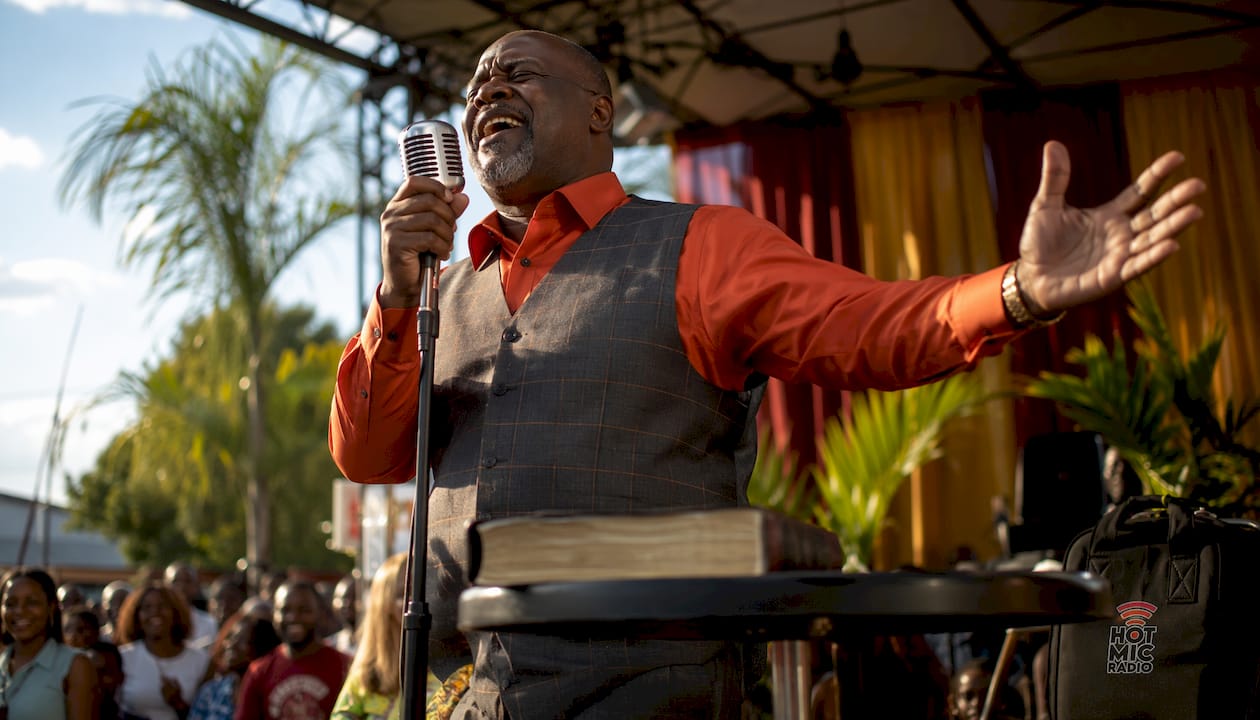
Gospel music is the DNA of R&B. Full stop. The vocal techniques, call-and-response energy, and performance culture that define R&B’s emotional core were all born in the Black church, then carried into secular music by artists who refused to leave that power behind. Sam Cooke walked away from The Soul Stirrers and took every gospel run with him. Aretha Franklin learned to preach through a microphone before she ever cut a pop record. Ray Charles rewired gospel melodies into secular hits that hit you in the chest the same way a Sunday sermon does. That lineage is not a footnote. It is the whole story.
Want to hear it for yourself? Hot Mic Radio’s R&B archives and gospel programming are curated specifically to make that connection audible, track by track.
Here is what you need to know:
- Gospel supplied the vocal technique: melisma, ornamental runs, and pleading phrasing that became R&B’s signature emotional delivery.
- Call-and-response, originally a dialogue between preacher and congregation, became the structural engine of soul and R&B records.
- The church was a full performance conservatory, training singers in improvisation, crowd engagement, and vocal stamina before they ever touched a secular stage.
- Sam Cooke, Aretha Franklin, Ray Charles, and Mahalia Jackson each represent a different chapter of this crossover story.
Table of Contents
- Why did gospel influence R&B so deeply?
- How did the church become a training ground for R&B artists?
- Which artists made gospel’s influence mainstream?
- How can you actually hear gospel’s influence in R&B?
- Does gospel still shape R&B and hip-hop today?
- What scholarship backs all of this up?
- Key Takeaways
- The gospel-R&B link is deeper than most people realize
- Hear it on Hotmicradio right now
- Useful sources and further listening
Why did gospel influence R&B so deeply?
The short answer: gospel gave R&B its voice, its structure, and its emotional vocabulary. Gospel’s call-and-response between leader and choir became the rhythmic backbone of early soul and R&B, creating spontaneity and audience engagement that no other musical tradition could replicate. The longer answer involves five specific musical traits that moved from the sanctuary to the studio.

Call-and-response is the most recognizable. A lead vocalist throws out a phrase; the choir or backing singers answer. In church, that dialogue involved the whole congregation. In the studio, producers used it to build tension and release across a track’s structure.
Melisma and vocal runs are the ornamental flourishes where a single syllable stretches across multiple pitches. Gospel singers developed this technique to express spiritual intensity. In R&B, it became the signature of emotional authenticity. You hear it in Aretha’s “I Never Loved a Man the Way I Love You” and in virtually every contemporary R&B vocalist who came after her.
Syncopated backbeat and hand-clap rhythms came straight from Pentecostal and Baptist services. That off-beat clap pattern you hear in gospel choirs? Producers translated it into the snare and tambourine patterns that drive classic soul records.

Choir textures and layered harmonies gave R&B its fullness. Gospel quartets and church choirs stacked voices in ways that secular pop had never attempted. That wall-of-voices sound became a production staple, from Motown to modern neo-soul.
Organ and piano vamping is the rhythmic, repetitive comping style that gospel musicians used to sustain energy during a preacher’s sermon. In R&B, that same technique keeps a groove locked while a vocalist improvises.
| Gospel Feature | How It Sounds in R&B | Track to Hear It |
|---|---|---|
| Call-and-response | Lead vocal answered by backing singers | Aretha Franklin, “Respect” |
| Melisma / vocal runs | Single syllable stretched across multiple notes | Sam Cooke, “A Change Is Gonna Come” |
| Syncopated hand-clap rhythm | Off-beat percussion driving the groove | Ray Charles, “What’d I Say” |
| Choir harmonies | Layered backing vocals creating fullness | Mahalia Jackson, “Move On Up a Little Higher” |
| Organ/piano vamping | Repetitive rhythmic comping under the lead | Ray Charles, “Georgia on My Mind” |
Pro Tip: When you listen to any of these tracks, focus on the relationship between the lead vocalist and the backing singers. That interplay is the gospel DNA in action.
How did the church become a training ground for R&B artists?
Church was not just where these artists worshipped. It was where they trained. Gospel choirs, musical directors, and preachers functioned as an informal conservatory system, developing vocal dexterity, improvisational instinct, and the ability to read and move a crowd. None of that was accidental.
Music historians point to the Great Migration and urban church scenes in Chicago, Detroit, and New York as the cultural pipeline that moved gospel performers directly into the recording industry. When Black families relocated north during the mid-20th century, they brought their church communities with them. Those urban congregations became incubators for the talent that would define soul and R&B.
That training came with real stakes. Crossing over from gospel to secular music in the 1950s frequently produced backlash from church communities. Singers who made the move risked being cut off from the world that raised them. That tension made the crossover historically significant beyond the music itself.
Which artists made gospel’s influence mainstream?
Three names define the crossover moment, and each one tells a different part of the story.
- Sam Cooke left The Soul Stirrers in 1957 and immediately applied gospel phrasing to secular pop. His move to secular music normalized gospel techniques in mainstream R&B and helped turn soul into a commercial force. Listen to “You Send Me” and notice how his vocal control mirrors a gospel lead singer holding a congregation.
- Ray Charles went further. He transformed gospel melodies and phrasing into secular hits by literally adapting spirituals and changing their subjects, swapping references to God for references to a lover. “What’d I Say” is the clearest example: the call-and-response between Charles and his backing singers is a direct lift from church. It provoked controversy at the time and became one of the most influential recordings in American music history.
- Aretha Franklin is the fullest expression of the gospel-to-R&B arc. Nelson George describes the 1960s soul synthesis as an artist-led learning process where gospel power was refined into commercially viable soul. Aretha’s 1972 Amazing Grace sessions, recorded live at New Temple Missionary Baptist Church in Los Angeles, showed that the line between her gospel self and her R&B self was always thin. Her phrasing on “I Never Loved a Man” and “Chain of Fools” is ministerial. She is not singing at you; she is testifying.
- Mahalia Jackson never crossed over, but her recordings set the vocal standard that every R&B singer who followed her was measured against. Her influence on Aretha was direct and documented.
- Gospel quartets like The Soul Stirrers and The Five Royales built the harmonic vocabulary and stage presence that defined early soul groups.
How can you actually hear gospel’s influence in R&B?
Here is a focused listening guide. Pair the gospel original with the secular track it shaped, and the influence becomes impossible to miss.
- Mahalia Jackson, “Move On Up a Little Higher” (1947) — Listen for the choir texture and the way Jackson’s lead vocal floats above the arrangement. This is the template.
- Sam Cooke with The Soul Stirrers, “Touch the Hem of His Garment” (1956) — Note the melismatic runs and the call-and-response with the group.
- Sam Cooke, “A Change Is Gonna Come” (1964) — Same vocal technique, secular subject. The gospel DNA is identical.
- Ray Charles, “This Little Girl of Mine” (1955) — A direct adaptation of the gospel standard “This Little Light of Mine,” with the religious subject swapped for a romantic one.
- Ray Charles, “What’d I Say” (1959) — Cue to the 2:30 mark. The call-and-response between Charles and the Raelettes is pure church energy in a secular context.
- Aretha Franklin, “I Never Loved a Man the Way I Love You” (1967) — Focus on the vocal runs at the end of each phrase. That is melisma from Baptist choir training.
- Aretha Franklin, “Amazing Grace” (live, 1972) — Her secular R&B phrasing applied to gospel material. The two worlds are indistinguishable.
- The Five Royales, “Think” (1957) — Gospel quartet harmony structure applied to secular R&B. Aretha later covered it.
Pro Tip: Use headphones and loop the 30-second section where the lead vocalist and backing singers trade phrases. That back-and-forth is the call-and-response at work. Once you hear it, you will catch it in every R&B record you play.
Does gospel still shape R&B and hip-hop today?
Absolutely. The influence did not stop in the 1960s. Gospel vocal techniques, choir textures, and the “truth to spirit” ethic of emotional authenticity continue to shape what contemporary R&B sounds like and what listeners respond to.
- Modern R&B producers regularly sample gospel choir recordings or recreate that layered vocal texture digitally. The choir-as-backdrop sound is everywhere in current production.
- The gospel roots behind secular vocal styles trace directly to Pentecostal and Baptist church traditions, and contemporary artists trained in those traditions carry that vocabulary into their recordings.
- Gospel’s “truth to spirit” ethic, the idea that a performance must be emotionally true before it can be technically correct, is why R&B listeners respond to rawness and vulnerability over polish. That value system came from the church.
- Hip-hop-adjacent R&B has absorbed gospel sampling as a production technique, using choir swells and organ chords to add weight and spiritual resonance to tracks that have nothing to do with religion.
- Streaming-era curation, including Hot Mic Radio’s gospel programming and R&B archives, makes this lineage audible for listeners who might not have grown up in a church context.
What scholarship backs all of this up?
The gospel-to-R&B connection is not a fan theory. It is one of the most documented relationships in American music history. Here is the evidence base:
- TeachRock documents gospel call-and-response and its direct role in the birth of soul and R&B, with lesson materials built from primary sources.
- Billboard / Nelson George provides critical analysis of how Aretha Franklin and the broader soul movement married gospel power with secular production, framing it as an artist-led process rather than a top-down industry decision.
- uDiscoverMusic traces Sam Cooke’s and Ray Charles’s crossovers with historical detail, including the controversy those moves generated.
- Gospel Roots of Rock and Soul (xpngospelroots.org) catalogs specific song-to-song adaptations where gospel recordings were directly repurposed into secular hits, with case studies on the Five Royales and Ray Charles.
- MusicalFlora covers the instrumentation and arranging techniques that migrated from church to studio, including organ vamping and choir texture.
- Atlantis Press published academic analysis of gospel music’s integration into R&B and hip-hop since the 1960s, examining the fusion from a musicological perspective.
- Hot Mic Radio’s archives function as contemporary listening evidence: curated playlists make the gospel-to-R&B lineage audible for modern listeners who want to hear the connection rather than just read about it.
Key Takeaways
Gospel music is R&B’s foundation, not its influence, because the vocal techniques, structural devices, and performance values that define R&B were developed in the Black church and carried directly into secular music by artists who refused to separate the sacred from the soulful.
| Point | Details |
|---|---|
| Gospel supplied R&B’s core techniques | Call-and-response, melisma, syncopated rhythm, and choir textures all moved from church to studio. |
| The church was a performance school | Urban church scenes in Chicago, Detroit, and New York trained the singers who built soul and R&B. |
| Three artists defined the crossover | Sam Cooke, Ray Charles, and Aretha Franklin each carried gospel techniques into mainstream R&B. |
| The influence is still alive today | Modern R&B and hip-hop-adjacent production continues to use gospel choir textures and emotional delivery values. |
| Hot Mic Radio curates the connection | The R&B archives and gospel programming make this lineage audible for contemporary listeners. |
The gospel-R&B link is deeper than most people realize
Here is what most articles get wrong: they treat gospel as an influence on R&B, as if it were one ingredient among many. That framing undersells it. Gospel was not a seasoning. It was the whole kitchen. The vocal runs, the call-and-response, the emotional urgency, the choir textures, the organ comping — none of those elements arrived in R&B from anywhere else. They came from the Black church, carried by artists who had spent years performing in that tradition before they ever touched a secular microphone.
The part that gets overlooked is the cost. Crossing over was not a career move that everyone celebrated. It was often a rupture with community, family, and faith. That tension is audible in the music. When Ray Charles adapted a gospel melody into a secular hit, the controversy was not just cultural noise. It was proof that the music carried real spiritual weight. The same weight that makes those records still hit you in the chest sixty years later.
What that means for listeners today: when you hear a contemporary R&B vocalist stretch a single syllable across four notes, or when a track builds to a choir swell that feels like a Sunday morning, you are not hearing a stylistic choice. You are hearing a lineage. The blues-gospel intersection that shaped early R&B guitar phrasing runs parallel to the vocal tradition, and together they built the emotional architecture of American popular music. That is worth knowing. And it is worth listening for.
Hear it on Hot Mic Radio right now
If this piece lit something up for you, the best next step is to actually listen. Hot Mic Radio’s R&B archives are built around exactly this kind of curated, roots-forward programming. You will find classic soul records where the gospel DNA is right on the surface, neo-soul tracks that carry the tradition forward, and hip-hop-adjacent R&B that samples the choir textures we have been talking about throughout this piece.
For the historical deep dive, the Classic R&B archives and the R&B Rewind show are where you want to start. Live DJ sets on Hot Mic Radio connect those classic recordings to what is happening in the culture right now. Head to the Hip Hop & R&B archives to hear how gospel’s emotional vocabulary lives inside contemporary hip-hop-adjacent tracks. Tune in, turn it up, and let the music make the argument better than any article can.
Useful sources and further listening
- TeachRock: “Gospel Music and the Birth of Soul” — The clearest academic entry point for understanding call-and-response and its structural role in R&B. Free lesson materials with primary source documentation.
- Billboard / Nelson George: “How Aretha Franklin Bridged the Secular and the Spiritual” — Essential reading for understanding the artist-led nature of the gospel-to-soul transition. George’s framing of the “soul synthesis” is the critical lens the field uses.
- uDiscoverMusic: “A Change Is Gonna Come: How Gospel Influenced Rhythm ‘n’ Blues” — Solid historical narrative covering Sam Cooke and Ray Charles with named recordings and cultural context.
- Gospel Roots of Rock and Soul (xpngospelroots.org) — The most detailed catalog of direct song-to-song adaptations. If you want to trace a specific gospel original to its secular counterpart, start here.
- MusicalFlora: “How Gospel Shaped R&B, Soul, and Pop” — Good on instrumentation: organ vamping, piano comping, and how those arranging techniques moved from church to studio.
- Atlantis Press: “The Evolution and Integration of Gospel Music in R&B and Hip-Hop since the 1960s” — Academic musicology paper analyzing the fusion from a structural and cultural perspective.
- Recommended albums for deep listening: Mahalia Jackson’s In Concert, Easter Sunday 1967; Sam Cooke’s Night Beat (1963); Aretha Franklin’s Amazing Grace (1972); Ray Charles’s What’d I Say (1959). Each one is a masterclass in the gospel-to-R&B continuum. Use Hot Mic Radio’s gospel archives alongside these records to hear how the tradition continues in curated contemporary programming.


Post comments (0)