


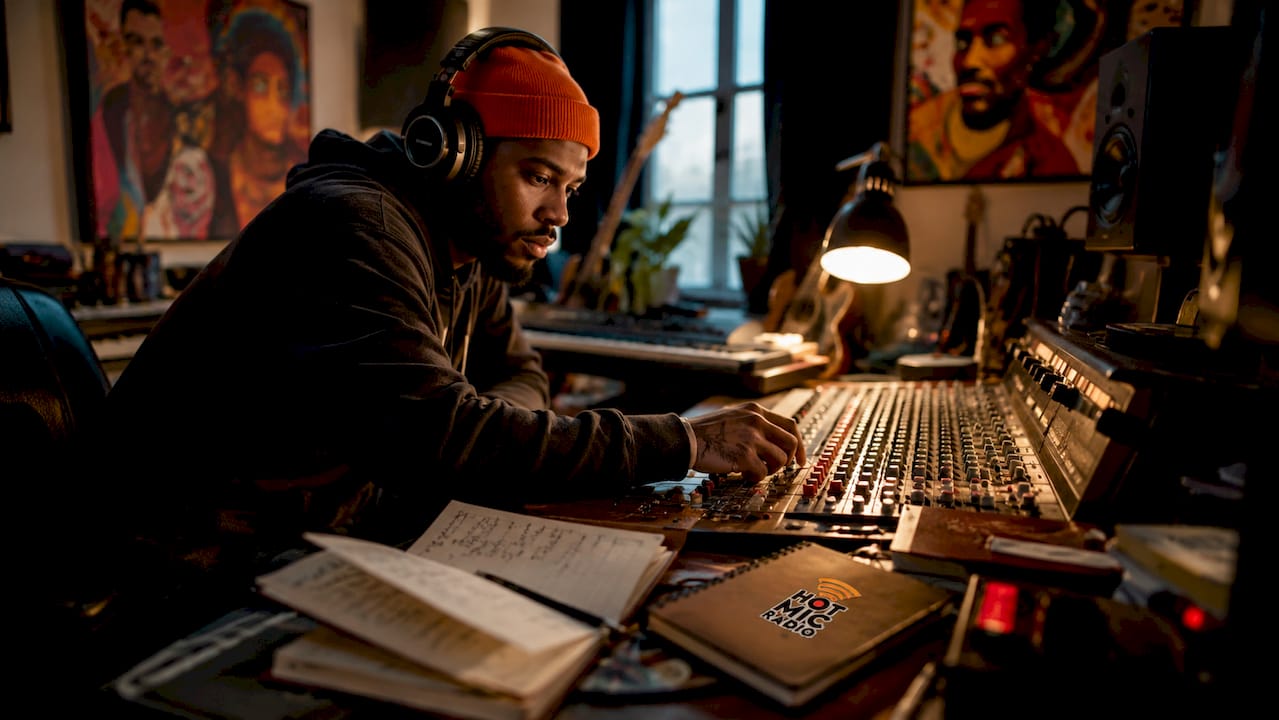
Afrobeats influence on R&B is the defining musical shift of this generation, transforming how producers build tracks, how artists deliver vocals, and how global audiences connect with soul music. The genre, rooted in West African rhythmic traditions and popularized by Nigerian and Ghanaian artists, has moved from a regional sound to a global production standard. Afrobeats generated over 14 billion streams by 2024, growing 550% over a decade and valuing the industry at $29.6 billion. That number tells you everything about the scale of what we are witnessing. This is not a trend. This is a structural shift in how R&B is made, heard, and felt worldwide.
1. How Afrobeats shapes R&B through rhythm and production
The most direct way Afrobeats reshapes R&B is through its drum architecture. Afrobeats uses syncopated, mid-tempo patterns that sit differently in the pocket compared to classic R&B’s four-on-the-floor or hip-hop’s boom-bap foundation. The groove lands between 80 and 100 BPM, creating space that lets vocal emotion breathe.
Key production features Afrobeats brings to R&B include:
- Syncopated percussion: Off-beat hi-hats and talking drum patterns that push and pull the listener’s body response
- Roomy low-end: Bass lines that sit back rather than punch forward, giving vocals room to sit on top
- Traditional percussion layered with electronics: Shakers, congas, and hand drums blended with 808s and trap snares
- Melodic call-and-response hooks: Short, repeated vocal phrases borrowed from West African musical tradition
- Mid-tempo groove: Tempos that feel too slow for a club but too alive for pure chill, landing in a sweet spot for emotional R&B
Afro-R&B production uses intentional space, with airy drum patterns that complement emotive vocal delivery. That space is the secret ingredient. It is what makes an Afrobeats-influenced R&B track feel like it is pulling you in rather than pushing you around.
Pro Tip: When you hear an R&B track that makes you want to sway rather than bounce, check the drum pattern. Odds are there is an Afrobeats influence in the percussion arrangement.

2. The rise of Soft Afrobeats as an R&B bridge
Soft Afrobeats is a mid-tempo fusion that blends the emotional depth of R&B with the rhythmic identity of Afrobeats. It is slower, more vulnerable, and built for the listener who wants to feel something rather than just move. This subgenre has become the most commercially accessible entry point for global audiences discovering African music through R&B playlists.
Soft Afrobeats is defined by several characteristics:
- Tempos in the 70–90 BPM range that favor reflection over energy
- Lush, reverb-heavy production with shimmering synth pads
- Lyrics centered on love, longing, and emotional honesty
- Vocal delivery that borrows R&B’s melisma and phrasing techniques
- Placement in mood-based streaming playlists like “Chill Afrobeats” and “African R&B”
“Soft Afrobeats emerges as a crucial emotional bridge, blending high-energy Afrobeats and R&B chill vibes into a sound that global streaming audiences are actively seeking out.”
That quote captures exactly why this subgenre matters. Streaming platforms reward mood-based listening, and Soft Afrobeats fits perfectly into the late-night, introspective playlist slot that R&B has historically owned. Understanding how streaming shapes music reach helps explain why this subgenre spread so fast across global markets.
3. Influential Afrobeats artists driving the R&B fusion
The R&B and Afrobeats fusion did not happen by accident. Specific artists made deliberate creative choices that pulled both worlds together. Here are the key figures shaping this sound:
- Wizkid — The Lagos-born artist whose album Made in Lagos introduced millions of Western R&B fans to Afrobeats’ emotional range. His collaborations with artists across the Atlantic proved the sound translates without losing its identity.
- Tems — Her vocal style is pure R&B in delivery but rooted in Afrobeats rhythmically. Her feature on Drake’s “Fountains” brought Afrobeats phrasing into mainstream American R&B playlists overnight.
- Mr Eazi — A key architect of the Afro-R&B sound. His joint album with King Promise, See What We’ve Done, is a masterclass in blending both genres.
- King Promise — His production choices lean heavily on retro textures like mallet keys and shimmering synths, grounding African rhythms in early 2000s R&B familiarity.
- Rema — His collaboration with Selena Gomez on “Calm Down” passed 1 billion Spotify streams in mid-2024, making it the first African-led track to hit that milestone. That is not a cultural moment. That is a commercial takeover.
Afrobeats artists maintain linguistic authenticity by singing in Pidgin, Yoruba, and other local languages even within R&B-structured songs. That authenticity is not a barrier to global appeal. It is the reason for it. Audiences worldwide connect with the emotional truth in the delivery, regardless of the language.
Pro Tip: Start with Mr Eazi and King Promise’s collaborative album if you want to hear the clearest example of Afro-R&B production done right. Every track is a case study in how two genres can merge without either one losing its soul.
4. How the production toolkit changed for R&B producers
R&B producers in New York, London, and Los Angeles have fundamentally changed how they build tracks. The influence is not just stylistic. It is structural. Producers in major music hubs now look to Lagos and Accra for rhythmic and structural inspiration, reversing the traditional flow of musical influence that once ran exclusively from West to East.
The production shift shows up in three specific areas. First, drum programming now incorporates Afrobeats-style percussion layering, with shakers and hand percussion sitting alongside trap elements. Second, harmonic choices have shifted toward simpler, more repetitive chord progressions that let the groove carry the emotional weight. Third, vocal production now favors a more natural, less processed sound that mirrors how Afrobeats artists record.
Successful Afro-R&B producers incorporate nostalgic early-2000s R&B textures like mallet keys and shimmering pads to ground African rhythms in familiar sound palettes. That combination of the familiar and the fresh is exactly what makes these tracks land so hard with global audiences. You feel like you have heard it before, but you have never heard anything quite like it.
5. The role of streaming and social media in spreading the fusion
TikTok and short-form video platforms have accelerated the Afrobeats-R&B fusion faster than any radio campaign could. TikTok prioritizes rhythm and viral moments, which drives R&B artists to incorporate Afrobeats percussion specifically for engagement. A track with an Afrobeats-influenced groove is built for the kind of body-movement content that racks up millions of views.
The impact of short-form video on music promotion in 2026 shows that rhythm is now the primary driver of virality. Afrobeats delivers that rhythm natively. R&B artists who adopt it gain a structural advantage in the algorithm-driven streaming environment. This is why the fusion is not slowing down. The platform incentives actively reward it.
6. Global industry impact and commercial growth
The commercial numbers behind this cultural exchange are significant. The Afrobeats industry alone is valued at $29.6 billion, with Africa’s total creative economy projected to reach $200 billion by 2030. US Afrobeats live shows grew 400% year-over-year by early 2026. These figures reflect a genre that has moved from niche to mainstream at a speed the industry rarely sees.
| Metric | Detail |
|---|---|
| Afrobeats global streams | Over 14 billion by 2024, up 550% over a decade |
| Industry valuation | $29.6 billion and growing |
| Rema’s “Calm Down” streams | Passed 1 billion on Spotify in mid-2024 |
| US live show growth | 400% year-over-year by early 2026 |
| Africa creative economy projection | $200 billion by 2030 |
By 2026, Afrobeats structural influence in pop and R&B is mainstream, with producers worldwide adopting Afro-inspired rhythms as a standard tool rather than an exotic addition. Spotify reports the related genre Amapiano hit 1.4 billion streams in 2023 alone. The cultural exchange in music that Afrobeats represents is now a primary driver of global pop, not a footnote.
7. What linguistic and cultural authenticity adds to the fusion
The most underrated element of the Afrobeats-R&B fusion is what artists choose to keep, not what they change. Afrobeats artists who cross into R&B territory do not abandon their linguistic identity. They bring it with them. Singing in Yoruba, Pidgin, or Twi while using Western melodic structures creates a sound that feels genuinely global rather than culturally diluted.
This approach works because authenticity registers emotionally even when listeners do not understand every word. The phrasing, the cadence, and the tonal quality of West African languages carry their own musicality. When that musicality meets R&B’s vocal tradition, the result is something that shapes global pop culture in ways that purely English-language tracks cannot replicate. The fusion is richer precisely because both sides of it remain intact.
Key takeaways
Afrobeats has permanently restructured R&B production, shifting the genre’s rhythmic foundation, melodic approach, and global commercial reach in ways that cannot be reversed.
| Point | Details |
|---|---|
| Rhythmic foundation shift | Afrobeats’ syncopated, mid-tempo drum patterns are now standard tools in R&B production. |
| Soft Afrobeats as a bridge | This subgenre merges emotional R&B depth with Afrobeats grooves, thriving in mood-based streaming playlists. |
| Artist-led cultural exchange | Artists like Wizkid, Tems, Rema, Mr Eazi, and King Promise drove the fusion through deliberate creative choices. |
| Commercial scale | The Afrobeats industry is valued at $29.6 billion, with US live show growth at 400% year-over-year by 2026. |
| Authenticity as a strength | Maintaining local language and cultural identity enhances global resonance rather than limiting it. |
Our take on where this fusion is headed
Hot Mic Radio Team
We have been watching this fusion build for years, and the thing that strikes us most is how it flips the old narrative. For decades, African artists were told to sound more Western to reach global audiences. Wizkid, Tems, and Rema proved the opposite. The more authentically African the sound, the wider the global reach.
What we find genuinely exciting is the production conversation happening right now. Producers who grew up on classic R&B are learning Afrobeats drum programming. Afrobeats producers are studying early 2000s R&B harmonic structures. The knowledge is flowing in both directions, and the music coming out of that exchange is some of the most interesting we have heard in a long time.
Our honest prediction is that Soft Afrobeats becomes the dominant emotional R&B sound of the next five years. The mid-tempo groove, the vulnerability in the lyrics, the roomy production. It fits perfectly into how people listen now, which is on headphones, alone, in a mood. The R&B archives at Hot Mic Radio already reflect how deep this influence runs. We are not waiting to see where this goes. We are already there.
— Hot Mic Radio Team
Hot Mic Radio is your home for the Afrobeats-R&B sound
If this fusion has you ready to update your rotation, Hot Mic Radio has the programming to match every mood in this genre space. We curate the full spectrum, from classic R&B roots to the freshest Afrobeats-influenced tracks dropping right now.
Our Hip Hop & R&B archives pull together the tracks where these two worlds collide hardest. You will find the collaborations, the crossover hits, and the deep cuts that show exactly how this fusion developed over time. For listeners who want to go deeper into the pure R&B side of the equation, the R&B archives at Hot Mic Radio cover everything from the genre’s soul roots to its Afrobeats-influenced present. Tune in, turn it up, and let the music do the rest.
FAQ
What is Afrobeats’ influence on R&B?
Afrobeats influence on R&B refers to the adoption of West African rhythmic patterns, mid-tempo grooves, and production techniques into contemporary R&B music. This fusion has reshaped how R&B tracks are structured, produced, and delivered globally.
What is Soft Afrobeats?
Soft Afrobeats is a mid-tempo subgenre that blends the emotional depth of R&B with Afrobeats rhythms, favoring slower tempos, lush production, and vulnerable lyrics. It thrives in mood-based streaming playlists and serves as the most accessible entry point for global audiences.
Which artists best represent the Afrobeats and R&B fusion?
Wizkid, Tems, Rema, Mr Eazi, and King Promise are the most prominent artists driving the R&B and Afrobeats fusion. Rema’s “Calm Down” with Selena Gomez became the first African-led track to pass 1 billion Spotify streams, marking a commercial milestone for the genre.
How has streaming accelerated the Afrobeats-R&B fusion?
TikTok and short-form video platforms prioritize rhythm-driven content, which gives Afrobeats-influenced tracks a structural advantage in the algorithm. This has pushed R&B producers to incorporate Afrobeats percussion specifically to increase a song’s viral potential.
Why do Afrobeats artists sing in local languages within R&B-structured songs?
Singing in Yoruba, Pidgin, or Twi while using Western melodic structures creates a sound that feels globally authentic rather than culturally diluted. The tonal quality and cadence of West African languages carry their own musicality, which enhances emotional resonance for international listeners.


Post comments (0)