


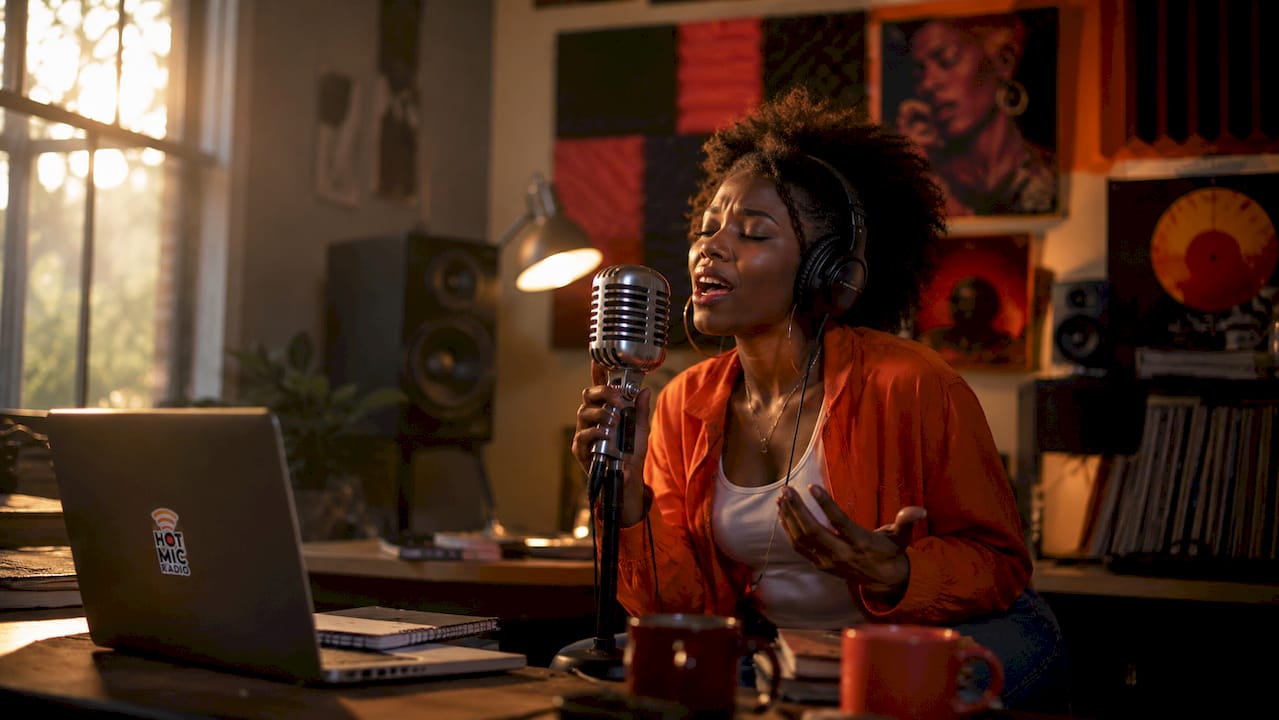
R&B music, short for rhythm and blues, is a genre defined by soulful vocals, danceable grooves, and deep emotional expression rooted in African American communities since the 1940s. It pulls from blues, jazz, gospel, and boogie, creating a sound that hits you in the chest every single time. What is R&B music at its core? It’s the genre that taught popular music how to feel something. From Ray Charles bending notes on a piano to Beyoncé commanding a stadium, R&B has never stopped evolving. At Hot Mic Radio, we live and breathe this music every day, and we want to break it all the way down for you.
What is R&B music and what makes it unique?
R&B, or rhythm and blues, is defined as a genre that blends jump blues, jazz, gospel, and boogie into a sound built around groove, emotion, and vocal power. That combination is what separates it from every other genre. You can feel the blues in the chord progressions, the gospel in the vocal delivery, and the jazz in the improvisation. The result is music that connects on a gut level before your brain even processes the lyrics.
The genre also carries a cultural identity that no other label quite captures. R&B was born from Black American experience, and that origin shapes everything from its lyrical themes to its performance style. It has always been about telling real stories with real feeling. That authenticity is the reason R&B keeps influencing every corner of popular music, from pop to hip-hop to Afrobeats.

What are the key musical characteristics of R&B music?
The R&B music characteristics that define the genre come down to a few core elements working together. Get any one of them wrong and the song loses its soul.
The building blocks of the R&B sound:
- Vocals. R&B vocals emphasize tone, control, and emotional depth with smooth phrasing, vocal runs, and melisma. The voice is the lead instrument, full stop.
- Rhythm and groove. A locked-in, danceable backbeat is non-negotiable. Whether it comes from a live drummer or a drum machine, the groove has to move you.
- Instrumentation. Early R&B leaned on piano, saxophones, guitars, and drums. Modern production shifted to synthesizers, drum machines, and layered electronic textures without losing the groove.
- Harmony. Background vocals and chord stacking create that warm, lush feeling you get from classic Motown records and modern neo-soul alike.
- Emotional authenticity. Every lyric, every note, every breath serves the feeling. R&B does not do detached or ironic. It goes all in.
The vocal performance is where R&B separates itself most clearly from other genres. A great R&B vocalist does not just sing the words. They shape every syllable to carry weight. Think about Aretha Franklin holding a note until the room shakes, or H.E.R. letting a guitar phrase and a vocal line answer each other. That conversation between instrument and voice is pure R&B.
Pro Tip: When you want to identify R&B by ear, focus on the vocal phrasing first. If the singer is bending notes, adding runs between words, or stretching a syllable for emotional effect, you are almost certainly listening to R&B or one of its direct descendants.
The genre also rewards listeners who pay attention to production. Modern R&B uses polished, layered production to frame those raw vocal performances. The gloss on the surface does not cancel out the emotion underneath. It actually amplifies it by giving the voice a clean space to breathe.

How did R&B music originate and evolve over time?
The history of R&B music starts with a marketing decision. Billboard began using “Rhythm and Blues” in 1949 to replace the term “race music” in its charts. That shift mattered because it reframed Black American music as a commercial category rather than a racial one, even if the underlying intent was still to segment the market.
Here is how R&B music evolved decade by decade:
- 1940s: The birth of the genre. Jump blues artists like Louis Jordan mixed big band swing with blues lyrics and a driving backbeat. The sound was energetic, fun, and built for dancing.
- 1950s: Rock and roll splits off. Early rock and roll borrowed heavily from R&B. Artists like Little Richard and Chuck Berry straddled both worlds. R&B itself deepened its gospel influence during this period.
- 1960s: Soul takes center stage. Motown Records and Atlantic Records turned R&B into a cultural force. Aretha Franklin, Marvin Gaye, and Stevie Wonder defined soul as R&B’s most powerful expression.
- 1970s: Funk and disco enter the mix. James Brown pushed the groove to its limit with funk. Disco took the danceable elements of R&B and added orchestration and club energy.
- 1980s–90s: New Jack Swing and contemporary R&B. Producers like Teddy Riley fused hip-hop beats with R&B vocals. Artists like Whitney Houston and Boyz II Men brought the genre to its commercial peak.
- 2000s–present: The genre goes global. Modern R&B integrates hip-hop, pop, and electronic music while maintaining emotional authenticity. Artists like Frank Ocean and SZA pushed the boundaries of what the genre could say and sound like.
The table below maps the key eras to their defining sounds:
| Era | Dominant Sound | Key Influence |
|---|---|---|
| 1940s–50s | Jump blues, boogie | Jazz, gospel |
| 1960s–70s | Soul, funk | Gospel, blues |
| 1980s–90s | New Jack Swing, contemporary R&B | Hip-hop, pop |
| 2000s–present | Neo-soul, alternative R&B | Electronic, hip-hop |
R&B’s early use as a marketing umbrella allowed many styles and experiments under one label. That flexibility is exactly why the genre survived every decade. It was never locked into one sound. It absorbed what was happening around it and made it its own.
Who are the most influential R&B artists of all time?
The artists who shaped R&B did more than make great records. They redefined what popular music could do emotionally, technically, and culturally.
The Foundational Icons:
- Ray Charles merged gospel fervor with blues structure and created a template that every R&B vocalist since has studied. His piano playing and vocal phrasing are still the standard.
- Aretha Franklin brought church-level vocal power to secular music. Her 1967 album I Never Loved a Man the Way I Love You is still one of the most emotionally direct records ever made.
- Marvin Gaye proved R&B could carry social commentary. What’s Going On (1971) addressed war, poverty, and environmental destruction without losing a single groove.
The Modern Architects:
- Usher defined 2000s R&B with a combination of vocal precision, choreography, and production instinct. His album Confessions sold over 10 million copies in the United States alone.
- Beyoncé expanded R&B into a full artistic statement. Lemonade (2016) wove together R&B, rock, country, and spoken word into a genre-defying work that still gets studied in music programs.
- H.E.R. represents the current generation’s commitment to authenticity in songwriting. She plays her own instruments, writes her own material, and keeps the emotional core of classic R&B alive in every track.
Pro Tip: Start with the classics before you go deep on contemporary R&B. Listen to Aretha Franklin’s “Respect,” Marvin Gaye’s “Let’s Get It On,” and then jump to Frank Ocean’s “Blonde.” That three-stop journey shows you the full arc of how R&B music evolved without losing its soul.
Early R&B performers also cultivated a “cool, relaxed, and in control” persona on stage, even when delivering the most emotionally charged material. That balance of composure and feeling became a lasting standard for stage presence across popular music. You still see it in the way Usher moves and the way H.E.R. plays guitar with her eyes closed.
What cultural significance does R&B music hold today?
R&B is a vehicle for real human emotion and African American historical narrative. That is not a poetic description. It is the genre’s actual function, and it is why R&B keeps finding new audiences every generation.
“R&B has strong cultural significance as a vehicle for real human emotion and African American historical narratives. It is especially popular for live events because of its mood-setting ability and emotional connection.”
The genre’s ability to set a mood makes it irreplaceable in live settings. A well-programmed R&B set can move a room from high energy to intimate vulnerability in three songs. That emotional range is something very few genres can match. It is why R&B anchors wedding receptions, late-night sets, and arena tours with equal effectiveness.
R&B also continues to shape the culture around it. The hip-hop and R&B intersection has produced some of the most commercially successful and critically respected music of the past 30 years. Artists like Drake, Rihanna, and The Weeknd built careers in that exact space. The genre does not sit still. It absorbs new influences, reflects current realities, and keeps pushing the conversation forward.
The genre’s longevity comes from one thing: emotional authenticity. Listeners can tell when an R&B performance is genuine and when it is manufactured. The ones that last are always the genuine ones. That standard keeps the genre honest and keeps its audience loyal.
Key Takeaways
R&B music is defined by emotional authenticity, vocal virtuosity, and a groove-centered sound that has absorbed jazz, gospel, blues, hip-hop, and electronic music across eight decades without losing its core identity.
| Point | Details |
|---|---|
| R&B’s definition | Rhythm and blues combines gospel, jazz, blues, and groove into emotionally driven music. |
| Historical origins | Billboard coined the term in 1949 as a marketing label for Black American music. |
| Core characteristics | Vocal runs, danceable backbeats, and emotional authenticity define the genre’s sound. |
| Genre evolution | R&B absorbed soul, funk, hip-hop, and electronic music while keeping its emotional core. |
| Cultural significance | R&B reflects African American experience and sets the emotional standard for live music. |
Why R&B still hits harder than anything else on the dial
We have been curating R&B at Hot Mic Radio long enough to say this with full confidence: no genre carries emotional weight the way R&B does. You can put on a neo-soul record at 2 AM and feel like the artist wrote it specifically for your situation. That is not an accident. It is the result of a tradition built on honesty.
What concerns us about the current moment is the pressure on artists to prioritize production gloss over vocal truth. Modern R&B’s polish can sometimes bury the rawness that made the genre matter in the first place. The artists who break through consistently, from H.E.R. to Silk Sonic, are the ones who refuse to let the production swallow the feeling. They understand that the groove is the vehicle, but the emotion is the destination.
Our honest take is that R&B is healthier right now than the mainstream conversation suggests. The classic R&B archives prove the roots are strong. The indie lane is producing artists with serious vocal chops and real stories to tell. If you want to understand where popular music is going, keep your ears on R&B. It has always been the genre that shows everyone else what is possible.
— Hot Mic Radio Team
Hear it for yourself on Hot Mic Radio
R&B is a genre you understand better by listening than by reading about it. Hot Mic Radio has you covered across every era and every mood.
Our R&B archives cover everything from Motown classics to the latest indie R&B releases, curated by DJs who actually know the music. If you want to go deeper into the genre’s roots, our indie R&B collection spotlights independent artists who are keeping the emotional core of the genre alive right now. We also run live DJ shows that move through the full spectrum, from slow jams to high-energy sets, so you can experience R&B the way it was meant to be heard. Tune in, turn it up, and let the music do the rest. The Hip Hop & R&B archives are waiting for you.
FAQ
What does R&B stand for in music?
R&B stands for rhythm and blues. Billboard introduced the term in 1949 to describe music popular among African American audiences, replacing the earlier label “race music.”
What are the main characteristics of R&B music?
R&B music characteristics include emotional vocal performances with runs and melisma, danceable backbeats, and instrumentation rooted in blues, gospel, and jazz. Modern R&B adds synthesizers and hip-hop production techniques to that foundation.
How did R&B music evolve into modern genres?
R&B evolved by absorbing soul in the 1960s, funk and disco in the 1970s, and hip-hop beats in the 1980s and 1990s. Contemporary R&B now blends electronic production with traditional vocal styles, producing subgenres like neo-soul and alternative R&B.
Who are the most influential R&B artists in history?
Ray Charles, Aretha Franklin, and Marvin Gaye defined the genre’s foundations. Usher, Beyoncé, and H.E.R. represent its modern evolution, each contributing to vocal style, production, and cultural impact.
Is R&B the same as soul music?
Soul is a subgenre of R&B that emerged in the 1960s, emphasizing gospel-influenced vocals and emotional intensity. All soul music is R&B, but not all R&B is soul. The two terms overlap significantly but are not interchangeable.


Post comments (0)