


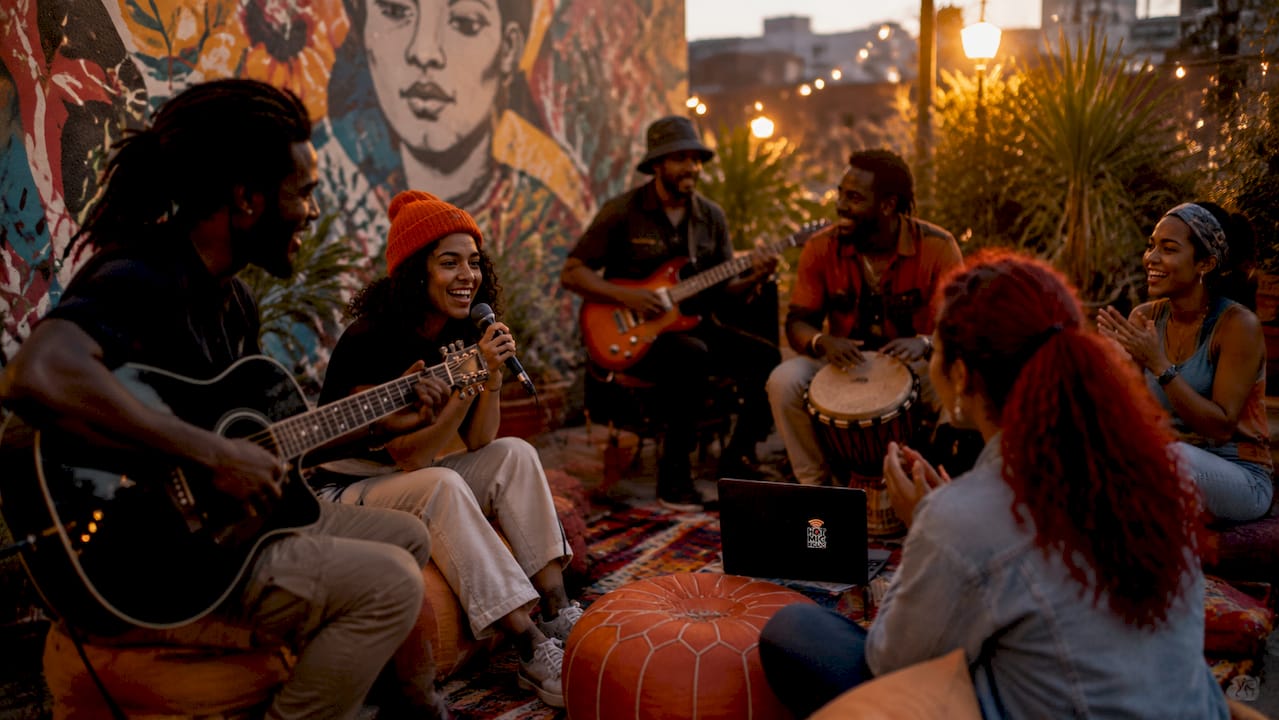
Music is defined as one of the most powerful social forces humans have ever created, and the science now proves exactly why. A 2026 study with 1,392 participants found music scores high on fostering creativity, identity expression, empathy, and collective engagement, with averages between 4.28 and 4.46 out of 5. That is not a soft cultural observation. That is hard data confirming what every concert crowd, church choir, and block party already knows: why music connects communities is a question with real, measurable answers rooted in neuroscience, psychology, and cultural identity.
Why music connects communities at the brain level
The connection starts before you even realize it. A 2026 study published in The Journal of Neuroscience found that predictable chord progressions combined with eye contact activate brain areas directly linked to social bonding. That means the familiar four-chord progression you hear in Gospel, R&B, and Hip-Hop is not just satisfying. It is literally wiring your brain for connection.
The brain areas involved include networks tied to social perception and reward. When music follows a predictable harmonic structure, the brain generates shared neural expectations across listeners. That synchronized expectation is the biological foundation of “we’re in this together.” Unpredictable music does not produce the same effect, which is why a well-crafted hook lands differently than pure noise.

This also explains why live music hits harder than a playlist. Predictable musical structures upregulate social neural networks most powerfully when combined with physical presence and face-to-face interaction. The crowd at a Soca festival or a Neo-Soul show is not just having fun. They are collectively activating the same bonding circuits that humans evolved to build tribes.
Pro Tip: If you want to feel the full social power of music, prioritize live or communal listening experiences over solo headphone sessions. The neural bonding effect is significantly stronger when shared in real time.
Here is what makes this especially interesting for music lovers:
- Harmonic predictability triggers social neural networks more reliably than musical complexity alone.
- Eye contact during music amplifies the bonding effect beyond what either music or eye contact achieves separately.
- Shared listening environments, like radio, concerts, and community events, create synchronized emotional states across groups.
- Genre familiarity deepens the effect because listeners already carry shared expectations for the music’s structure.
How does group music participation build empathy?
Group music participation does not just feel good. It produces measurable psychological change. A march 2026 structural equation modeling study found that group music boosts empathy through a serial mediation process: participation increases musical self-expression, self-expression increases empathy, and empathy drives pro-social behavior. That chain reaction is the engine behind music and community bonding.

The study focused on university students, but the pattern holds across age groups and cultures. When people make music together, or even actively listen together, they practice reading emotional cues, matching energy, and responding to others. Those are the exact skills that make communities function. Music is essentially a rehearsal space for social life.
Here is how that process plays out in practice:
- Participation begins. Someone joins a choir, a drum circle, a cypher, or even a group listening session.
- Self-expression opens up. The shared musical frame makes it safer to express emotion without social risk.
- Empathy activates. Participants start reading and mirroring each other’s emotional states through sound and movement.
- Pro-social behavior follows. People become more cooperative, more generous, and more willing to support each other outside the musical context.
- Community strengthens. Repeated cycles of this process build durable social bonds that outlast any single event.
This is why the role of music in communities goes far beyond entertainment. Music is a structured practice for building the emotional intelligence that communities need to survive. Hip-Hop cyphers, Gospel call-and-response, and Afrobeats dance circles all run this same psychological program, just in different cultural languages.
Pro Tip: You do not need to be a musician to get the community benefits. Active, engaged listening in a group setting, whether at a live show or a listening party, produces many of the same empathy-building effects as playing an instrument.
How does music shape cultural identity and community resilience?
Music functions as auditory rhetoric that reduces the psychological distance between self and other. That is a precise way of saying music makes “us vs. them” thinking harder to maintain. When two people share a song, a genre, or a musical tradition, they share an experiential frame that lowers social barriers and makes cooperation feel natural.
This is music as a cultural connector at its most powerful. Communities that have faced trauma, displacement, or conflict use music to rebuild collective identity. The shared experiential frame that music creates is not just pleasant. It is a survival tool. Research published in Frontiers in Psychology in 2026 specifically highlights music’s role in community resilience in rural and post-conflict settings, where it helps people reconstruct shared meaning after disruption.
Music also carries cultural memory in ways that written history cannot. A Motown record holds the emotional texture of a generation. A Dancehall riddim carries the social energy of a neighborhood. These are not just sounds. They are living archives of who a community is and where it came from. Understanding music as a vehicle for identity helps explain why certain genres become non-negotiable parts of cultural life.
“Music decreases self-other distinction by creating a shared experiential frame, facilitating cooperation and collective engagement. This makes it uniquely effective at building social cohesion in communities facing division or hardship.” — Frontiers in Psychology, 2026
- Music preserves cultural memory across generations without requiring literacy or formal education.
- Shared genres and musical traditions create in-group identity that strengthens social trust.
- Music in post-conflict communities actively rebuilds the sense of collective belonging that trauma disrupts.
- Genre diversity within a community signals cultural openness, which correlates with broader social cohesion.
How do artists build real community beyond viral reach?
Viral reach is not the same as community. That distinction matters more now than it ever has. Industry analysis confirms that long-term career sustainability depends on building behavioral loyalty, not just follower counts. A million passive followers who never engage produce less career value than ten thousand fans who show up, share, and spend.
The shift from followers to community requires a different approach entirely. Artists who build lasting communities do so through transparency, consistency, and genuine connection. That means showing up even when the algorithm does not reward it. It means creating spaces where fans talk to each other, not just to the artist. The community becomes the product, and the music becomes the shared language that holds it together.
Pro Tip: Artists who find their specific community first, even a small and polarizing one, always outperform those chasing mass appeal. Specificity creates belonging. Mass appeal creates audiences. Audiences leave. Communities stay.
| Approach | What it produces |
|---|---|
| Chasing viral reach | Temporary spikes, passive followers, low retention |
| Building behavioral loyalty | Repeat engagement, word-of-mouth growth, durable fan relationships |
| Mass appeal focus | Broad but shallow attention, easily displaced by the next trend |
| Community-first focus | Shared identity, active participation, long-term career foundation |
The local Hip-Hop scene model proves this point at the grassroots level. Regional artists who invest in their immediate community consistently build more durable careers than those who skip local roots to chase national attention. The community-first approach is not a consolation prize. It is the actual strategy.
Key Takeaways
Music connects communities through a combination of neurological, psychological, and cultural mechanisms that no other art form replicates at the same scale or depth.
| Point | Details |
|---|---|
| Neural bonding is real | Predictable chord progressions activate social brain networks, especially during shared listening. |
| Group participation builds empathy | Joining music activities increases self-expression, empathy, and pro-social behavior in sequence. |
| Music reduces social division | Shared musical experiences lower self-other barriers, making cooperation and trust easier to build. |
| Cultural identity lives in music | Genres and musical traditions carry collective memory and reinforce community belonging across generations. |
| Community beats follower count | Artists who build behavioral loyalty through genuine engagement sustain longer, stronger careers. |
Why music will always be the culture’s social glue
Here is our honest take, and we have been living inside this music for a long time. The research confirms what we already felt in our bones. Music does not just accompany community. It creates it. Every time a DJ drops a record that makes a room go still before it erupts, that is not entertainment. That is a social bonding event happening in real time.
What the science adds is the “why” that makes the feeling undeniable. The chord progressions in Gospel and R&B are not just beautiful. They are neurologically designed, through centuries of cultural refinement, to open people up to each other. The cypher, the listening party, the late-night radio session: these are not casual activities. They are the rituals that hold communities together when everything else is pulling them apart.
We also think the artist community conversation is the most underrated part of this whole picture. Too many artists are still chasing streams and follower counts while their actual community is waiting to be built. The artists who get it right, the ones who show up consistently and create real space for fan-to-fan connection, those are the ones who last. That is what genre diversity in music actually protects: the specific communities that form around specific sounds, each one irreplaceable.
Music is not background noise. It is the architecture of belonging. Treat it that way.
— Hot Mic Radio Team
Hot Mic Radio: where the community lives in the music
At Hot Mic Radio, we built the whole station around one belief: music and social cohesion are inseparable, and the right programming can hold a community together across any distance.
Our Hip-Hop archives and R&B programming are not just playlists. They are curated cultural spaces where the music does exactly what the science says it should: create shared experiences, reinforce identity, and build the kind of belonging that keeps people coming back. From classic Motown to independent artists grinding right now, we cover the full spectrum because the community deserves the full story. Tune in, turn it up, and feel what real music community bonding sounds like.
FAQ
Why does music connect people so strongly?
Music activates brain networks linked to social bonding, especially when its harmonic structures are predictable and familiar. Shared listening creates synchronized emotional states that lower social barriers and increase feelings of connection.
What is the role of music in building community identity?
Music carries cultural memory and reinforces shared values, making it a primary tool for collective identity formation. Communities use specific genres and musical traditions to signal who they are and where they belong.
How does group music participation affect behavior?
A 2026 study found that group music participation increases musical self-expression and empathy, which then drives pro-social behavior. The effect follows a sequential path from participation to empathy to cooperative action.
Why does music community matter for artists?
Artists who build genuine communities with behavioral loyalty sustain longer careers than those who chase passive follower counts. Community creates repeat engagement, word-of-mouth growth, and a durable foundation that viral reach alone cannot provide.
How does music support community resilience?
Music reduces the psychological distance between individuals by creating a shared experiential frame, which makes cooperation easier. Research highlights its specific role in helping rural and post-conflict communities rebuild collective meaning and social cohesion.


Post comments (0)