

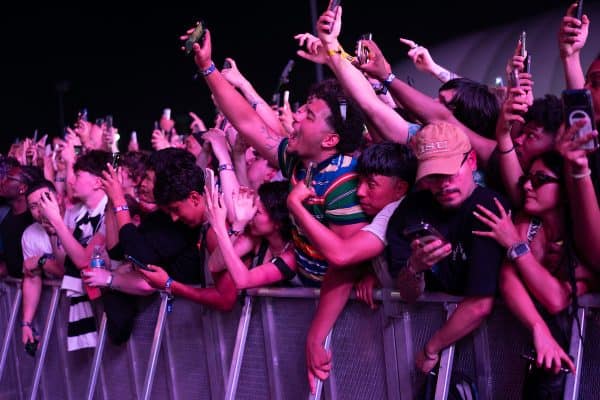
Summer Smash 2026, Chicago. Photograph by Dan Garcia via The Source.
The dancefloor didn’t die overnight. But you feel it the second you walk in: phones held up at chest height, half the room facing the DJ booth like it’s a stage, people moving like they’re auditioning for a clip instead of getting lost in the music. The floor used to be a place to move. Now it’s a set.
For hip-hop and R&B, that shift cuts deeper than anywhere else, because these genres were built by dancers. Dancing here was never just following steps. It was a live conversation between the beat, the room and the person you become when the record takes over. When everyone is watching themselves through an imaginary camera, that conversation gets quieter — and the culture loses its best studio.
A BBC report on Gen Z and the fear of being filmed captures the feeling: one student described staying alert for promoters’ cameras and strangers filming, worried that an awkward moment could become online content. It’s hard to let loose when part of your attention is asking, Could somebody post this? You can see it in the crowd shots from this summer’s festivals — a sea of phones where a sea of dancers used to be.
The camera turns presence into performance
A phone doesn’t have to be pointed directly at you to change the room. Just knowing you might be in the background can be enough to make you monitor your face, your outfit and your moves. Instead of responding to the song, you start imagining the clip.
The Washington Post’s January reporting on the dancefloor connects that self-consciousness to fears of embarrassment, unwanted filming and online judgment. Its conclusion is more nuanced than “dancing is dead”: social dancing has also moved into smaller gatherings, block parties, studios and community spaces. Still, club-goers who feel watched may choose a cautious sway over the uninhibited movement a packed room can invite.
That’s a real loss, not because everyone needs to be a great dancer, but because freedom to be a little awkward is part of the point. A club should be a place where you can move badly, beautifully, strangely or simply in your own way without picturing the comments section.

Sexyy Red keeping the floor moving at Summer Smash 2026. Photograph by Dan Garcia via The Source.
Choreography can travel. Spontaneity is Black culture made live.
TikTok dances aren’t the enemy. They can be fun, skillful and a way for people to connect with a song. The problem is when rehearsed, repeatable choreography becomes the default idea of dancing, when the goal is to reproduce a move for the camera rather than make a move for the music.
A viral routine offers certainty: learn the sequence, hit the counts, know what it should look like. Freestyle offers no such guarantee. It asks you to listen, react and invent in real time. Sometimes that’s a shoulder roll, a two-step, a bounce, a line dance, or a move that only makes sense to the people around you. It doesn’t need a tutorial or a perfect angle to count.
This is a specifically Black cultural inheritance, and the DNA of the music we play. In hip-hop, the dancefloor was the birthplace of the culture itself: when Kool Herc stretched the breaks in the Bronx in the seventies, the b-boys didn’t just dance to the music, they shaped it. The breakbeat became the centerpiece of the record because dancers demanded it — DJs extended the break to keep crews moving, and those crews invented top rock, footwork and freezes on the spot, each move answering a break nobody had heard before. Atlanta gave the world the snap, the dougie’s cousins and the whole bankhead bounce lineage that turned crunk into movement. New Orleans second lines, Memphis buck jumping, LA’s krump born in mirrored living rooms as a release of pain — these weren’t routines, they were regional dialects of the same language. R&B carries its own floor: the slow-drag conversations to quiet storm records, the steppers’ sets in Chicago that turned a genre into a nightly ritual, the line dances that move through Southern Soul and make a room move as one body. None of it was choreographed in an office and pushed to an app. It was made live, in rooms full of Black dancers, on the fly, passed from city to city and generation to generation. That’s the tradition the feed flattened: regional sounds grow their own movement, and in our look at cities shaping hip-hop in 2026, Milwaukee’s danceable sound is one more reminder that local rhythms can move people in distinct ways.
The artistry isn’t reserved for trained dancers. It’s in the split-second choice to catch a snare differently, answer someone else’s step or start a groove the crowd picks up — the exact improvisational spirit that made hip-hop cyphers and R&B floors into laboratories. That’s creation, not a performance for strangers online, but a small piece of Black culture made together — which is exactly why it stings to watch the imitation replace the invention. When the moves that once came from the room now come from a feed, the tradition that birthed them gets flattened into a trend. The dances that hip-hop and R&B built — from breaking to bounce to the Chicago step — were never meant to be frozen into one repeatable routine for a camera. They were meant to keep changing, because that’s how the culture has always renewed itself. The dancers who made the dancefloor an art form deserve better than to see their legacy reduced to a countdown of the week’s most-replicated routines.
It’s not just phones, and it’s not just young people
Phones aren’t the only pressure on the dancefloor. In an October 2026 Guardian report, DJs and clubbers also point to loud conversations, changing drug habits, crowded rooms, rising costs and fewer dedicated dance spaces. Those conditions shape a night as surely as a screen does.
And it’s too easy to blame a whole generation. The BBC’s reporting includes young people who want to dance but feel watched, alongside others who still find spaces where they can let loose. The issue isn’t that young people lack individuality. It’s that a culture built around recording, ranking and sharing can make spontaneous self-expression feel risky for anyone.
Even the numbers need context. Decoded Magazine reports that half of UK clubbers in a survey thought phones were harming the dancefloor. The survey was commissioned by Ray-Ban Meta, so its results shouldn’t be treated as definitive proof of what every clubber thinks. But the contradiction it describes, disliking phones on the floor while using them there, is familiar.

The barrier between performer and audience collapsing at Summer Smash 2026. Photograph by Dan Garcia via The Source.
Why clubs are pushing back
Some venues are trying to make it easier to be present. Lakota in Bristol announced a phone-free dancefloor in its Moon Club room in 2025, saying it wanted people to enjoy the music without distraction, according to the BBC. In Toronto, Wiggle Room announced a ban on smart glasses in September 2026, citing guest privacy and a safer dance space, as Exclaim! reported.
Those rules aren’t about pretending technology has no place in music culture. Phones help fans discover artists, share a track and build attention for a night out. A great clip can even introduce someone to a DJ they might never have found otherwise. But there’s a difference between capturing a moment now and then and treating the whole night as content production.
A phone-free room can offer a simple invitation: you don’t have to document this to prove it happened. You can just be here.

Chief Keef at Summer Smash 2026, a direct line back to Chicago’s influence on the sound. Photograph by Dan Garcia via The Source.
Bring back the imperfect move
The fix isn’t to ban every dance trend or shame anyone for taking a photo. It’s to make room for more than one way of moving, and to remember that the dancefloor belongs to the people on it, not the imaginary audience beyond it.
Put the phone away for a song. Try the step you haven’t mastered. Answer the beat instead of waiting for someone else to show you what to do. If a friend starts a groove, build on it. If the room gives you a little space, take it. The move doesn’t have to go viral. It just has to feel like yours.
That’s the difference between choreography and a living dancefloor: one is repeated; the other keeps changing. The best nights aren’t always polished. They’re the ones where a room full of individuals finds a shared rhythm without moving as one person.
That belief connects to the music we play and the conversations we make room for. In our article on why artist interviews still matter, we talk about the value of hearing an artist’s perspective beyond a quick viral moment. The same idea applies on the dancefloor: hip-hop and R&B have always lived in the unfiltered part, the part that can’t be planned for a post.
And if you’ve been looking for ways to reconnect with music beyond the scroll, our piece on why fans are buying records and CDs explores another version of that impulse: wanting a more tangible, intentional relationship with the music we love.
Club culture isn’t gone. But when people are too worried about being captured to move freely, it loses some of its spark. So here’s the invitation: choose presence over content. Dance like nobody’s filming, not because nobody ever will, but because the artistry of the dancefloor only exists in the moment.
That’s the Hot Mic spirit, too: authentic, unfiltered and in the moment. Find more ways to connect with the station and its live experiences through the Hot Mic Radio app and the Bars & Beats Club.