

A hip hop mix show is a continuous, DJ-curated block of hip hop and R&B tracks blended with seamless transitions instead of being played as separate songs. The fastest way to start listening is a live DJ stream on an online radio station or an archived continuous mix on a mix-hosting app, both of which deliver curated flow, host personality, and genre blends you won’t get from a shuffled playlist. Follow a show’s page or browse a mix-hosting app to catch the next live set or jump into a replay.
TL;DR:
- Online radio offers scheduled shows and archives, while Mixcloud supports gapless playback and offline listening; social live streams add chat but usually weaker archives.
- Shows commonly last thirty minutes to two hours; choose faster club sets for movement, or slower lounge mixes for studying, driving, and winding down.
- Favor hosts who add track context, seamless transitions, a balance of familiar and new artists, and searchable archives with consistent schedules.
- Continuous mixes suit parties, workouts, or focused sessions, while playlists work better when you want to skip, reorder, or repeat tracks.
- Regional spotlight shows can surface independent local artists before national attention, while themed archives help listeners find past sets by genre or place.
Table of Contents
- Where to listen: platforms and formats that host hip hop mix shows
- Types of hip hop mix shows and how they differ
- How to choose a great hip hop mix show (practical criteria)
- How to tune in, save shows, and build a listening routine
- Hot Mic Radio spotlight: curated programming and archives that serve mix-show listeners
- Playlists, mixtapes, and continuous DJ mixes: pick the right format for your activity
- The gear behind the mix: what hip hop DJs actually use
- From block parties to broadcast: how hip hop mix shows evolved
- How mix shows give independent artists their shot
- Why human-curated mix shows still matter now
- Tune into Hot Mic Radio and support the shows that move you
- FAQ
- Sources
Where to listen: platforms and formats that host hip hop mix shows
The hip hop and R&B mix show lives across a handful of formats, and each one serves a slightly different kind of listening moment.
Online radio stations with programmed streams are the closest thing to appointment listening. Shows run on a schedule, hosts talk between blends, and most stations archive the set afterward so you can catch what you missed. YouTube is the other heavyweight: full-length recorded sets and live DJ broadcasts stack up by the hour, which makes it a deep well for throwback mixes and festival sets, though the viewing-focused format can pull your attention away from the audio-first experience you’re after.
Mix-hosting platforms and apps built specifically for DJ mixes, like Mixcloud, are made for this exact use case. They’re built around gapless playback, so one track rolls into the next the way the DJ intended, and most support downloads or offline listening for when you don’t want to burn data.
Social live platforms are a different animal. A DJ going live on social media creates a real-time event with chat and shout-outs, which has an energy a programmed stream can’t match, but it rarely offers the same archive depth or reliable schedule.
A few habits make continuous listening easier:
- Follow a show’s page or channel so new episodes land in your feed automatically.
- Subscribe inside a mix-hosting app to get notified the moment a new set drops.
- Save favorite episodes to a “watch later” or offline queue before you lose your data connection.
The Infinite Dial 2026 report from Edison Research found that a strong share of Americans age 12 and up listen to online audio weekly, which backs up what mix show fans already know: continuous streams and replayable archives are how people actually tune in now.
Types of hip hop mix shows and how they differ
Not every mix show scratches the same itch, so it helps to know what you’re walking into before you hit play.
- Era and throwback mixes lean on catalog deep cuts, built for listeners chasing nostalgia and a familiar flow from one classic into the next.
- Genre-blend shows cross hip hop with R&B, Afrobeats, or neo-soul in a single set, giving you range instead of one lane for sixty straight minutes.
- Regional spotlights shine a light on a specific city or scene, often surfacing independent artists who haven’t broken through nationally yet.
- Club and party sets run hot and fast, built for movement, with quick transitions and high-energy drops.
- Chill or lounge mixes slow the tempo down and favor longer, smoother blends, better suited to studying, driving, or winding down.
Set length is worth watching too. A lot of mix shows run somewhere between thirty minutes and two hours, and the gapless mixing cue to listen for is simple: you shouldn’t hear dead air or an abrupt jump between songs. If the DJ is doing it right, one track melts into the next without you noticing the seam.
How to choose a great hip hop mix show (practical criteria)
Picking a mix show you’ll actually stick with comes down to a handful of checkable things.
- Check the host’s credibility. A DJ who adds context, drops names, or tells a quick story about a track gives you more than background noise.
- Listen for the flow. Gapless mixing matters because it’s the difference between a curated experience and a random stack of songs.
- Look at the track balance. The best shows mix recognizable hits with newer entries and a few names you’ve never heard, instead of leaning entirely on one or the other.
- Notice the production value. Guest mixes, on-air shout-outs, and a little banter between tracks signal a show built around real interaction, not autoplay.
- Confirm accessibility. A consistent schedule, an archive you can scroll back through, and mobile playback that doesn’t choke on your commute all matter more than they sound.
Pro Tip: If a show’s archive goes back several weeks and the episodes are tagged by theme or region, that’s a strong sign the curator is organized and worth following long-term.
How to tune in, save shows, and build a listening routine
Turning a one-time listen into a habit takes almost no effort once you know what to click.
Start by following or subscribing wherever the show lives, whether that’s an app follow, a channel subscription, or a schedule page you bookmark. From there:
- Add live show times to your calendar so you’re not stumbling on a set halfway through.
- Save episodes to a “watch later” queue or download them where the platform allows offline listening.
- Browse structured archives by genre or region to find past themed sets and spotlights you missed the first time.
- Turn on gapless playback in your app’s settings and keep an eye on data usage if you’re listening on mobile data.
- Support the shows and DJs you love by sharing episodes, and look into donation or membership options where they’re offered.
Our own guide on how to tune into live DJ shows walks through the follow-and-save steps in more detail if you want a station-specific reference, and our hip hop station guide for 2026 cover the broader setup.
Hot Mic Radio spotlight: curated programming and archives that serve mix-show listeners
We built our programming around the exact listening experience this guide describes: curated flow, live energy, and real discovery.
Our rotation splits into three lanes featuring gospel, southern soul, and Motown classics; hip hop, R&B, neo-soul, jazz, and lo-fi; plus soca, Afrobeats, and dancehall for listeners who want range without switching stations. On top of that, live DJ shows bring club energy and lounge intimacy straight into the stream, and regional spotlight shows give a voice to hip hop and R&B scenes that don’t always get national airplay.
A few ways to dig into what we’ve built:
- Browse our shows archive to find past live sets and themed rotations.
- Explore our hip hop archives for genre-specific episodes.
- Check our charts page for curated playlists tied to what’s currently in rotation.
- Read about how DJ support helps artist discovery to see how our shows connect to the broader scene.
We’re not claiming to be the only station doing this. We’re showing you what a well-organized, curated mix show operation looks like from the inside, so you know what to look for wherever you end up listening.
Playlists, mixtapes, and continuous DJ mixes: pick the right format for your activity
A playlist gives you on-demand control: skip, reorder, repeat whatever you want. A continuous DJ mix trades that control for pacing, blending tracks together so the energy builds instead of resetting every three minutes.
- Playlists work best for skippable, background listening where you might want to jump around.
- Mixtapes, whether studio-produced or recorded from a live set, carry their own production history and sometimes different licensing than a straight DJ mix, as documented in Revolt’s rundown of influential mixtapes.
- Continuous mixes shine during parties, workouts, or focused listening sessions where you want momentum, not pauses to pick the next song.
- Track metadata differs too: a mix often buries individual song IDs inside one long file, which is why a DJ calling out track names mid-set matters for crediting the artist and helping you find the song later.
Pick based on the moment: control when you want it, flow when you don’t.
The gear behind the mix: what hip hop DJs actually use
Most hip hop mix show DJs build their sets on DJ controllers or CDJs paired with mixing software like Serato DJ, rekordbox, or Virtual DJ, which handle beatmatching, looping, and the gapless transitions that make a set feel seamless. Turntablists still work vinyl or digital timecode records into the mix for scratch elements and classic blending techniques that go back to the genre’s earliest days.
On the broadcast side, getting a live mix show onto a stream usually means an audio interface, a mixer with at least two channels, and streaming software that routes the DJ’s output cleanly to the station or platform. Headphones built for cueing, with strong isolation, let a DJ preview the next track without the crowd or stream audio bleeding in.
For DJs who build in visual elements, like our partner project THE GURLZ, location-based video and original production get layered on top of the audio mix, turning a straight audio set into a full audiovisual performance. That’s a growing corner of the mix show world worth knowing about if you ever want more than sound from your DJ set.
None of this gear matters if the selection is weak, but it’s the toolkit that turns good track choices into a set that actually flows.
From block parties to broadcast: how hip hop mix shows evolved
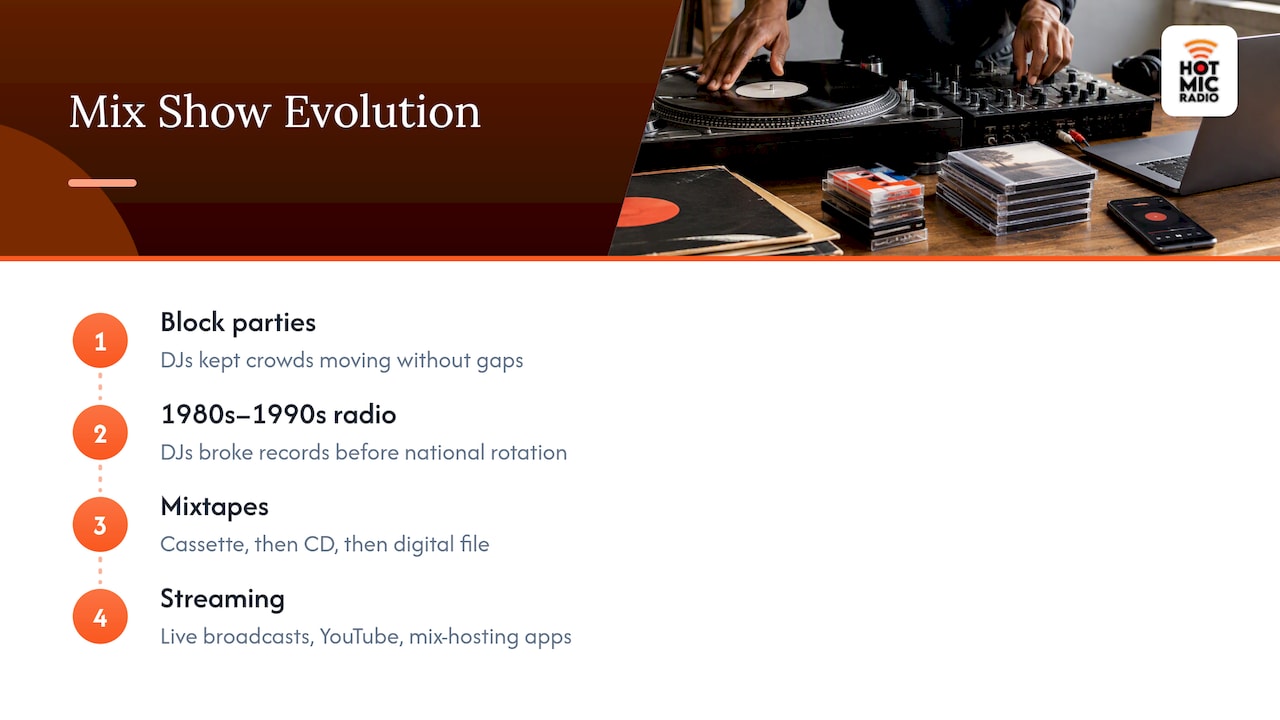
The hip hop mix show traces back to the genre’s earliest days, when DJs at block parties and park jams built reputations on their ability to keep a crowd moving from one record to the next without a gap. That same instinct, blend don’t stop, carried the format onto college and commercial radio by the 1980s and 1990s, where mix show DJs became tastemakers in their own right, breaking new records before they hit national rotation.
Mixtapes grew out of that same culture, turning live mixing skill into something you could carry around on cassette, then CD, then a digital file. The format gave DJs a second platform beyond the radio dial and gave emerging artists a way onto a tape without waiting on a label or a program director.
Streaming didn’t kill the mix show, it multiplied it. Live DJ broadcasts, long-form YouTube sets, and mix-hosting apps all descend from the same block party instinct: a DJ reading a room, or an audience, and building a set that tells a story across an hour instead of three minutes at a time. The cultural throughline is continuity, the same quality that made a park jam DJ legendary decades ago still defines a great mix show today.
How mix shows give independent artists their shot
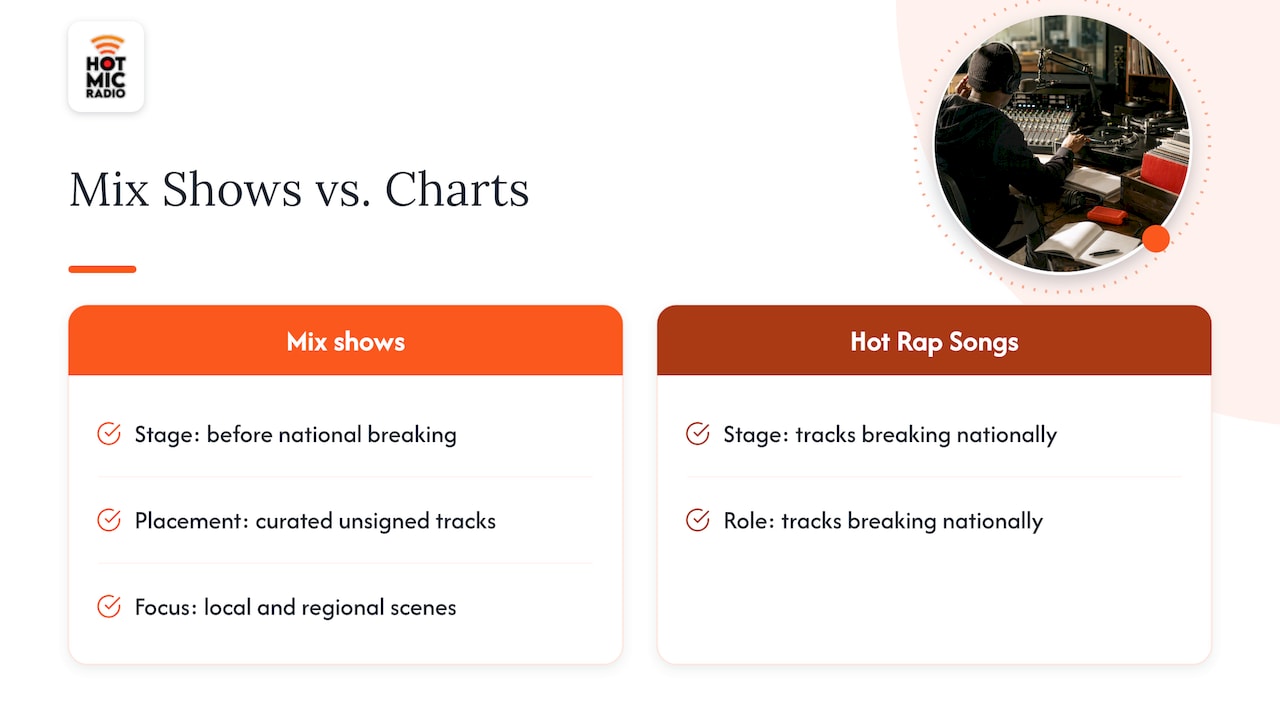
A mix show is often the first real airplay an independent hip hop or R&B artist gets. A curator with a loyal audience can drop an unsigned track into a themed set or a regional spotlight and put it in front of listeners who’d never have found it through an algorithmic feed built on what they already stream.
Regional spotlight shows do this especially well, since they’re built around surfacing a local or regional scene rather than repeating the same national rotation every other station plays. That structure rewards artists who are grinding without a label behind them, and it gives listeners a genuine discovery moment instead of another recommendation that just echoes their last search.
Billboard’s Hot Rap Songs chart tracks what’s already breaking nationally, but mix shows do their best work a step before that, catching artists while they’re still building. That’s also where song submission paths matter: a station or show that accepts independent submissions gives an unsigned act an actual shot at the same kind of curated placement a major release gets, something we talk through in our piece on how to release music on online radio.
Why human-curated mix shows still matter now
Algorithms are good at matching you to songs you already like. They’re not good at telling you why a track matters, who influenced it, or what scene it came out of. That’s the gap a human curator fills: context, storytelling, and a community voice an algorithm has no way to replicate.
Live shows add something else entirely, an event you show up for, not just content you consume. That sense of occasion is part of why SSRS’s summary of The Infinite Dial points to strong weekly online audio usage as evidence that audio-first discovery still works. A DJ who knows the room, or the audience, beats a recommendation engine every time it comes to actually building a scene.
— Hot Mic Radio Team
Tune into Hot Mic Radio and support the shows that move you
We’d love for you to make Hot Mic Radio part of your regular rotation. Our live DJ shows, regional spotlights, and themed blends across The Roots, The Vibe, and The Global Beat are built exactly for the kind of continuous, curated listening this guide walks through, and we’re adding more programming all the time.
Tune in live, browse our shows archive to catch what you missed, or check our event archive for recent live sets. If you’re a brand looking to get involved, our advertising page covers sponsorship opportunities for brands trying to reach our audience. However you plug in, we’re glad to have you in the mix.
FAQ
What hip hop show was Cardi B on?
Hot Mic Radio does not have programming or guest appearance records tied to that claim, so we can’t confirm a specific show here. For an accurate answer, check artist interviews or official show archives directly tied to the appearance in question.
What are the top 10 hip hop songs right now?
Current rankings shift week to week, and the most reliable snapshot comes from Billboard’s Hot Rap Songs chart, which tracks what’s actually charting. Mix show DJs often pull current rotation picks from charts like this one alongside R&B/Hip-Hop Airplay data.
What is considered underground hip hop?
Underground hip hop generally refers to independent or lesser-known artists operating outside major label systems and mainstream radio rotation. Regional spotlight shows and mix shows that accept independent submissions are often where underground tracks get their first real airplay.
What is the best radio for rap?
The right station depends on whether you want nonstop hip hop, a blend with R&B and neo-soul, or regional and independent spotlights alongside the hits. We built Hot Mic Radio around that blend, with live DJ shows and themed rotations across The Vibe and regional spotlight programming, as one option worth checking out.
How long is a typical hip hop mix show?
Most mix shows run somewhere between thirty minutes and two hours, depending on the format and the platform hosting it. Club and party sets tend to run shorter and faster, while chill or lounge mixes often stretch longer with smoother transitions.
Sources
- The Infinite Dial® 2026 — Edison Research
- The Infinite Dial® 2026 — SSRS insights
- Hot Rap Songs — Billboard
- Mixcloud on Google Play